Biggest Startups in the US: 2026 Valuation and Funding Report
In this report: the biggest startups in the US in 2026, ranked by valuation, funding, revenue, and salaries.

Investment in US and Canadian startups reached $392 billion in the first half of 2026 alone, a figure that dwarfs any prior comparable period on record (source: Crunchbase News).
BestFirms tracks the companies, platforms, and vendors that define how modern business gets built, and the private company league table is now the clearest signal of where the US economy is heading.
The largest American startups are no longer scrappy challengers waiting for scale; several now post revenue run rates that rival mid-cap public companies, and two of them absorbed more capital in six months than entire national venture markets.
This report breaks down which US startups are the biggest by valuation, what they earn, what they pay, where they sit, and what the concentration at the top actually means.
Key Takeaways
- Anthropic leads all US startups at a $965 billion valuation.
- OpenAI and Anthropic captured 43% of global venture funding in H1 2026.
- The US minted 110 new unicorns in H1 2026, 56% of the global total.
- AI startups took roughly 80% of North American venture dollars in Q2 2026.
- Frontier lab engineers now clear $900,000 in median total compensation.
The US Venture Market Entering 2026
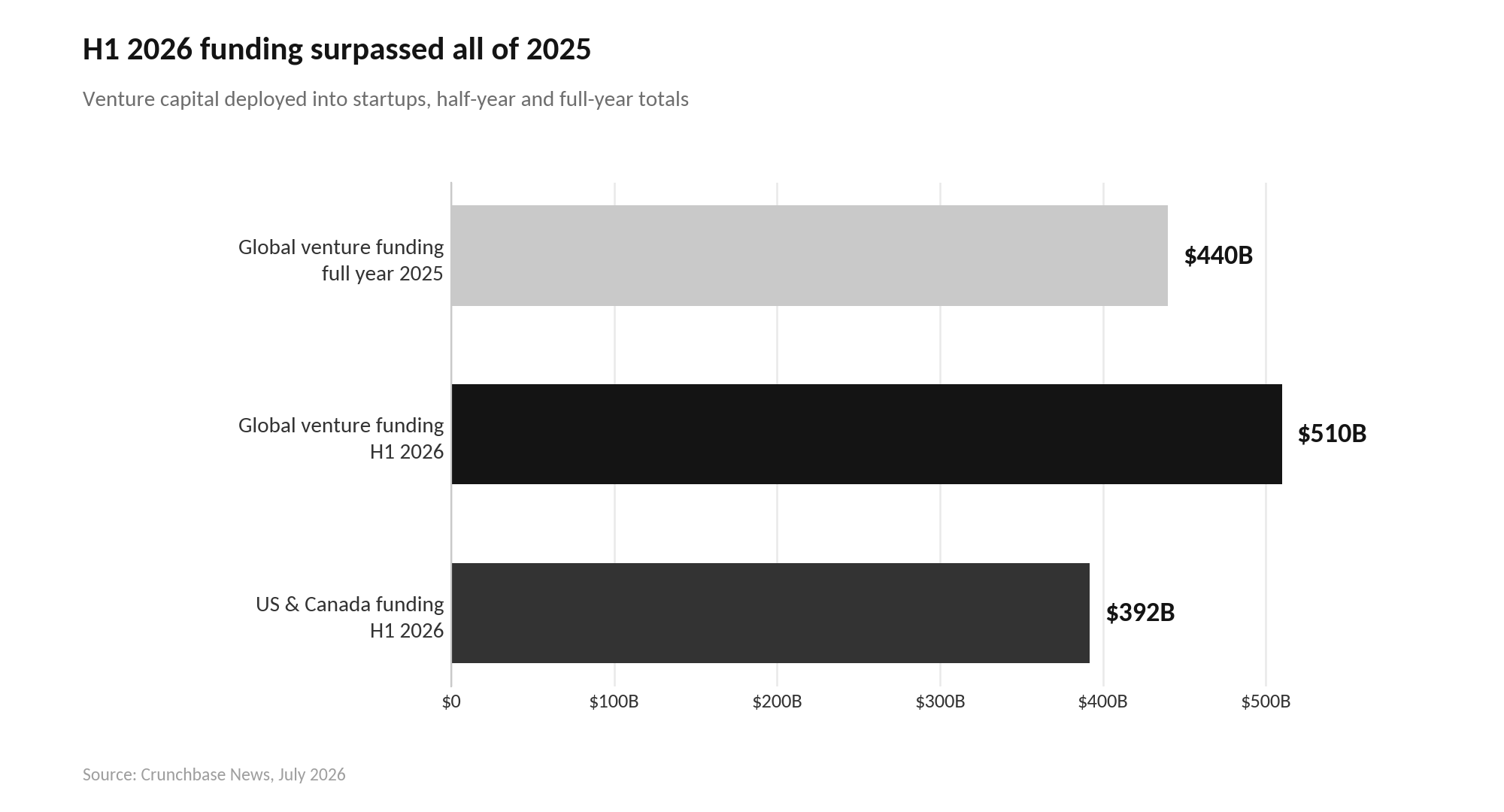
The backdrop matters before the rankings do. Global venture funding hit a record $510 billion in the first half of 2026, surpassing the $440 billion invested across all of 2025 (source: Crunchbase News). North America absorbed the majority of it.
The distribution is what makes this cycle unusual.
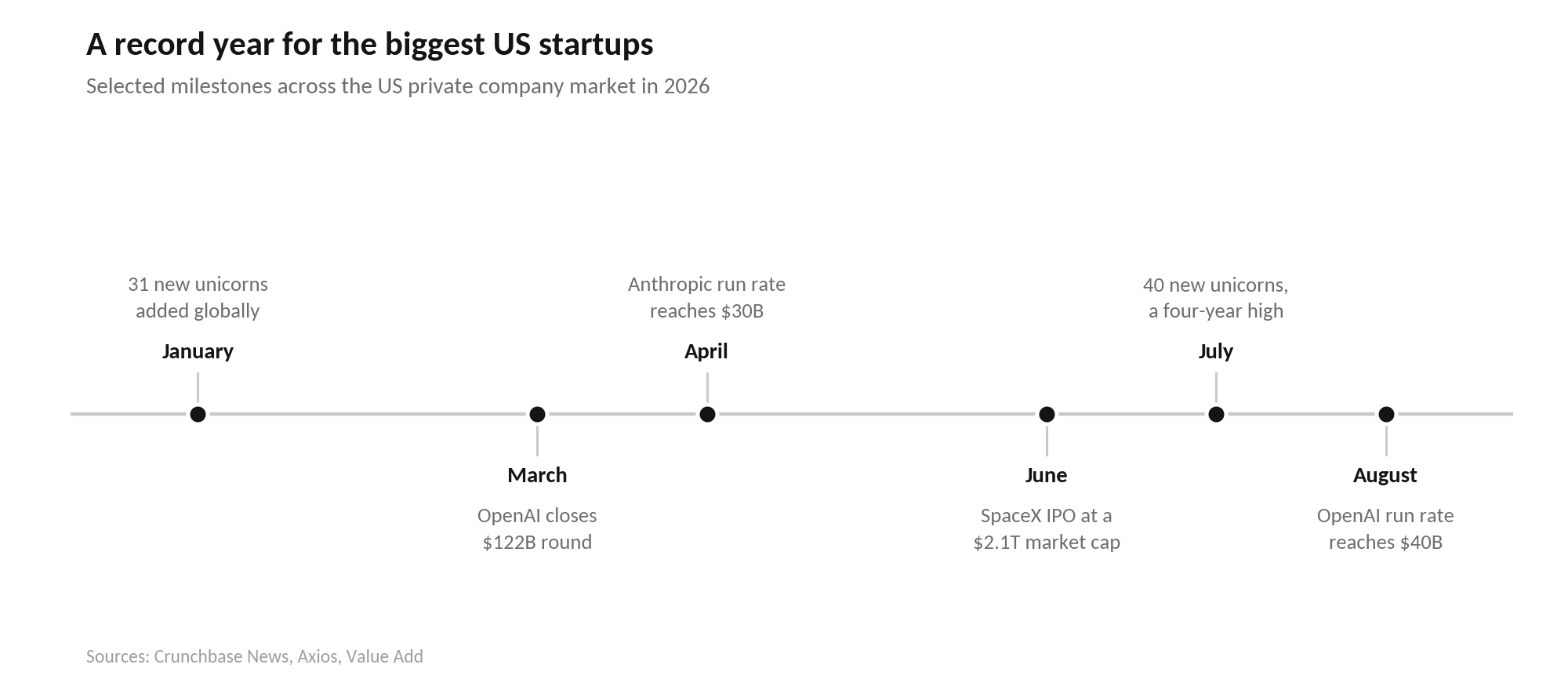
In Q1 2026, four companies alone raised $188 billion between them: OpenAI at $122 billion, Anthropic at $30 billion, xAI at $20 billion, and Waymo at $16 billion, together accounting for nearly 65% of global venture investment that quarter (source: Crunchbase News).
Meanwhile, the base of the market contracted. Seed and angel rounds in North America totaled roughly $4.9 billion in Q2 2026, down 15% from the prior quarter and down 27% year over year (source: Crunchbase News).
More money is flowing into fewer companies. That barbell shape is the single most important context for reading any list of the biggest US startups in 2026.
How This Report Defines a "Startup"
A startup here means a privately held, venture-backed company that has not yet listed publicly and has not been acquired. That definition does real work in 2026.
SpaceX, long the default answer to this question, no longer qualifies. It completed its IPO on June 12, 2026, raising roughly $75 billion and closing its first trading day at a $2.1 trillion market capitalization, the largest listing in history (source: Crunchbase News).
It is now a public company. xAI is also off the list, having been absorbed into SpaceX in February 2026.
Valuations cited below are post-money figures from each company's most recently disclosed private round or secondary sale, sourced from Crunchbase.
They are marks set by investors, not market prices, and they can move fast in either direction.
The 18 Biggest Startups in the US by Valuation
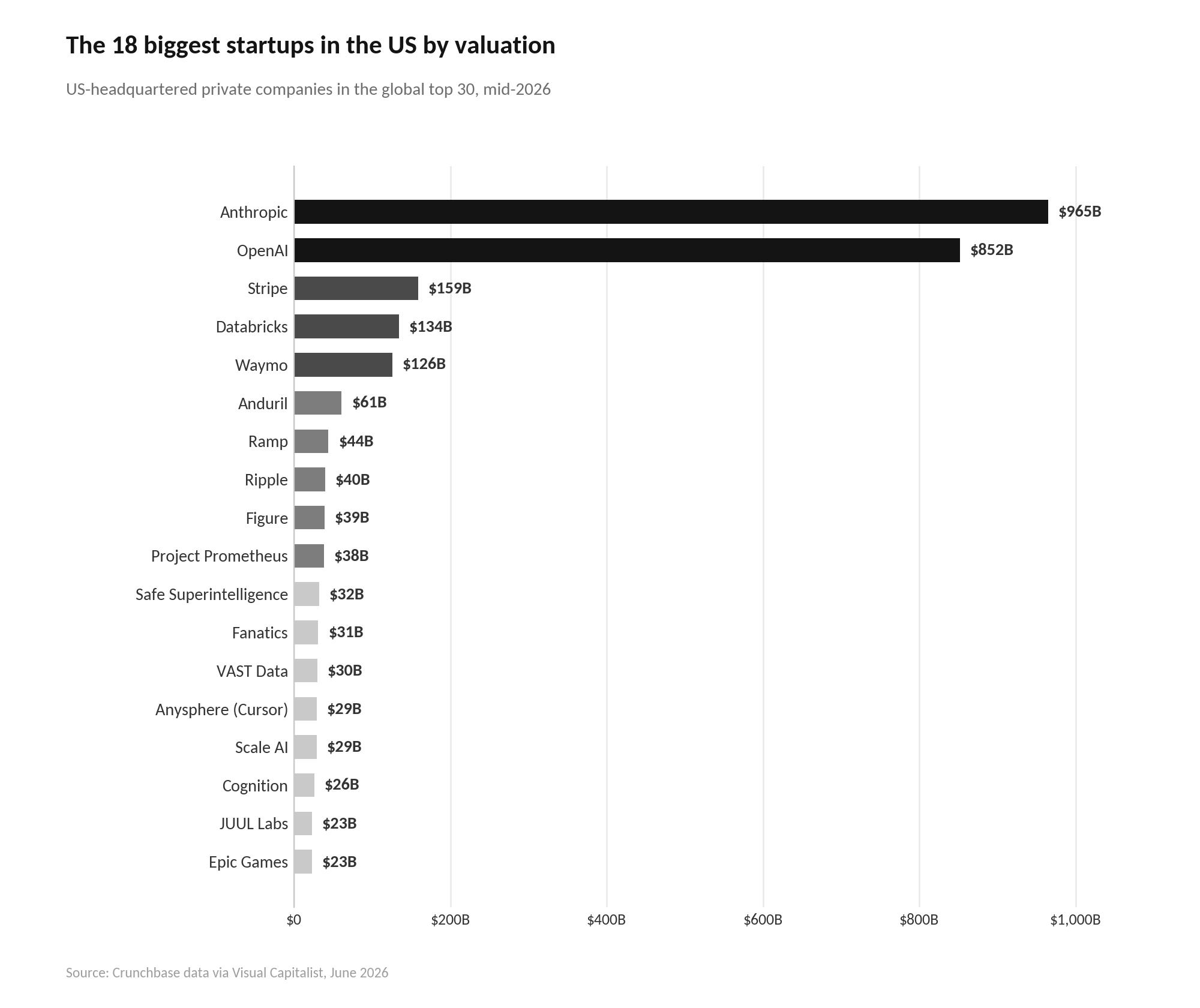
The table below covers every US-headquartered private company in the global top 30 by valuation as of mid-2026 (source: Visual Capitalist).
Anthropic and OpenAI alone are worth a combined $1.8 trillion, more than the next sixteen companies on this list put together.
The Top Five, in Detail
- Anthropic ($965B). The highest-valued private company in the world. Its annualized revenue run rate surpassed $65 billion at the end of July 2026, with more than $11.5 billion in preliminary Q2 revenue, roughly 14 times the same quarter a year earlier (source: Axios). Roughly 85% of that revenue comes from enterprise and developer customers (source: Forbes).
- OpenAI ($852B). Raised $122 billion in Q1 2026, the largest venture round ever recorded. Its run rate reached $40 billion by August 2026, roughly $3.3 billion a month, with enterprise revenue exceeding consumer revenue for the first time in July (source: Axios). ChatGPT remains the most-visited AI product on the web by a wide margin, a dynamic covered in more depth in this ChatGPT statistics breakdown.
- Stripe ($159B). The largest US startup outside AI and the anchor of American fintech. Payments infrastructure has proven durable across three separate valuation cycles.
- Databricks ($134B). The data platform layer beneath much of enterprise AI. Its position sits at the intersection of warehousing, governance, and model deployment.
- Waymo ($126B). Raised $16 billion in Q1 2026. Autonomous driving finally translated pilot metrics into commercial route density across multiple US metros.
Sector Concentration: AI Is the Category
Of the 18 US companies above, ten are direct AI plays and several more are AI-adjacent infrastructure. That reflects the wider market.
AI-focused startups captured roughly 80% of North American venture investment across all stages in Q2 2026 (source: Crunchbase News).
Beyond the frontier labs, the strongest secondary categories are:
- Robotics and humanoids. Figure at $39 billion leads a category that produced more new unicorns than any other sector in H1 2026. See our breakdown of trending robotics startups.
- Defense and aerospace. Anduril at $61 billion, plus Hadrian, whose valuation jumped to $7.9 billion from $1.6 billion in seven months (source: Crunchbase News).
- AI infrastructure and semiconductors. VAST Data at $30 billion and Etched, which doubled to a $10 billion valuation six months after its prior round (source: Crunchbase News).
- Cybersecurity. Cyera raised $600 million at a $12 billion valuation in June 2026, and NinjaOne closed a Series C extension at $12.3 billion (source: Crunchbase News).
- Vertical AI applications. A deeper category map is available in our list of the 50 most promising vertical AI startups.
Geographic Distribution
The biggest US startups remain overwhelmingly concentrated in two metros.
In June 2026, California accounted for 47.9% of all US venture funding while New York recorded 24.4%, the highest share the city had posted in at least a year (source: AlleyWatch).
Fourteen of the eighteen companies in the ranking above are headquartered in California or New York.
The outliers are instructive: Fanatics in Jacksonville, Epic Games in Cary, and JUUL in Washington DC are all non-AI businesses that scaled around a regional advantage rather than a talent cluster.
In March 2026, twenty of the month's new unicorns were US-based, eleven of them from the San Francisco Bay Area alone (source: Crunchbase News).
The Bay Area's grip on frontier AI has, if anything, tightened.
Salaries at the Biggest US Startups
Compensation at the top of this list has separated from the rest of the technology labor market entirely.
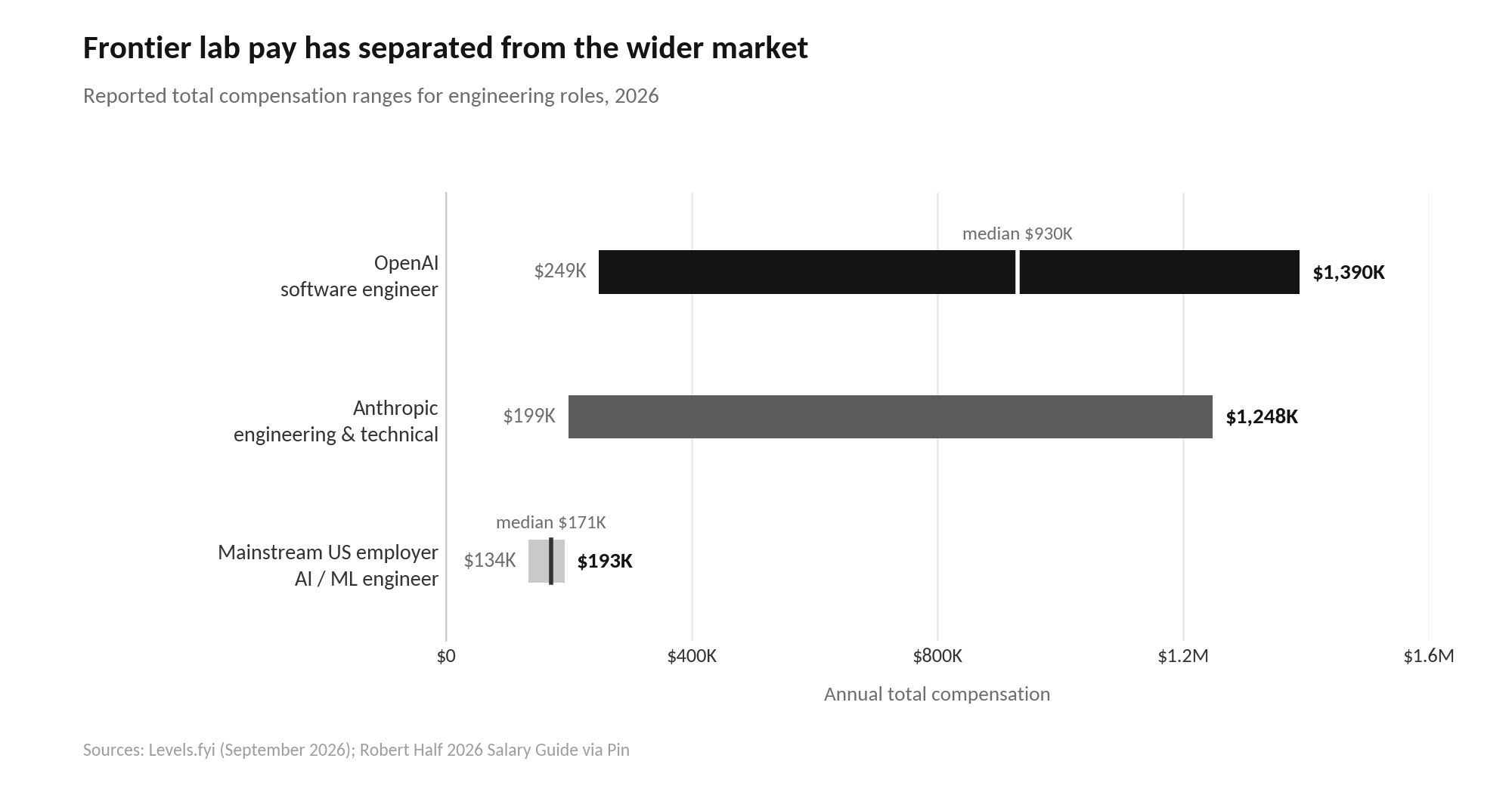
At OpenAI, software engineer total compensation ranges from $249,000 per year at L2 to $1.39 million at L6, with a median package of $930,000 (source: Levels.fyi).
At Anthropic, reported packages run from $198,588 for trust and safety roles up to $1,248,333 for senior software engineers (source: Levels.fyi).
For contrast, AI and machine learning engineers at mainstream tech employers earn roughly $134,000 at the starting point, $170,750 at the midpoint, and $193,250 at the high end (source: Pin).
That is a gap of roughly five times at the median for functionally similar titles, and it sits almost entirely in equity rather than base salary.
Frontier lab packages now deliver 55% to 70% of value through stock (source: Perspective AI).
A few practical implications:
- Equity at these valuations is a leveraged bet on further markup, not a cash equivalent.
- Non-engineering functions at frontier labs still clear $500,000 in reported medians, which is unusual even for late-stage private companies.
- The rest of the startup market cannot match these bands, which is reshaping hiring across the ecosystem.
Our 2026 startup salaries report and the wider highest-paying tech companies list cover where the rest of the curve sits, and this hiring statistics roundup adds the demand-side picture.
Unicorn Creation and the Pipeline Behind the Leaders
The companies at the top are not the whole story.
A total of 195 companies joined the Crunchbase Unicorn Board in the first half of 2026, already ahead of the 193 minted across all of 2025, with the US accounting for 110 of them, or 56% of the global total (source: Crunchbase News).
Momentum continued through the summer. July 2026 alone produced 40 new unicorns, the highest monthly count in more than four years, with 19 of them US-based (source: Value Add Pulse).
Repricing speed is the defining feature. Valar Atomics, building nuclear reactors for AI data centers, reached a $6 billion valuation four months after being valued at $2 billion (source: Crunchbase News).
Deep tech is a meaningful part of this cohort, and our deep tech industry breakdown covers how those categories are structured.
The Exit Window Reopened
For most of 2023 and 2024, the biggest US startups had nowhere to go. That changed decisively.
Q2 2026 recorded the highest quarterly exit values on record for venture-backed companies in both acquisitions and IPOs.
A total of 32 companies went public above $1 billion, and 24 companies were acquired at $1 billion or more, totaling $113 billion in acquisition value (source: Crunchbase News).
After SpaceX, the largest listings of the quarter were inference chipmaker Cerebras Systems and quantum computing company Quantinuum.
Both Anthropic and OpenAI have filed confidential IPO paperwork, with Anthropic expected to list first (source: TechCrunch).
The implication for this list is straightforward: the top of the ranking will look materially different within twelve months, because several of the largest names will no longer be startups.
Risks and Structural Fragilities
Three risks deserve attention when reading these numbers:
- Concentration risk. OpenAI and Anthropic alone accounted for more than 40% of all venture funding globally in H1 2026 (source: Crunchbase News). A repricing at either company would ripple through fund marks across the entire asset class.
- Definitional drift. A $1 billion valuation set during a period of unusually fast repricing does not carry the same meaning it did in the tighter capital environment of 2022 and 2023.
- Unit economics. Even the largest names carry heavy losses. SpaceX posted a $4.28 billion net loss in Q1 2026 on $4.69 billion of revenue (source: Crunchbase News), and OpenAI's leaked audited financials showed a $20.9 billion operating loss on $13.07 billion of booked 2025 revenue (source: Value Add).
The compute-versus-return question is unresolved, and this analysis of compute versus intelligence investment is a useful frame for founders weighing it.
What This Means for Buyers, Founders, and Operators
For enterprise buyers, the practical takeaway is vendor durability.
A company with a $65 billion run rate and a filed S-1 is a materially different procurement risk than a $6 billion startup that repriced twice in four months.
For founders, the seed contraction is the number to internalize. Capital is abundant at the top and tighter than it has been in years at the bottom.
Category selection now determines fundraising outcomes more than execution quality does.
For operators and job seekers, the compensation split is permanent enough to plan around. Roughly a dozen employers pay frontier-lab bands. Everyone else competes on equity upside, mission, and speed.
Broader context on where American growth is happening sits in our reports on the fastest-growing companies in the US and the biggest industries in the US.
Conclusion
BestFirms gives operators an accurate, current view of the companies and platforms shaping their markets, and no dataset captures the current moment better than the US private company league table.
The biggest startups in the US in 2026 are led by Anthropic at $965 billion and OpenAI at $852 billion, followed by Stripe, Databricks, and Waymo.
AI dominates the list, California and New York dominate the geography, and top compensation has separated from the rest of the market by roughly five times the median.
Capital is concentrating into fewer companies at larger checks while the seed stage contracts, and the exit window has reopened forcefully enough that several of the names on this list will be public companies before the year ends.
Read Next
FAQs
1. What is the biggest startup in the US in 2026?
The biggest startup in the US in 2026 is Anthropic, valued at $965 billion, making it the highest-valued private venture-backed company in the world ahead of OpenAI at $852 billion.
2. How many unicorn startups are there in the US?
There are more unicorn startups in the US than in any other country, and the US added 110 new unicorns in the first half of 2026, representing 56% of all new unicorns created globally in that period.
3. What is the highest-paying startup in the US for engineers?
The highest-paying startup in the US for engineers is OpenAI, where software engineer total compensation ranges from $249,000 at entry level to $1.39 million at senior level, with a median package of $930,000.
4. Which US city has the most large startups?
The US city with the most large startups is San Francisco, and California overall accounted for 47.9% of all US venture funding in June 2026, with New York second at 24.4%.
5. Is SpaceX still considered a US startup?
SpaceX is no longer considered a US startup because it completed its IPO on June 12, 2026, raising roughly $75 billion and closing its first trading day at a $2.1 trillion market capitalization.
Disclaimer: This content is provided for informational purposes only and does not constitute legal, financial, or compliance advice. Protocol versions, governance arrangements, and partner counts cited here reflect publicly announced milestones as of August 2026 and are moving quickly. Adoption figures come from vendor and foundation announcements with differing methodologies and should be treated as directional signals rather than guaranteed outcomes.