
Highest Paying Tech Companies in 2026: A Complete Compensation Report
In this report, we break down the highest-paying tech companies of 2026, with verified median pay by level, role, and firm type.

As of August 2026, Anthropic reports the highest median total compensation for senior software engineers in the United States at $750,000 per year, ahead of Broadcom at $637,777 and Databricks at $622,550 (source: Levels.fyi).
BestFirms is a research-driven directory that benchmarks companies, software, and markets so that operators and job seekers can make decisions from verified numbers instead of anecdotes.
Tech pay has stopped moving as a single market: frontier AI labs and quantitative trading firms now sit far above the traditional Big Tech band, while the median engineer outside those tiers has seen close to flat real growth.
This report breaks down which companies actually pay the most in 2026, how much they pay at each level, what drives the gaps, and how to read the numbers without being misled by them.
Key Takeaways
- Anthropic leads senior software engineer pay at $750,000 median total compensation.
- Quant firms dominate entry level pay, with Hudson River Trading at $410,000.
- AI skills now carry a 62% average wage premium across all industries globally.
- Staff level engineers saw the fastest 2025 pay growth at 7.52%.
- Equity, not base salary, explains most of the gap between employers.
The State of Tech Compensation Heading Into 2026
The baseline matters before the outliers do.
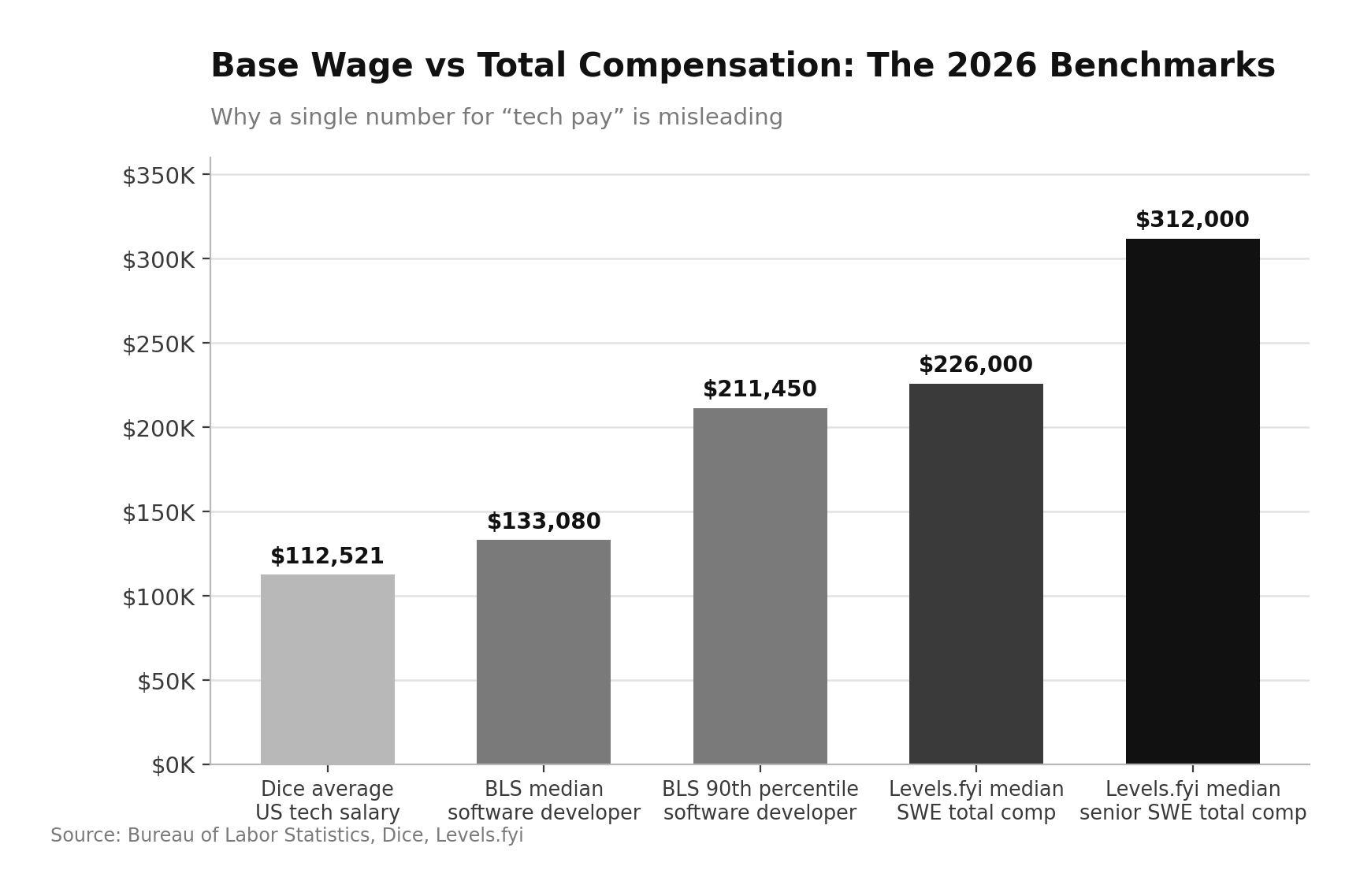
The U.S. Bureau of Labor Statistics puts the median annual wage for software developers at $133,080, with the top 10% earning more than $211,450 and total employment at roughly 1.9 million (source: Bureau of Labor Statistics).
That figure is base wage only, across every employer in the country, including banks, hospitals, insurers, and government contractors.
The picture changes when equity enters. Across 245,000+ submissions covering more than 5,000 companies, median total compensation for U.S. software engineers grew 3.49% year over year, with research roles posting the largest increase at 15.38% (source: Levels.fyi).
Broader survey data has been flatter still: the average U.S. tech salary reached $112,521, a number that, adjusted for purchasing power, is almost identical to what technologists earned two decades earlier (source: Dice).
Two conclusions follow:
- First: "tech pay" as a single number is close to useless.
- Second: almost all of the growth is concentrated in a narrow band of employers and specializations, which is exactly what this report maps. For adjacent context on how hiring budgets are shifting, see 2026 hiring statistics.
Why the Ceiling Keeps Rising While Headcount Falls
The unusual feature of 2026 is that record compensation and record layoffs are happening simultaneously.
Multiple large employers, including Microsoft, Oracle, PayPal, and Meta, announced significant reductions during the year while naming AI adoption as a stated factor (source: TechCrunch).
Those same companies raised capital expenditure on AI infrastructure.
Compensation follows that reallocation. Jobs requiring specific AI skills are growing roughly eight times faster than the overall jobs market, 69% versus 9%, and the average wage premium for AI skills has risen to 62%, up from 57% the prior year (source: PwC).
The result is a barbell. Generalist roles face a contracting market; scarce specialists face bidding wars. Teams building around this shift often start with AI-powered talent acquisition for niche tech roles.
How Tech Compensation Is Actually Structured
Total compensation at top-paying employers has three components, and the mix is the story:
- Base salary. Cash, paid regardless of company performance. Netflix and most quant firms weight heavily here.
- Equity. RSUs at public companies, or options and RSUs at private ones. Usually the largest and most volatile component.
- Bonus. Annual, performance-linked, and often the deciding variable at trading firms.
A $500,000 package that is 80% equity at a private AI lab and a $500,000 package that is 100% cash at Netflix are not comparable instruments.
One carries liquidity and valuation risk; the other does not.
Highest Paying Tech Companies for Senior Engineers
Senior engineer (typically 5+ years of experience) is the level where the market separates most clearly.
All figures are median total annual compensation in the U.S. as of August 2026 (source: Levels.fyi).
| Rank | Company | Median Total Comp | Base | Stock |
|---|---|---|---|---|
| 1 | Anthropic | $750,000 | $405K | $345K |
| 2 | Broadcom | $637,777 | $178K | $400K |
| 3 | Databricks | $622,550 | $217K | $373K |
| 4 | OpenAI | $605,000 | $255K | $350K |
| 5 | Notion | $600,000 | $260K | $340K |
| 6 | Jane Street | $590,000 | $400K | $45K |
| 7 | Remitly | $555,000 | $215K | $340K |
| 8 | Snowflake | $550,000 | $220K | $300K |
| 9 | Harvey | $550,000 | $250K | $300K |
| 10 | Two Sigma | $524,874 | $256K | $0 |
| 11 | Ramp | $510,000 | $250K | $200K |
| 12 | Netflix | $500,000 | $500K | $0 |
| 13 | Hudson River Trading | $500,000 | $500K | $0 |
| 14 | Roblox | $490,000 | $290K | $200K |
| 15 | Millennium | $475,000 | $225K | $0 |
Three patterns are visible:
- Frontier AI labs occupy the top.
- Data infrastructure companies (Databricks, Snowflake, Broadcom) sit close behind on the strength of large equity grants.
- Cash-heavy firms such as Netflix, Jane Street, and Hudson River Trading reach similar totals through an entirely different mechanism.
Highest Paying Tech Companies for Entry-Level Engineers
Entry level is where trading firms are unmatched, because they pay new graduates in cash rather than deferred equity (source: Levels.fyi).
| Rank | Company | Median Total Comp |
|---|---|---|
| 1 | Hudson River Trading | $410,000 |
| 2 | Optiver | $393,750 |
| 3 | The D. E. Shaw Group | $375,000 |
| 4 | Anthropic | $375,000 |
| 5 | Harvey | $375,000 |
| 6 | Jane Street | $339,000 |
| 7 | IMC | $275,000 |
| 8 | CoreWeave | $261,000 |
| 9 | Two Sigma | $254,000 |
| 10 | Airtable | $250,000 |
| 11 | Databricks | $246,875 |
| 12 | OpenAI | $245,000 |
A new graduate at Hudson River Trading earns roughly 3.1 times the BLS median for all software developers.
The relevant caveat is selection: these firms hire in very small numbers from a narrow pool of candidates.
Median Total Compensation by Level
Company rankings only make sense against the ladder.
Median U.S. software engineer total compensation by standardized level (source: Levels.fyi):
| Level | 2024 | 2025 | Change |
|---|---|---|---|
| Entry Level Engineer | $152K | $155K | +1.64% |
| Software Engineer | $222K | $226K | +1.80% |
| Senior Engineer | $300K | $312K | +4.20% |
| Staff Engineer | $425K | $457K | +7.52% |
| Principal Engineer | $590K | $551K | -6.58% |
Staff level grew fastest at 7.52%, while principal level declined 6.58%, a reversal that reflects both equity mark-to-market effects and reduced hiring at the very top of the individual contributor ladder.
Entry level grew just 1.64%, well below inflation in most years.
Frontier AI Labs: The New Top of the Market
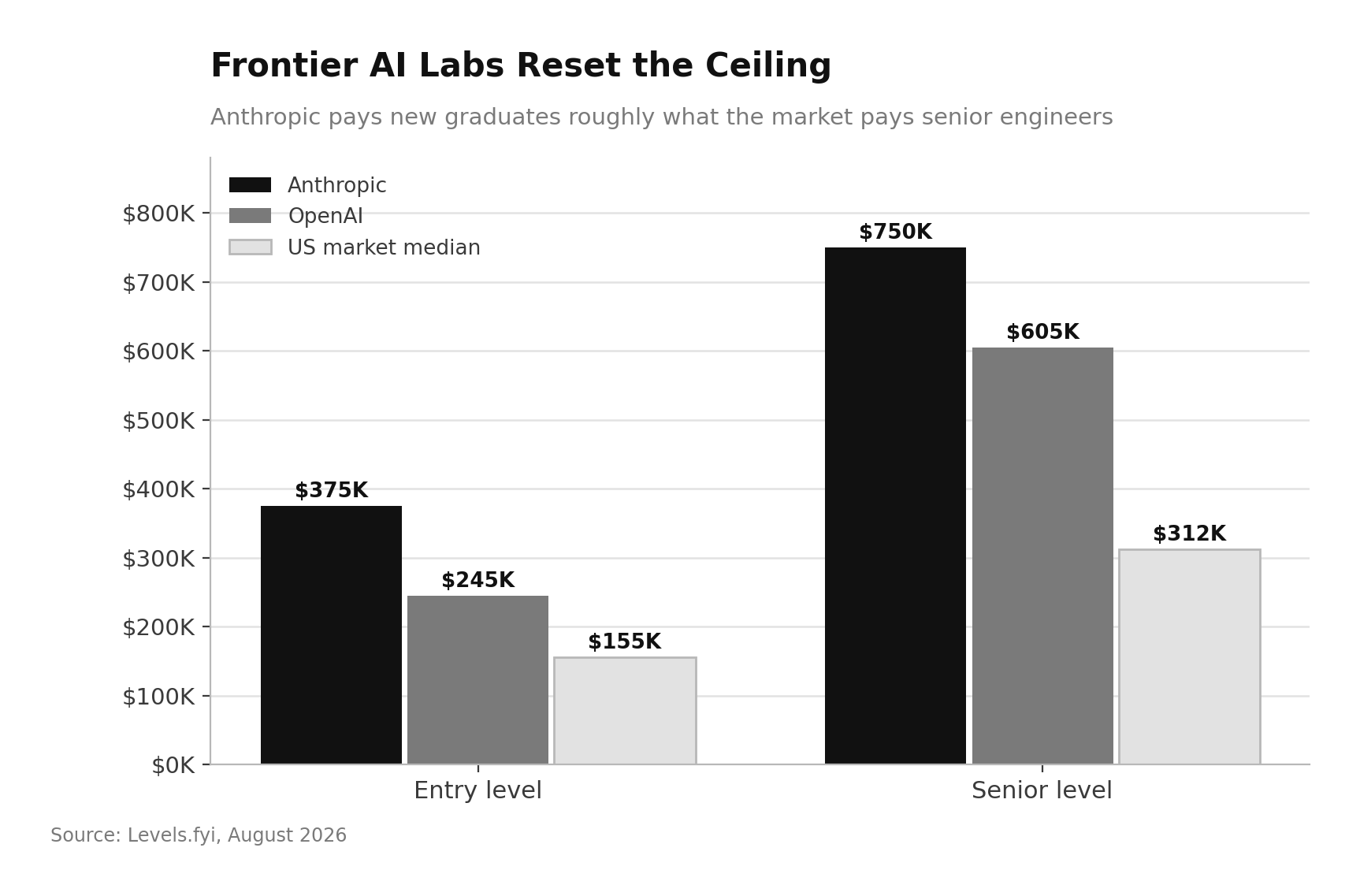
Anthropic, OpenAI, and their peers now define the ceiling at nearly every level. Anthropic pays $375,000 at entry level, matching what most Big Tech companies pay senior engineers, and $750,000 at senior.
OpenAI sits at $245,000 and $605,000 respectively.
The economics behind this are straightforward. These companies are competing for a talent pool measured in thousands, not millions, while deploying capital raised at valuations that make a $750,000 package a rounding error against compute spend.
The risk sits in the equity: most of these packages are denominated in private company stock with uncertain liquidity timelines.
Quant Trading Firms: The Cash Alternative
Hudson River Trading, Jane Street, Optiver, D. E. Shaw, Two Sigma, IMC, and Millennium all appear near the top of both tables, and all pay in cash.
Jane Street's $590,000 senior median is $400,000 base plus $45,000 stock, with the remainder in bonus. Two Sigma's $524,874 carries zero equity.
For a candidate weighing offers, this is the cleanest trade in tech: guaranteed cash and no vesting cliff, against longer hours, narrower domain exposure, and no equity upside.
For employers benchmarking against this tier, B2B account executive and technical role costs provide useful comparison anchors.
Big Tech Versus the New Tier
Traditional Big Tech no longer occupies the top of the leaderboard, though it remains the largest employer of high-paid engineers by volume.
Netflix appears at $500,000 for senior engineers on a pure cash model. The rest of the Magnificent 7 sit in a band roughly between the $312,000 senior median and the $457,000 staff median, with substantial variation by team, location, and stock performance.
The structural advantage Big Tech retains is liquidity and scale. Public company RSUs are sellable on vest, headcount is measured in tens of thousands, and internal mobility into higher-paying AI teams is a realistic path.
A comparison of career trajectories across employer types is covered in the 2026 startup salaries report.
Highest Paying Roles Beyond Software Engineering
Pay growth in 2025 was not uniform across job families (source: Levels.fyi):
| Job Title | YoY Pay Growth |
|---|---|
| Hardware Engineer | +15.00% |
| Software Engineering Manager | +9.64% |
| Product Manager | +4.55% |
| Data Scientist | +2.92% |
| Product Designer | +1.84% |
| Mechanical Engineer | +1.69% |
| Management Consultant | +1.31% |
Hardware engineering's 15% jump is the AI infrastructure buildout showing up in payroll: chip design, networking silicon, and data center hardware.
Research roles grew 15.38%, the highest of any track. Networking-focused software engineers declined 2.7%, the clearest example of a specialization losing ground.
Location, Remote Work, and the Pay Adjustment Question
Geography still moves the number, though less than it did in 2021.
Packages at the levels shown above generally assume the San Francisco Bay Area, New York, or Seattle. Lower cost-of-living markets typically price 10% to 20% below.
Office-based roles were the fastest-growing work arrangement in 2025, up 12% year over year in submission data (source: Levels.fyi).
Companies that still hire fully remote often use national pay bands rather than local ones, which advantages engineers outside major hubs.
Cost modeling for distributed teams is covered in remote work technology costs and remote work technology.
What Actually Drives the Gaps Between Employers
Four mechanisms explain most of the variance:
- Equity denomination: A private AI lab grant and a public company RSU are priced identically on an offer letter and behave completely differently afterward.
- Refresh policy: Some companies front-load vesting; others grant annual refreshers that compound. Two identical starting offers can diverge by six figures in year three.
- Level mapping: The gap between L4 and L5 at a large employer frequently exceeds $100,000. Title inflation makes cross-company comparison unreliable without a standardized ladder.
- Scarcity pricing: The 62% AI wage premium is not evenly distributed. It runs as high as 118% in consumer markets and as low as 16% in government work (source: PwC).
How to Read These Numbers Responsibly
Every figure in this report carries methodological caveats worth stating plainly:
- Self-reported data skews high: Levels.fyi aggregates voluntary submissions from professionals at companies that pay equity, which is not the median U.S. employer.
- Medians hide dispersion: At a single company and level, the 25th and 75th percentiles can differ by more than $200,000.
- Small samples distort rankings: A company appearing at rank 5 with a handful of submissions is not comparable to one with hundreds.
- Equity is marked at grant, not at exit: Reported totals annualize stock at the valuation on the day it was granted.
Treat these tables as directional market signals for negotiation and budgeting, not as guaranteed offers.
What This Means for Employers and Hiring Teams
If your organization is not a frontier lab or a trading firm, competing on headline total compensation is not a viable strategy.
The practical levers are speed of process, scope of ownership, level clarity, and cash-versus-equity flexibility for candidates who prefer certainty.
Budgeting accordingly matters more than matching.
Payroll and HR tooling decisions compound across headcount, and the relevant benchmarks are covered in the largest payroll companies in the US, the 2026 payroll spending report, and the 2026 HR tech spending report.
For teams scaling technical recruiting, the best AI recruiting tools in 2026 is a useful starting point, alongside an AI talent acquisition playbook.

Conclusion
BestFirms exists to replace guesswork with verified benchmarks, and tech compensation in 2026 is a category where the gap between perception and data is unusually wide.
The highest-paying tech companies are no longer the household names: frontier AI labs led by Anthropic at $750,000 for senior engineers, quantitative trading firms led by Hudson River Trading at $410,000 for new graduates, and data infrastructure companies such as Broadcom and Databricks now define the ceiling.
Below that tier, growth has been modest, with entry-level pay rising just 1.64% and principal-level pay declining.
The differentiator is not industry or job title but specialization, level, and how a company structures equity.
Anyone benchmarking an offer, a pay band, or a hiring budget should start from the level data, adjust for the cash-versus-equity mix, and treat headline numbers as the top of a distribution rather than its center.
Read Next
- Best Presentation Software in 2026
- How AI-Powered Customer Support Reduces First Response Time
- Cybersecurity Stack
FAQs
1. What is the highest paying tech company in 2026?
The highest paying tech company in 2026 is Anthropic, which reports a median total compensation of $750,000 for senior software engineers in the United States, ahead of Broadcom at $637,777 and Databricks at $622,550.
2. Which tech companies pay the most to entry-level engineers in 2026?
The tech companies that pay the most to entry-level engineers in 2026 are Hudson River Trading at $410,000, Optiver at $393,750, and The D. E. Shaw Group and Anthropic, both at $375,000 in median total compensation.
3. How much does a senior software engineer earn on average in 2026?
A senior software engineer earns a median total compensation of $312,000 in the United States, up 4.2% year over year, while the BLS median base wage for all software developers is $133,080.
4. Why do AI companies pay more than traditional tech companies?
AI companies pay more than traditional tech companies because AI skills now command a 62% average wage premium, AI-skill job postings are growing 69% versus 9% for the overall market, and the qualified talent pool is measured in thousands rather than millions.
5. Do the highest paying tech companies pay in cash or equity?
The highest paying tech companies split into two models: quantitative trading firms such as Hudson River Trading, Jane Street, and Two Sigma pay almost entirely in cash, while AI labs and data infrastructure companies such as Anthropic, Databricks, and Broadcom deliver 45% to 65% of total compensation in equity.
Disclaimer: This content is provided for informational purposes only and does not constitute legal, financial, or compliance advice. Protocol versions, governance arrangements, and partner counts cited here reflect publicly announced milestones as of August 2026 and are moving quickly. Adoption figures come from vendor and foundation announcements with differing methodologies and should be treated as directional signals rather than guaranteed outcomes.