
Largest Payroll Companies in 2026: A Data-Backed Market Report
The largest payroll companies in 2026 ranked by revenue, with PEO caveats, private leaders and market size. Updated October 2026.

*Last updated: October 16, 2026. Figures re-checked against company filings and releases published through October 2026, including Paychex's fiscal 2027 first quarter and Workday's fiscal 2027 second quarter.*
ADP closed fiscal 2026 with revenues of $21.9 billion, up 7% year over year, and Employer Services new business bookings of $2.2 billion (Source: ADP).
BestFirms tracks the vendors behind that spend and publishes independent, source-linked breakdowns of the platforms companies actually buy. Payroll is one of the few software categories where a single provider touches every employee in an organization every pay cycle, which is why scale and switching costs matter more here than in almost any other B2B market. This report ranks the largest payroll companies by revenue, client base and workers paid, and shows where the money, the growth and the risk sit in 2026.
Key Takeaways
- ADP leads all payroll companies with $21.9 billion in fiscal 2026 revenue (ADP).
- Paychex opened fiscal 2027 with $1.63 billion in quarterly revenue, up 6% (Paychex).
- Insperity and TriNet rank high only because PEO revenue includes pass-through wages and benefits.
- Deel, Rippling and Gusto each crossed $1 billion in revenue or ARR while still private.
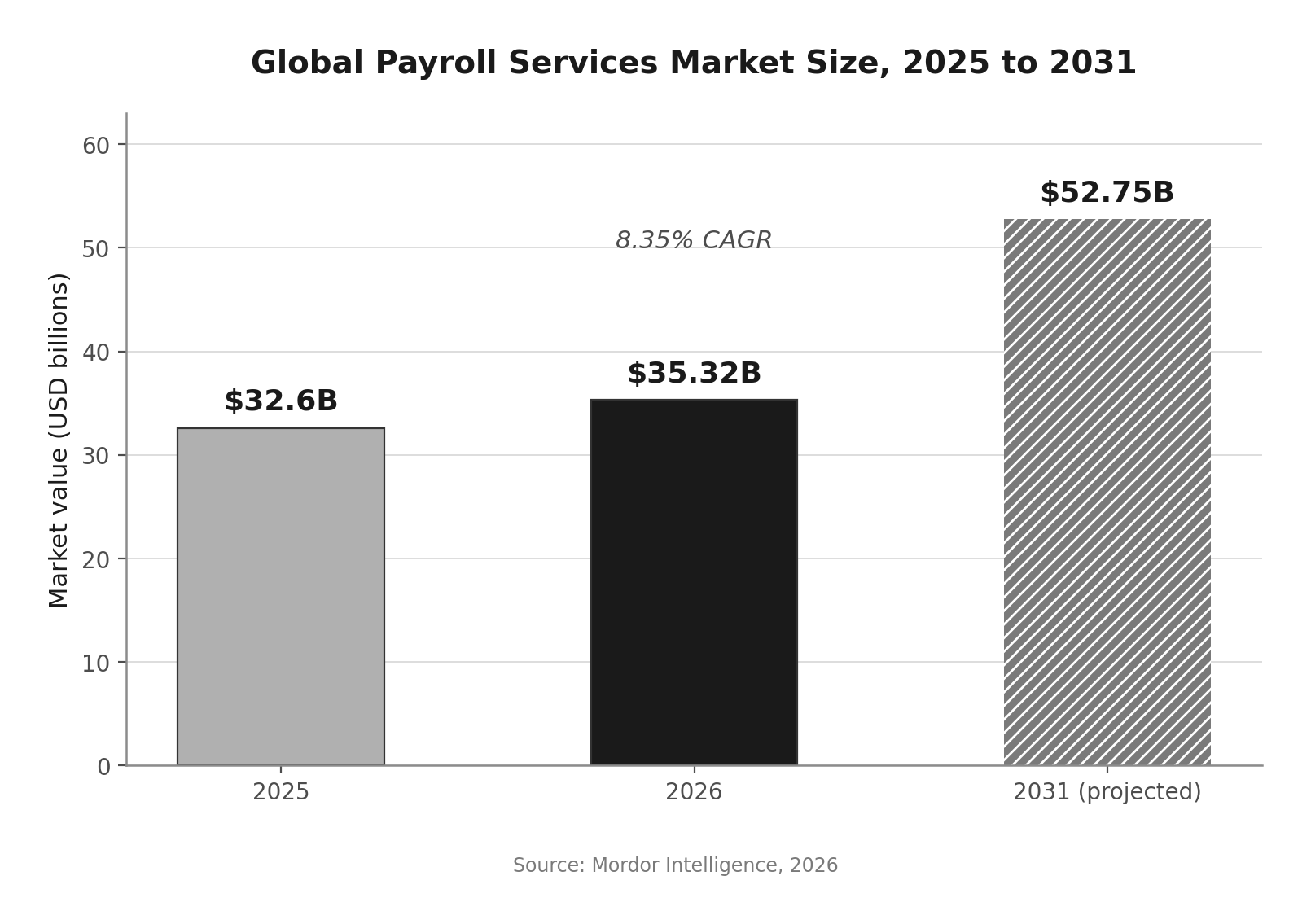
- The global payroll services market is worth $35.32 billion in 2026 (Mordor Intelligence).
The Largest Payroll Companies by Revenue
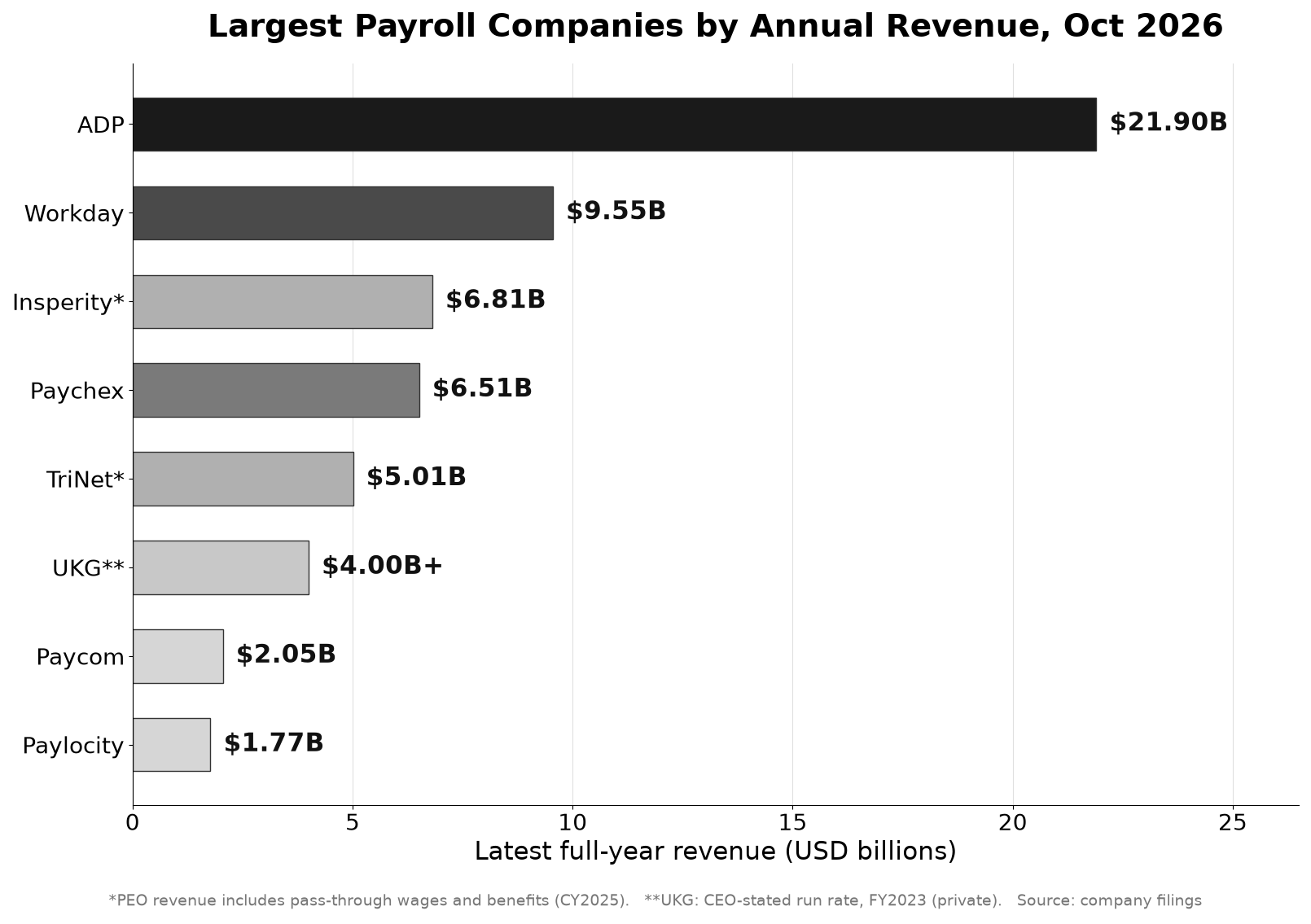
Companies are ranked by their latest full-year revenue. Fiscal years differ, so each figure carries its period. Professional employer organizations (PEOs) are flagged because their revenue includes wages and benefits they pass through for clients.
| Rank | Company | Latest full-year revenue | Period | Status |
|---|---|---|---|---|
| 1 | ADP | $21.9B | FY2026 (ended June 2026) | Public (NASDAQ: ADP) |
| 2 | Workday | $9.55B | FY2026 (ended Jan 2026) | Public (NASDAQ: WDAY) |
| 3 | Insperity (PEO) | $6.81B | CY2025 | Public (NYSE: NSP) |
| 4 | Paychex | $6.51B | FY2026 (ended May 2026) | Public (NASDAQ: PAYX) |
| 5 | TriNet (PEO) | $5.01B | CY2025 | Public (NYSE: TNET) |
| 6 | UKG | $4B+ run rate | FY2023, CEO-stated | Private |
| 7 | Paycom | $2.05B | CY2025 | Public (NYSE: PAYC) |
| 8 | Paylocity | $1.77B | FY2026 (ended June 2026) | Public (NASDAQ: PCTY) |
| 9 | Dayforce | Not disclosed | Private since Feb 2026 | Thoma Bravo, $12.3B EV |
Sources: ADP, Workday, Insperity, Paychex, TriNet, UKG via Apps Run The World, Paycom, Paylocity and Thoma Bravo. Private company figures are company-stated and unaudited.
ADP
ADP remains the largest payroll company in the world by a wide margin. Fiscal 2026 revenue reached $21.9 billion, net earnings rose 8% to $4.4 billion and adjusted EBIT grew 10% to $5.9 billion (Source: ADP).
Float is the line most rankings miss. ADP earned $1,355 million in client funds interest in fiscal 2026 on average client fund balances of $40.4 billion, and guides that line to $1,540 million to $1,560 million for fiscal 2027, alongside total revenue growth of 5% to 6% (Source: ADP).
Employer Services client revenue retention held at 92.1%, and Retirement Services crossed $1 billion in annual revenue for the first time, serving over 210,000 clients (Source: StockNow). More than 1.1 million clients across 140-plus countries use ADP (Source: ADP).
Workday
Workday reported fiscal 2026 total revenues of $9.552 billion, up 13.1%, with subscription revenues of $8.833 billion, up 14.5% (Source: Workday).
The newest quarter keeps that pace. Fiscal 2027 second-quarter revenue was $2.649 billion, up 12.8%, and Workday now guides fiscal 2027 subscription revenue to $9.940 billion to $9.950 billion, growth of 13% (Source: Workday). It is an enterprise HCM platform first and a payroll provider second, but its payroll footprint inside large organizations keeps it in any serious ranking.
Paychex
Paychex posted fiscal 2026 revenue of $6.51 billion, up 17%, with the Paycor acquisition contributing roughly 12 percentage points of that growth (Source: Paychex). Adjusted operating margin was 43.2%, and fiscal 2027 guidance called for 5% to 6% revenue growth.
The first quarter of fiscal 2027 confirms the return to mid-single digits. Revenue for the quarter ended August 31, 2026 rose 6% to $1.6305 billion, with Management Solutions at $1,213.1 million and PEO and Insurance Solutions at $367.6 million (Source: Paychex). Paychex also launched WISE, its workforce intelligence engine, with more than 600 AI features and agents (Source: Yahoo Finance).
Insperity and TriNet
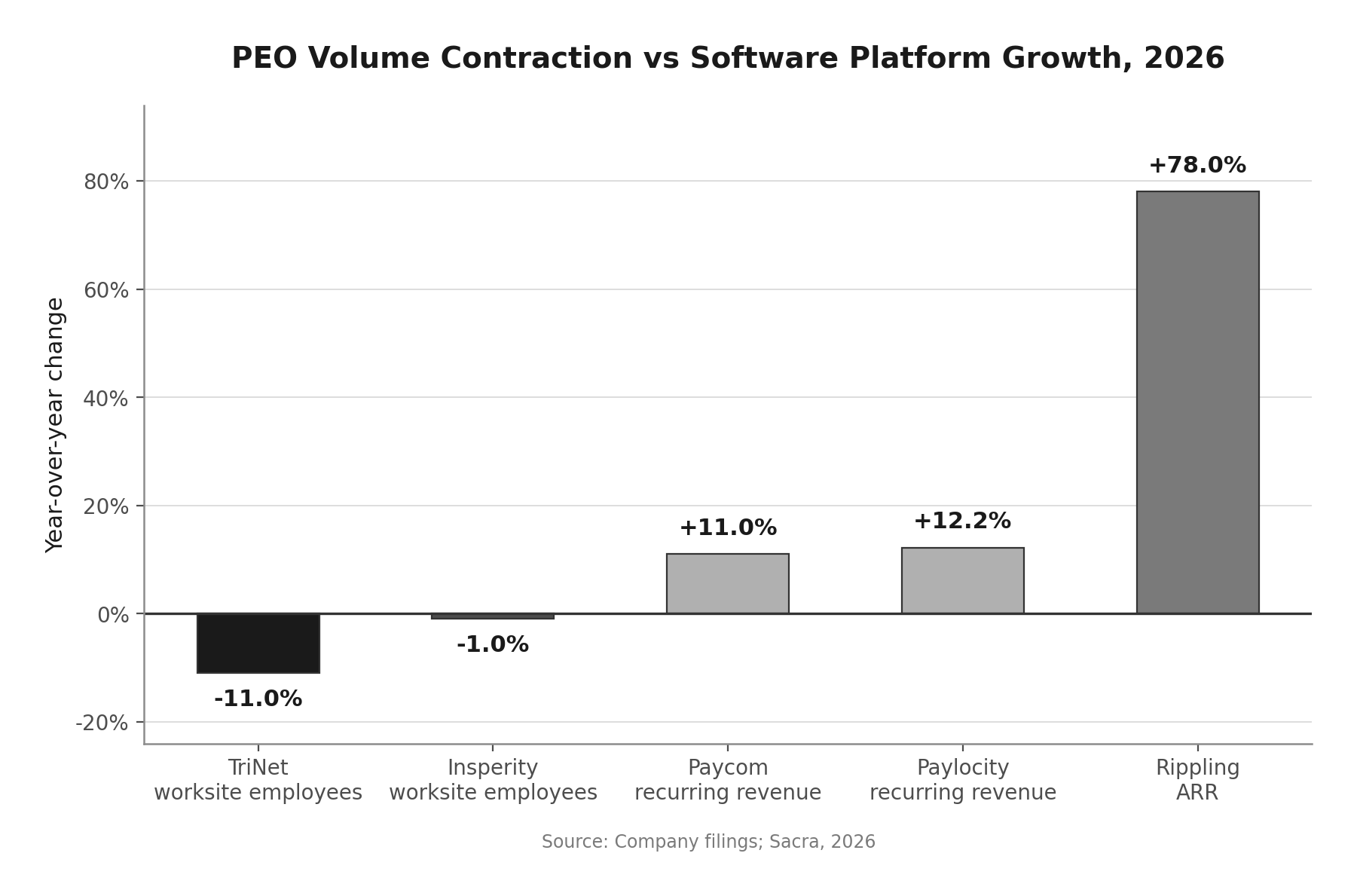
Insperity reported 2025 revenue of $6.812 billion, up 4%. Gross profit fell 14% to $900 million and adjusted EBITDA dropped to $131 million from $270 million, ending in a $7 million net loss (Source: Insperity). In Q2 2026, average paid worksite employees were 305,764, down 1% (Source: SEC).
TriNet's 2025 total revenues were $5.010 billion, down 1%, but professional service revenues, the part that resembles a software fee, were only $719 million and fell 6%. It guides 2026 revenue to $4.75 billion to $4.9 billion (Source: TriNet). Second-quarter 2026 revenue was $1.2 billion, down 5%, with average worksite employees down 11% to approximately 298,000 (Source: SEC).
UKG
UKG is the largest payroll provider that does not publish results. Its CEO described an annual run rate of more than $4 billion in fiscal 2023, the last company-attributed figure (Source: Apps Run The World). Everything published about its current scale is third-party estimation, so its rank here is approximate.
UKG is still buying distribution. In December 2025 it agreed to acquire Inova Payroll, the largest UKG Ready reseller in the US, which serves more than 4,000 small and mid-sized businesses (Source: UKG).
Paycom
Paycom finished 2025 with total revenue of $2.052 billion, up 9.0%, and adjusted EBITDA of $882.3 million, a 43% margin (Source: Paycom).
Second-quarter 2026 revenue was $531.2 million, up 9.8%, with recurring revenue of $505.2 million making up 95.1% of the total, and full-year guidance was raised to $2.197 billion to $2.212 billion (Source: Paycom).
Paylocity
Paylocity closed fiscal 2026 with total revenue of $1.771 billion, up 11%, and recurring revenue of $1.651 billion, up 12.2%. The client base grew roughly 7% to about 44,400, with average revenue per client of roughly $37,200 (Source: Yahoo Finance).
Dayforce
Dayforce is no longer public. Thoma Bravo completed its acquisition on February 4, 2026 for approximately $12.3 billion, and shareholders received $70.00 per share in cash. The stock no longer trades, so Dayforce has stopped publishing results (Source: Thoma Bravo).
The PEO Distortion: Revenue Rank vs Software Rank
A PEO becomes the employer of record for its clients' staff and books their wages and benefits as revenue. That is why Insperity's $6.812 billion top line sits above Paychex, even though its 2025 gross profit was only $900 million (Source: Insperity).
TriNet makes the gap explicit. Of $5.010 billion in 2025 revenue, $719 million was professional service revenue (Source: TriNet). Rank by that number and TriNet falls below Paycom and Paylocity.
The Largest Private Payroll Companies
Three venture-backed platforms now rival mid-cap public providers on revenue.
| Company | ARR / Revenue | Valuation | Scale |
|---|---|---|---|
| Deel | $1.5B ARR (H1 2026) | $17.3B | 150+ countries |
| Rippling | ~$1B ARR (Mar 2026) | $16.8B (last primary round) | 20,000+ customers |
| Gusto | $1B revenue (2026) | $9B+ | 400,000+ businesses |
- Deel said in August 2026 that it surpassed $1.5 billion in annual recurring revenue in the first half of the year, up from $1 billion in 2025, across more than 150 countries (Source: Calcalist). Its $300 million Series E valued the company at $17.3 billion (Source: Deel).
- Rippling hit roughly $1 billion in annualized revenue in March 2026, growing 78% year over year. It has not announced a primary round since its May 2025 Series G at $16.8 billion (Source: Sacra).
- Gusto surpassed $1 billion in trailing revenue in 2026 and has been cash flow positive for several years, valued at over $9 billion (Source: TechCrunch).
Cross-border payment infrastructure is the adjacent layer that has grown alongside these platforms. Providers such as Rise handle contractor and international worker payouts for companies that have outgrown domestic-only payroll but do not need a full employer-of-record setup. For a buyer-side comparison of the platforms above, see the BestFirms payroll platforms for startups review.
The Payroll Market in 2026: Size and Trajectory
The global payroll services market is estimated at $35.32 billion in 2026, up from $32.6 billion in 2025, and is projected to reach $52.75 billion by 2031 at a compound annual growth rate of 8.35% (Source: Mordor Intelligence).
Cloud delivery is the engine: cloud-based platforms account for 66.95% of the market and are growing at a 12.2% CAGR, well ahead of the category average (Source: Mordor Intelligence).
The adjacent payroll outsourcing segment sits at roughly $13.07 billion in 2026 and is forecast to hit $20.71 billion by 2034 at a 5.92% CAGR (Source: Straits Research). Buyers are not simply handing payroll to a service bureau anymore. They are buying software that automates compliance and then layering services on top.
Rank the providers above by revenue and the top three, ADP, Workday and Insperity, account for roughly $38.3 billion, more than the whole payroll services market estimate (Insperity, Workday). The reason is definitional: ADP, Workday and the PEOs earn large shares from HCM software, benefits administration and pass-through billings that market sizing firms exclude.
For a wider view of what companies are spending across the category, the 2026 payroll spending report breaks down budget allocation by company size.
What Is Driving Spend Toward the Largest Providers
- Compliance complexity. Cloud payroll platforms now embed compliance logic for more than 140 countries, a capability smaller providers cannot fund. Multi-state and multi-country employers increasingly treat regulatory coverage as the primary selection criterion.
- Interest on client funds. Paycom alone guided to approximately $105 million in interest on funds held for clients for 2026 (Source: Paycom). This float revenue scales with size.
- AI-driven margin expansion. ADP reported that clients and their employees held more than 12 million conversations with ADP Assist agents during fiscal 2026 (Source: Investing.com).
Consolidation Is Accelerating
The last eighteen months produced more structural change in this market than the previous five years combined.
- Paychex absorbed Paycor to move upmarket, adding roughly 12 points of fiscal 2026 growth (Paychex).
- Thoma Bravo took Dayforce private for about $12.3 billion (Thoma Bravo).
- UKG agreed to acquire Inova Payroll in December 2025 to sell directly to SMBs (UKG).
With Dayforce private and Gusto, Deel, Rippling and UKG all private, the share of this market that reports audited financials shrinks every year. Rankings built on public data will describe less and less of the actual industry.
What This Means for Buyers
Revenue rank is a poor proxy for product fit. Insperity outranks Paycom by revenue and is a fundamentally different purchase, aimed at companies that want to outsource employment liability rather than buy software.
The useful segmentation is by employer size and geography. Gusto and Paychex dominate small business. Paycom, Paylocity and Dayforce compete in the mid-market. ADP, Workday and UKG hold the enterprise. Deel and Rippling win where the workforce crosses borders.
Vendor count matters as much as vendor size. The average company now runs nine separate HR systems at roughly $204 per employee per year, which is why every platform on this list is pitching consolidation rather than best-of-breed.
What Payroll Actually Costs
Published pricing clusters into three tiers.
| Segment | Typical Pricing Model | Indicative Cost |
|---|---|---|
| Small business (1 to 50) | Base fee plus per employee | From $49/month plus $6 per employee |
| Mid-market (50 to 1,000) | Per employee per month, bundled | Roughly $37,200 average annual revenue per client |
| PEO / enterprise | Percentage of payroll or per WSE | Roughly $2,084 revenue per WSE per month |
Gusto's entry pricing starts at $49 per month plus $6 per employee (Source: Workstream). Paylocity's average revenue per client of roughly $37,200 gives a realistic mid-market benchmark (Yahoo Finance). Insperity's $2,084 monthly revenue per worksite employee reflects the PEO model, where benefits pass-through dominates the figure (SEC).
Buyers evaluating adjacent spend should also review HR software for small businesses and time tracking software, since both are commonly bundled.
Payroll Salaries and the Automation Squeeze
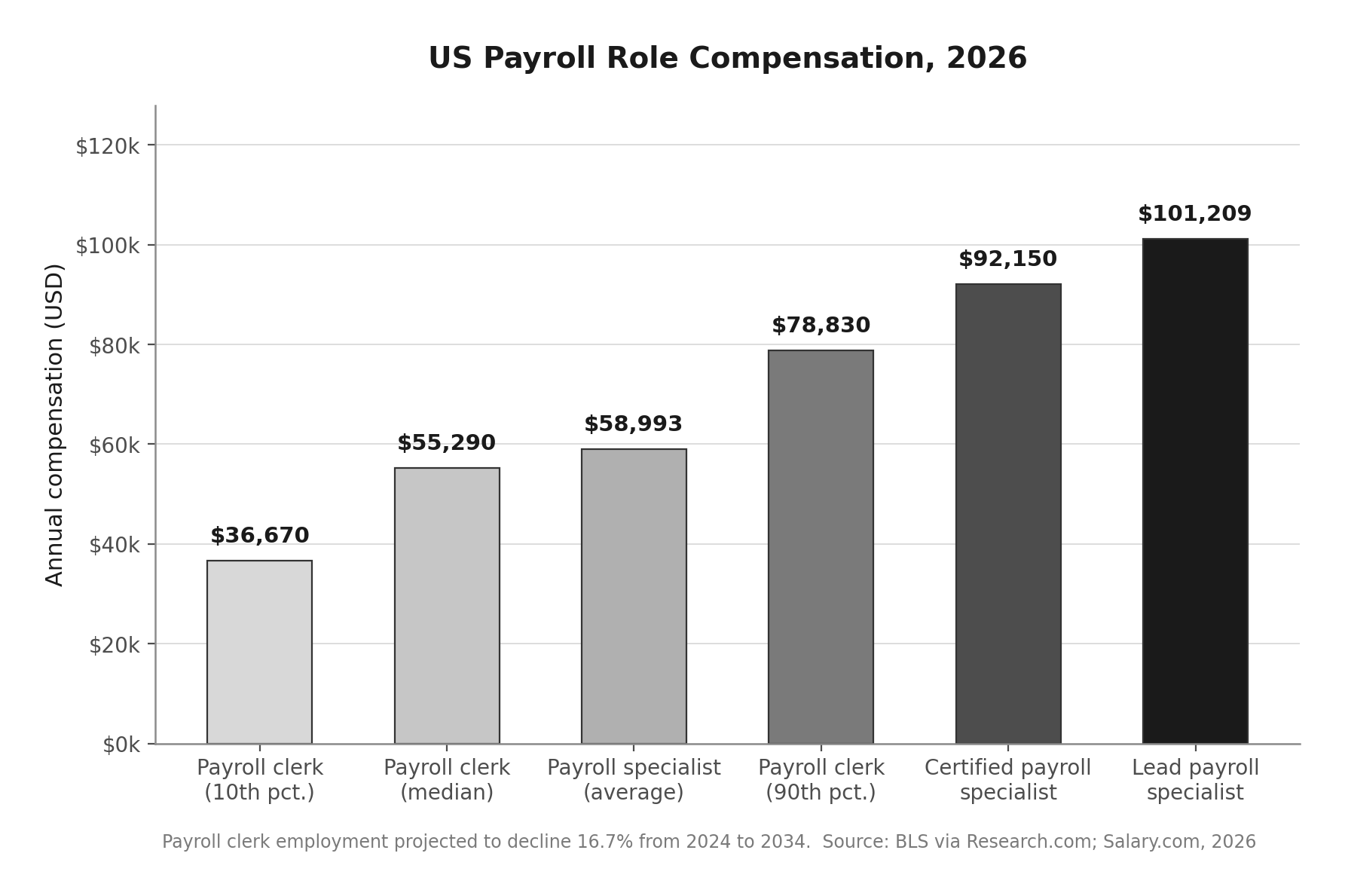
The economics of running payroll in-house are shifting. The Bureau of Labor Statistics recorded roughly 156,950 payroll and timekeeping clerks employed in 2024, earning a median annual wage of $55,290, with the 90th percentile at $78,830. Employment in the role is projected to decline 16.7% between 2024 and 2034 (Source: Research.com).
Senior roles hold up better than routine ones. Routine processing is being automated, while compliance interpretation and exception handling are not.
Compensation trends across adjacent roles appear in the 2026 startup salaries report.
The Cost of Getting Payroll Wrong
Compliance failure is the single strongest argument for buying from a large provider. In fiscal year 2024 the IRS assessed more than 4.4 million employment tax penalties totaling nearly $26.9 billion, and roughly 40% of small businesses pay a payroll tax penalty in a given year, at an average cost of $850 to $1,000 (Source: SurePayroll).
The failure-to-deposit penalty escalates on a fixed schedule: 2% for deposits one to five days late, 5% for six to fifteen days, and 10% beyond fifteen days. For late or missing returns, the 2026 minimum penalty for a return more than 60 days late is $510 or 100% of the unpaid tax, whichever is less (Source: Paylocity).
Where the Market Goes Next
- Private equity is reshaping the middle. Dayforce's $12.3 billion take-private removed a major public competitor, and Paychex absorbed Paycor. Expect more consolidation among mid-sized providers, where growth has slowed to single digits.
- IPO pressure is building. Deel, Rippling and Gusto have each passed $1 billion in revenue or ARR while private. At $16.8 billion on roughly $1 billion of ARR, Rippling is marked at approximately 17 times revenue, a premium that only holds if growth stays near current levels (Source: MEXC).
- PEO volume is the weak link. TriNet lost 11% of average worksite employees year over year and guides 2026 revenue below 2025. Both PEOs are holding revenue through pricing, which makes the segment the most exposed part of the market to a hiring slowdown. Wider automation trends are covered in AI workflow automation for HR processes and compliance.
- Next data points: ADP, Paycom, Paylocity, TriNet and Insperity report their next quarters from late October 2026.
Conclusion
The payroll market in 2026 is a $35.32 billion category growing at 8.35% a year (Mordor Intelligence), dominated by ADP's $21.9 billion in revenue, contested in the middle by Workday, Paychex, Paycom and Paylocity, and disrupted at the edges by Deel, Rippling and Gusto.
PEO volume has stalled, pricing power and float income are carrying margins, and AI is the lever every major provider is pulling. For buyers, size still correlates with compliance coverage, and a $26.9 billion annual penalty pool makes that coverage worth paying for.
Read Next
- Best Payroll Platforms for Startups (2026 Review)
- Fortune 500 Companies List
- Highest Paying Tech Companies in 2026
FAQs
What is the largest payroll company in the world in 2026?
ADP, which reported $21.9 billion in fiscal 2026 revenue and serves more than 1.1 million clients across 140-plus countries.
Which is the largest payroll company in the US?
ADP is the largest US payroll company by revenue, followed by Workday and Paychex. Insperity and TriNet report higher revenue than Paychex or Paycom only because PEO revenue includes pass-through wages and benefits.
Why does Insperity report more revenue than Paycom?
Insperity is a professional employer organization and reports gross billings, including the wages and benefits it passes through for client employees. Paycom reports software subscription revenue. The two figures measure different things.
How big is UKG?
UKG is private and does not publish results. Its CEO described an annual run rate of more than $4 billion in fiscal 2023. In December 2025 it agreed to acquire Inova Payroll, which serves more than 4,000 businesses.
Which private payroll company has the highest revenue in 2026?
Deel, which surpassed $1.5 billion in annual recurring revenue in the first half of 2026 at a $17.3 billion valuation. Rippling crossed about $1 billion in ARR in March 2026, and Gusto passed $1 billion in trailing revenue.
Is Dayforce still a public company?
No. Thoma Bravo completed its acquisition of Dayforce on February 4, 2026, at $70.00 per share and an enterprise value of approximately $12.3 billion.
Why do payroll companies earn interest income?
Payroll processors hold employer funds briefly between collection and payment to employees and tax authorities, and invest that balance. ADP earned $1,355 million in client funds interest in fiscal 2026.
How much does payroll software cost for a small business in 2026?
Payroll software for a small business typically starts around $49 per month plus $6 per employee, with mid-market platforms averaging closer to $37,200 in annual spend per client.
Disclaimer: This content is provided for informational purposes only and does not constitute legal, financial, or tax advice. Figures come from company filings, earnings releases and company statements published through October 2026. Private company figures are company-stated and unaudited, and fiscal years differ by company.