
Fastest Growing Companies in the US: A 2026 Data Report
In this report, see which companies are growing fastest in the US in 2026, plus the data behind their growth.
Last updated: September 2026. Figures in this report were re-checked against Inc., Deloitte, PitchBook, the Census Bureau and Fortune on September 27, 2026.
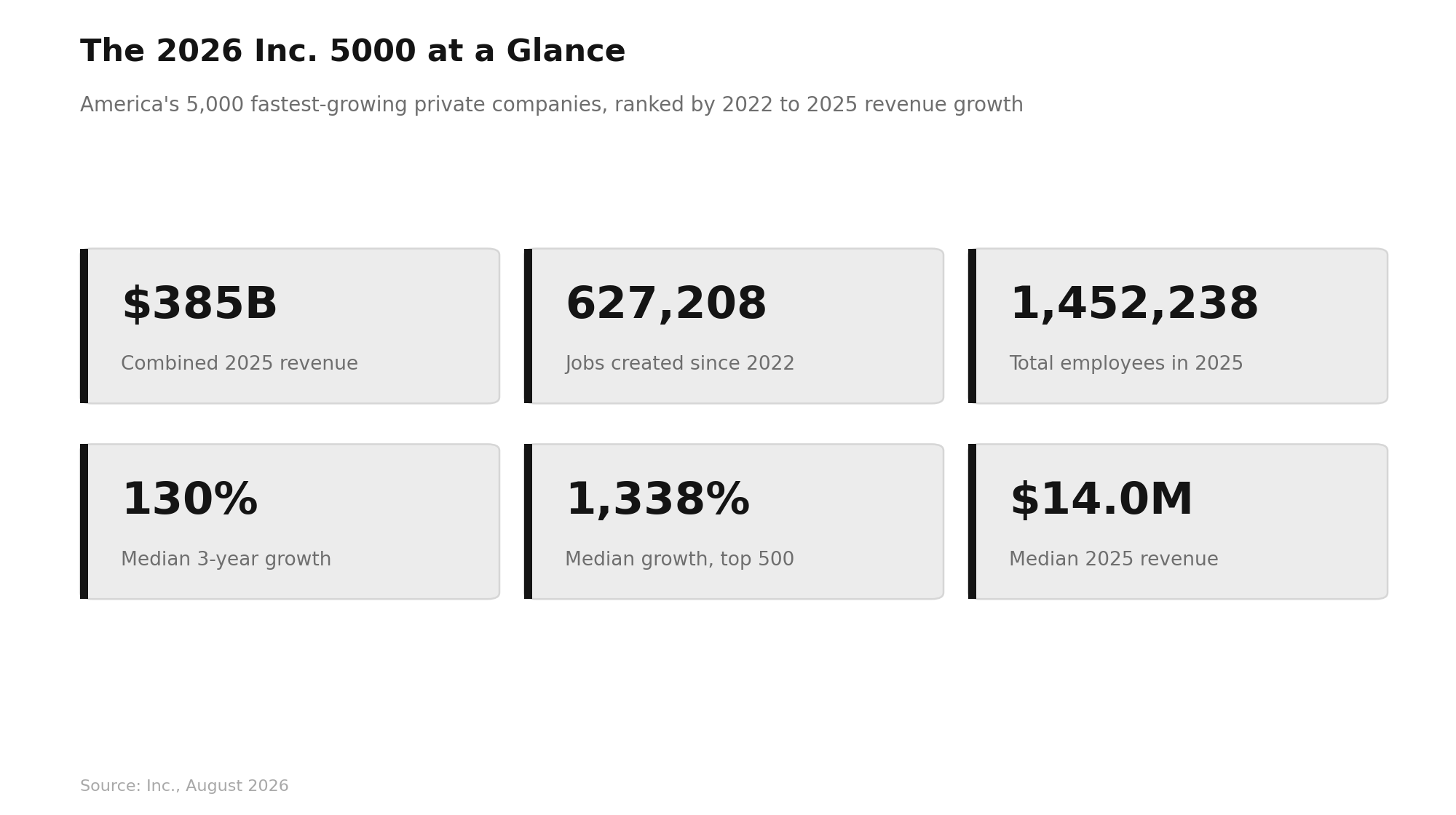
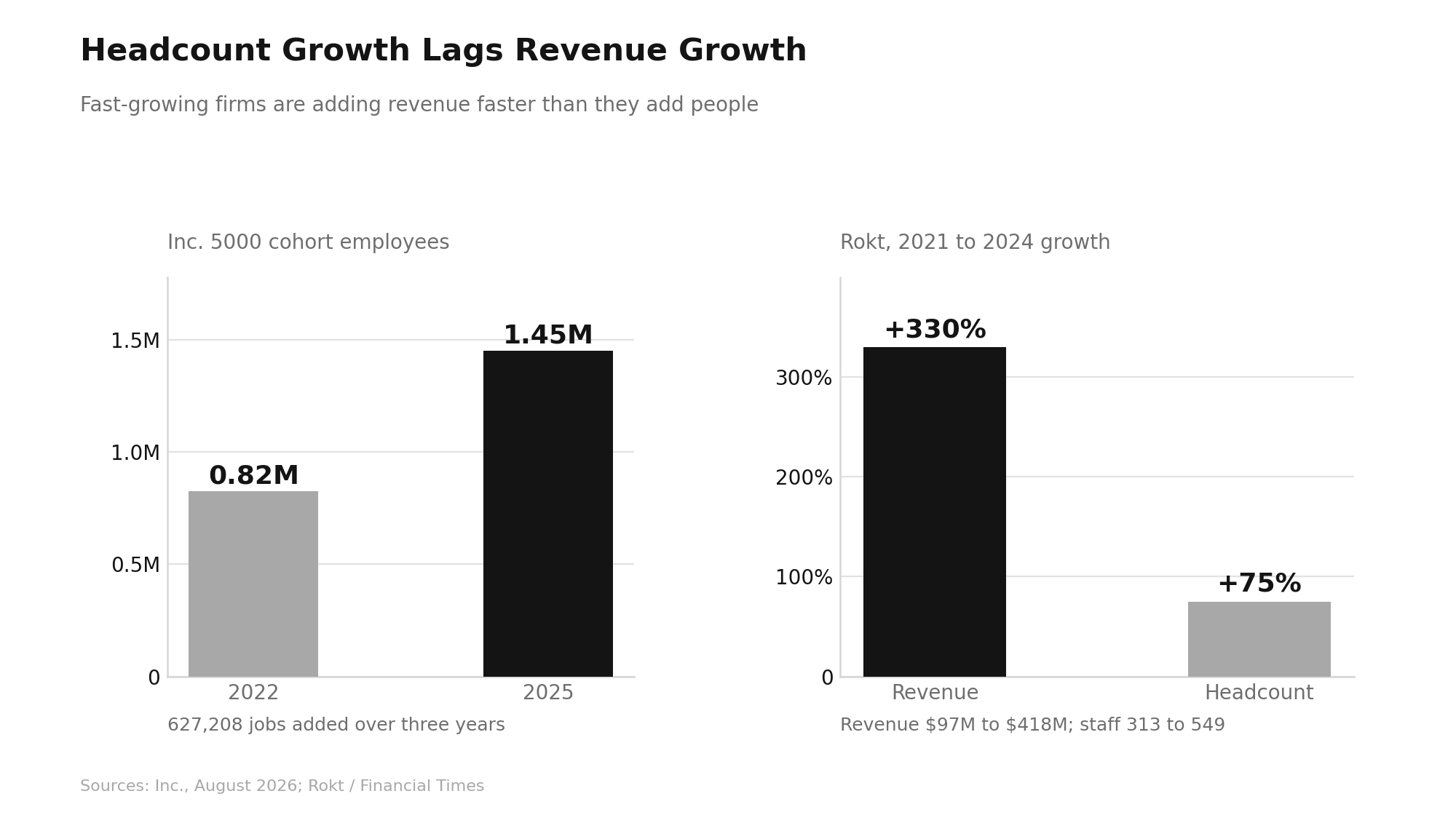
The 5,000 fastest growing private companies in America generated more than $385 billion in 2025 revenue and created 627,208 jobs over the previous three years (source: Inc.).
This report pulls together the four rankings that actually define high growth in the United States, Inc., Deloitte, the Financial Times, and Fortune, and reads them against venture funding, business formation, and compensation data from the same period.
Growth in 2026 is not evenly distributed. It's concentrated in a handful of sectors, a small number of metros, and an unusually narrow band of capital providers.
Below you'll find the exact numbers behind who is growing, how fast, in which industries, in which states, and what those companies pay.
Key Takeaways
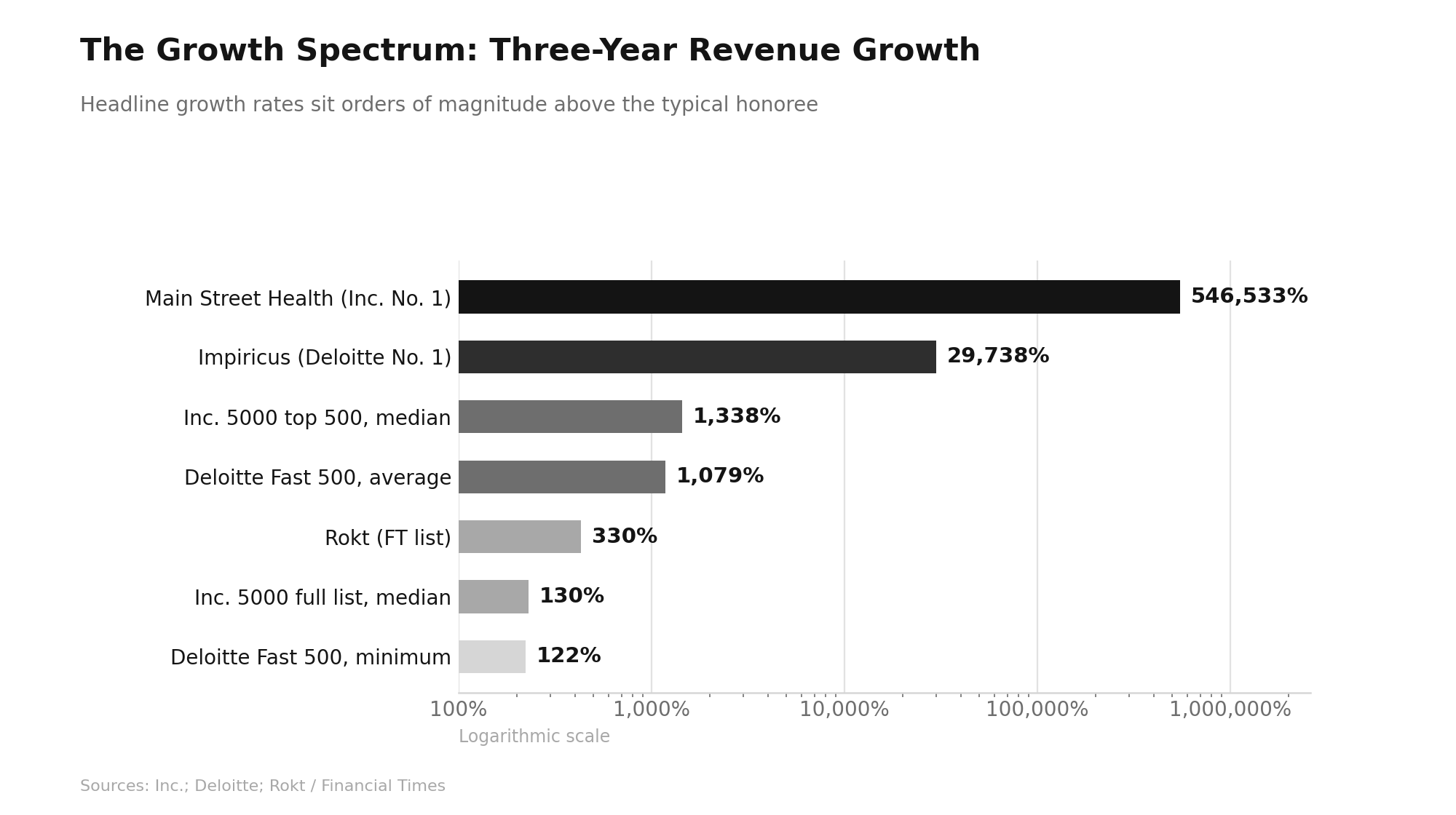
- Main Street Health topped the 2026 Inc. 5000 with 546,533% three-year revenue growth (Inc.).
- AI and data was the fastest growing Inc. 5000 sector, at 279% median revenue growth (Inc.).
- The full Inc. 5000 median growth rate was 130%; the top 500 hit 1,338% (Inc.).
- AI captured 86% of the $412.7 billion in US venture dollars deployed in H1 2026 (PitchBook).
- US business applications fell 7.8% in August 2026 to 531,728 (Census Bureau).
The Capital Backdrop: Growth Financing Has Never Been More Concentrated
Understanding which companies grew fastest requires understanding where the money went. US venture capital deployed $412.7 billion in the first half of 2026, nearly 30% more than investors put to work in all of 2025 (source: PitchBook).
That is the highest half-year total ever recorded.
The distribution matters more than the total. Artificial intelligence companies absorbed $355.9 billion of that figure, roughly 86% of every venture dollar spent in the six-month period (source: PitchBook).
Megadeals of $100 million or more captured 87.5% of all capital deployed, and just three firms, Andreessen Horowitz, Thrive Capital, and Founders Fund, took in 48.1% of all capital raised by funds (source: PitchBook-NVCA Venture Monitor).
Two additional data points frame the environment. Seven rounds of $1 billion or more closed in Q2 2026 alone, totaling $87.2 billion, and first-time fund count is annualizing to its lowest level in the report's decade of data (source: PitchBook-NVCA Venture Monitor).
Meanwhile, 2026 acquisition value has reached $375.4 billion, a decade high, with valuation step-ups running at 1.9x compared to 1.2x last year (source: Fortune).
The practical implication: a company with an AI narrative has had access to capital on terms unavailable to almost anyone else, while non-AI companies at Series D and later have faced a genuine drought.
Business Formation Is at a Record High, But Few Applications Become Employers
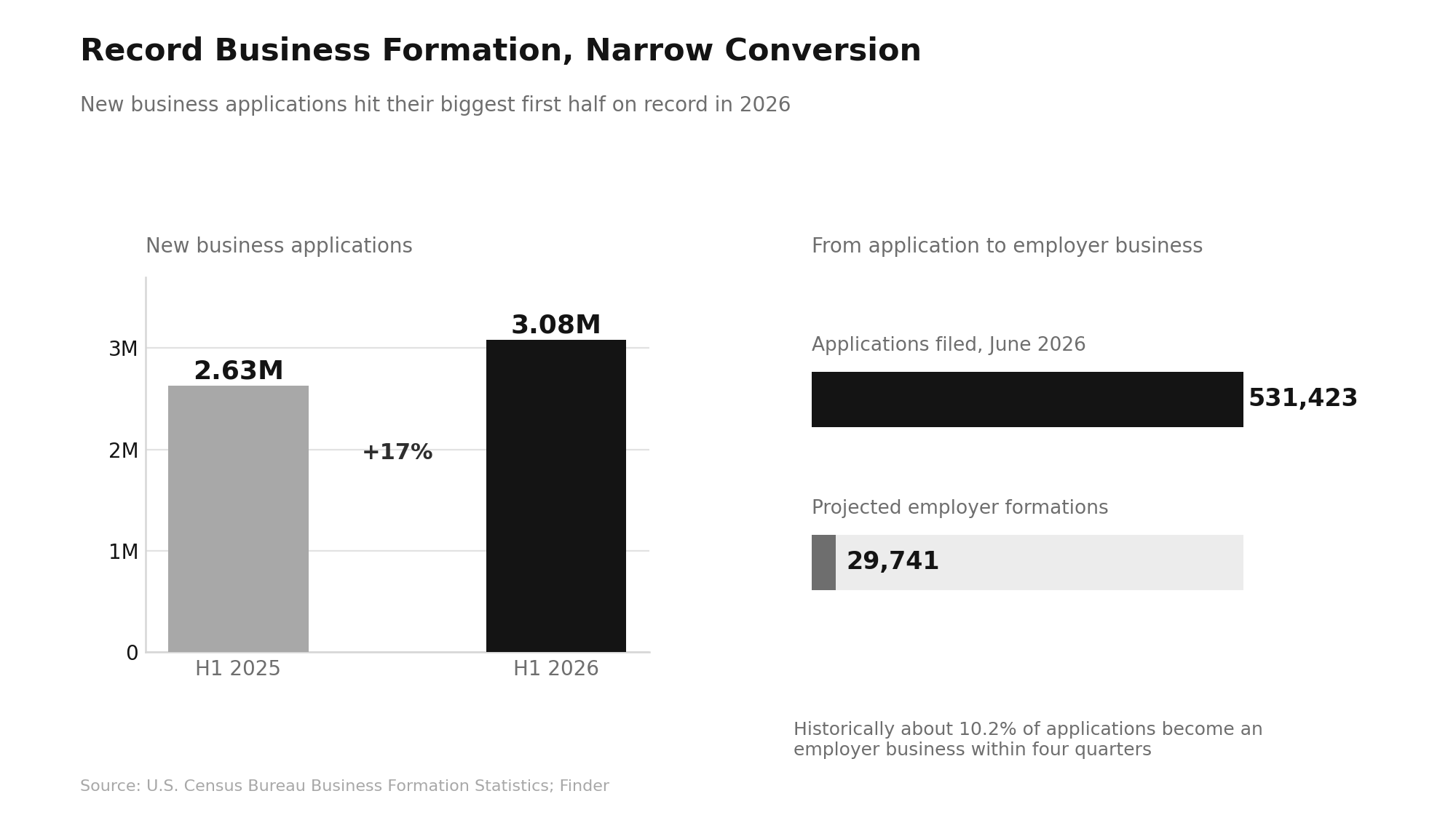
Beneath the venture layer, entrepreneurial activity ran hot through midyear. Americans filed 531,423 new business applications in June 2026, capping the biggest first half on record, with roughly 3.08 million applications filed in the first six months, up nearly 17% year over year (source: Self Employed).
The latest release cooled that picture. Business applications for August 2026 were 531,728, down 7.8% from July, and high-propensity applications fell 4.1% to 145,387, as of the September 11, 2026 release (source: U.S. Census Bureau).
The conversion rate is the sobering half of the story. The Census Bureau projects that 28,501 new employer startups will form within four quarters from the August 2026 application cohort, a 4.6% decline from July's projection and roughly 5.4% of the month's applications (source: U.S. Census Bureau).
Historically, an average of about 10.2% of applications become employer businesses within four quarters (source: Finder).
Record formation and record capital concentration are happening simultaneously. Most new US businesses are being founded outside the funding boom entirely.
The Four Rankings That Define "Fastest Growing" in the US
There is no single official list. Four rankings carry the most weight, and each measures something different.
| Ranking | Scope | Metric | Companies | 2026 Cycle |
|---|---|---|---|---|
| Inc. 5000 | US private, for-profit, independent | 3-year revenue growth % | 5,000 | Released Aug 11, 2026 |
| Deloitte Technology Fast 500 | North America, public and private, tech-adjacent | 3-year revenue growth % | 500 | 2025 winners; 2026 list not yet published (as of Sep 27, 2026) |
| FT / Statista Americas | 20 countries, organic growth only | Revenue CAGR | 300 | Released Apr 2, 2026 |
| Fortune 500 | US, largest by revenue | Total revenue | 500 | Released Jun 3, 2026 |
Sources: Inc., Deloitte, Statista, Fortune
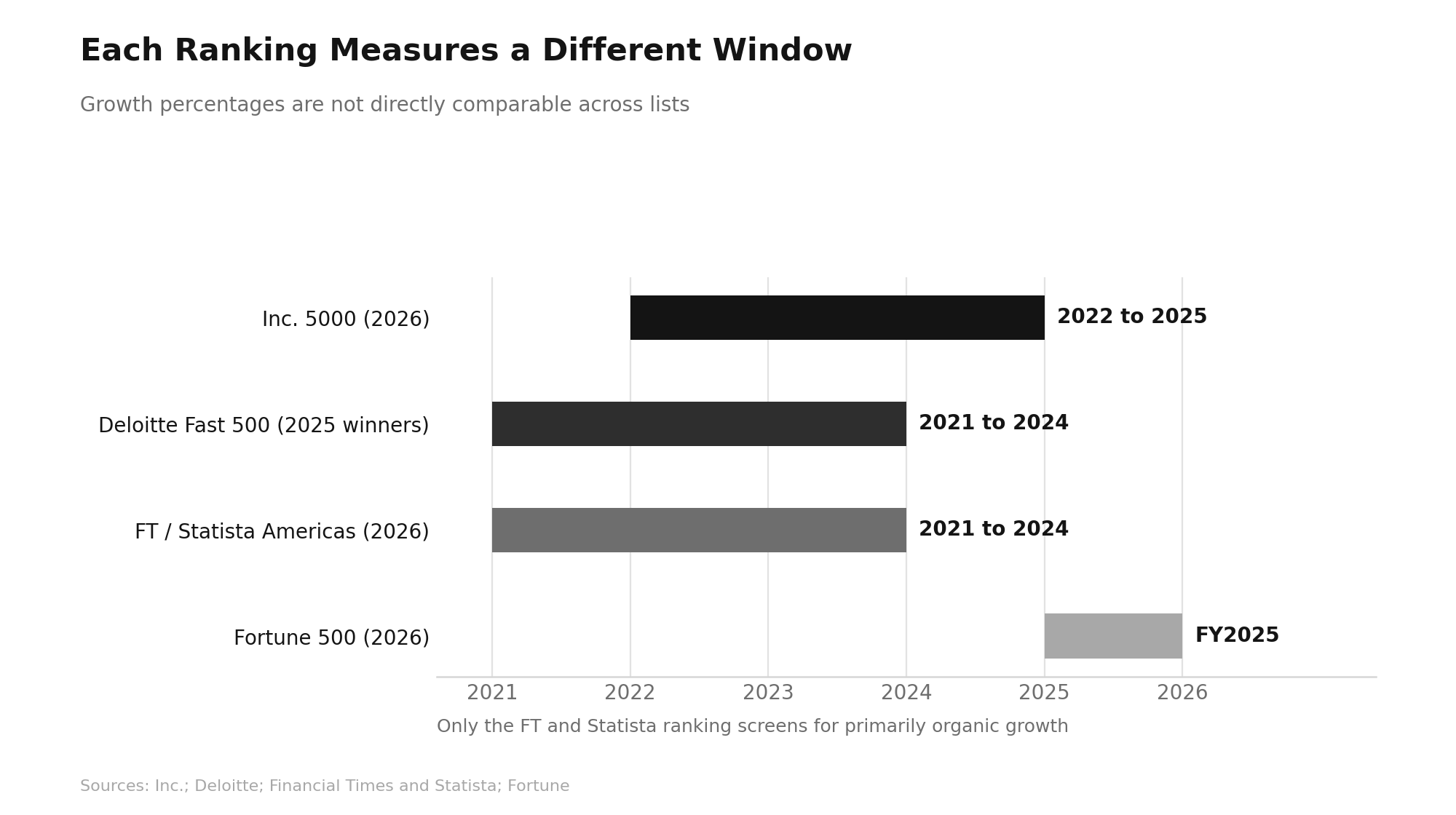
The Inc. 5000 requires companies to be privately held, for-profit, US-based, and independent as of December 31, 2025, founded and generating revenue by March 31, 2022, with minimum revenue of $100,000 in 2022 and $2 million in 2025 (source: Inc.).
Deloitte's Fast 500 requires proprietary intellectual property, base-year revenue of at least $50,000, current-year revenue of at least $5 million, and a growth rate of 50% or greater (source: Deloitte).
The FT and Statista ranking is the strictest on growth quality: it counts only primarily organic revenue growth, excluding companies that grew through acquisition (source: Statista).
Inc. 5000 2026: The Headline Numbers
The 2026 Inc. 5000 cohort produced the following figures (source: Inc.):
- Median revenue growth, top 500 companies: 1,338% (Inc.)
- Median revenue growth, full list: 130% (Inc.)
- Median 2025 revenue, full list: $14,002,513 (Inc.)
- Combined 2025 revenue: $385 billion+ (Inc.)
- Revenue growth since 2022: $200 billion+ (Inc.)
- Total employees in 2025: 1,452,238 (Inc.)
- Jobs created over three years: 627,208 (Inc.)
- Companies with $1 billion or more in revenue: 48 (Inc.)
- Companies led by a female CEO: 874 (Inc.)
- Companies appearing for the 10th time or more: 96 (Inc.)
The gap between the top 500 median (1,338%) and the full list median (130%) is the single most useful number here.
It shows that "fastest growing" describes two very different populations: a small group of hypergrowth outliers, and a much larger group of solid, compounding businesses roughly doubling revenue over three years.
Who Led: The Top Performers Across the 2026 Lists
- Main Street Health ranked No. 1 on the 2026 Inc. 5000 with 546,533% revenue growth from 2022 to 2025 (PR Newswire).
The Nashville-based rural value-based care company was founded in 2021 and now partners with over 3,800 providers across 24 states, serving nearly 4 million rural Americans (source: PR Newswire).
Founder Brad Smith is the only entrepreneur in the last 25 years to found two separate companies that each ranked No. 1 on the Inc. 5000, the other being CareBridge in 2023.
- Carahsoft Technology Corp. ranked No. 1 by absolute revenue on the 2026 list, with SpaceX, Judi Health, and G&A Partners also among the largest honorees by revenue (Inc.).
Other recognizable names on the 2026 list include:
- ShopMy
- Whatnot
- Blueland
- Babylist
- Beehiiv
- Loop
- Replit.
- Impiricus topped Deloitte's most recent Technology Fast 500 with 29,738% growth. Across that list, revenue growth ranged from 122% to 29,738%, with an average growth rate of 1,079% (source: Deloitte). Deloitte typically names North America winners in November, and the 2026 edition had not been published as of September 27, 2026 (Deloitte).
On the FT and Statista Americas list, the highest CAGR recorded was 538.8% and the minimum CAGR required for inclusion was 5.1% (source: Statista).
- Rokt is a representative case, growing revenue from $97 million to $418 million between 2021 and 2024, a 330% absolute increase and a 62.6% CAGR, while headcount rose from 313 to 549 (source: Rokt).
Industry Breakdown: Where Growth Is Actually Concentrated
The 2026 Inc. 5000 sectors with the highest median revenue growth were (source: Inc.):
- Artificial Intelligence and Data: 279% median growth (Inc.)
- Consumer Products: 209% median growth (Inc.)
- Automotive: 204% median growth (Inc.)
Deloitte's data adds resolution on the technology side.
Energy and sustainability technology held the highest median revenue growth rate at 624%. Within software and services, digital platforms represented 37% of winners, enterprise infrastructure and productivity 32%, security 19%, consumer software 10%, and education 2% (Deloitte).
Life sciences accounted for 14% of winners and fintech 13%, with AI moving into fourth position by sector while hardware, semiconductors, and communications networking slipped (source: Deloitte).
Healthcare deserves separate mention. The No. 1 company on the 2026 Inc. 5000 is a healthcare services business, not a software company, and value-based care models have now produced the top-ranked company twice in four years.
Geography: Where the Fastest Growing Companies Are Headquartered
Growth is geographically lopsided in a way that mirrors the capital data. In Q2 2026, 68% of US venture dollars landed in the Bay Area (source: AI Weekly).
Private company growth is more distributed than venture capital. Recent editions have seen the sharpest metro-level gains in Dallas-Fort Worth, Washington D.C., and Austin, while metro New York has retained the top spot by raw company count.
Tennessee is a useful case study for the 2026 cycle: 104 companies statewide made the list, combining for $12.9 billion in revenue and 35,965 employees, with 72 of those headquartered in the Nashville metro area (source: Teknovation).
At the large-cap end, the corporate map shifted in 2026. Texas reclaimed the lead with 57 Fortune 500 headquarters generating roughly $2.8 trillion in revenue, ahead of California's 56 companies at $2.7 trillion and New York's 53 at $2.2 trillion (source: Fortune).
Employment: What Rapid Growth Does to Headcount
The 2026 Inc. 5000 honorees employed 1,452,238 people in 2025 and added 627,208 jobs over three years, an average of roughly 290 employees and about 125 net new jobs per company (source: Inc.).
The revenue-to-headcount ratio is worth noting. With combined revenue of $385 billion across 1.45 million employees, the cohort averages roughly $265,000 in revenue per employee (source: Inc.).
Rokt's trajectory illustrates the modern pattern precisely: revenue grew 330% while headcount grew only 75%, from 313 to 549 people, so revenue per employee more than doubled (source: Rokt).
Compensation: What Fast Growing Companies Pay
Talent costs at high-growth companies have decoupled from the broader tech market.
- Baseline: BLS data puts median pay for software developers at $133,080 as of May 2024 (source: BLS).
- Mainstream AI and ML engineers: They start at approximately $134,000, sit at $170,750 at the midpoint, and reach $193,250 at the high end according to the Robert Half 2026 Salary Guide (source: Pin).
- AI-native startups pay above that band: The median base salary for a machine learning engineer at an AI startup in 2026 is $200,000, with a 25th percentile of $184,000 and a 75th percentile of $249,000, based on 122 tracked roles (source: Recruiting from Scratch).
- Frontier labs occupy a separate tier: Levels.fyi data as of May 2026 shows median total compensation of $600,000 for Anthropic software engineers and $795,000 at OpenAI (source: Pin).
- Growth rates diverge sharply by specialty: AI, ML, and data science roles are taking 4.1% starting salary gains in 2026, the highest of any tech specialty Robert Half tracks, while overall tech salary growth averages 1.6% year over year. PwC's Global AI Jobs Barometer documented a 56% wage premium for AI skills, up from 25% the prior year (source: Pin).
- Equity remains the lever. Senior AI engineers at seed to Series A companies commonly receive 0.25% to 1.0% in options, with Series B to C ranges at 0.05% to 0.30% (source: Ay Automate). Senior ML engineers in San Francisco and New York regularly clear $400,000 in total compensation once equity is included (source: KORE1).
What the Data Says About How These Companies Grow
Several patterns repeat across the 2026 cohorts.
- Small bases produce enormous percentages: Main Street Health's 546,533% figure is a function of launching in 2021 from effectively zero revenue (PR Newswire). Percentage growth is not a proxy for business scale.
- Repeat performance is common at the top: More than half of Deloitte's most recent Fast 500 winners were prior honorees, yet the majority of the top ten were first-time entrants (Deloitte). On the Inc. side, 96 companies made the 2026 list for the 10th time or more (Inc.).
- Category creation outperforms category competition: SharkNinja is the clearest recent example, landing on the FT's Americas' Fastest Growing Companies 2026 list after building Shark Beauty into a leading US facial device brand and posting 11 consecutive quarters of double-digit revenue growth through 2025 (source: SharkNinja).
- Services businesses are competitive with software: The top Inc. 5000 spot went to a healthcare services company, and the No. 1 company by revenue, Carahsoft, is a government IT distributor (Inc.).
How to Read These Rankings Without Being Misled
Three caveats apply to every figure in this report.
- Self-reported revenue: The Inc. 5000, Deloitte Fast 500, and FT rankings are all compiled from applications submitted by companies themselves. Non-applicants are absent regardless of performance, which means these lists are not exhaustive censuses of US growth.
- Different measurement windows: The 2026 Inc. 5000 measures 2022 to 2025. Deloitte's most recent published list measured 2021 to 2024. The FT list measures 2021 to 2024 CAGR. Cross-list comparisons of growth percentages are not apples-to-apples.
- Organic versus acquisitive growth: Only the FT and Statista ranking screens for primarily organic growth. A company can post extraordinary Inc. 5000 numbers largely through acquisition, which is a materially different business achievement.
Conclusion
Growth rankings are the clearest public signal of where the US economy is actually accelerating, and the 2026 data tells a consistent story across every list.
The fastest growing companies in the US are concentrated in AI and data, healthcare services, and consumer products. They cluster in a handful of metros led by Nashville, Dallas-Fort Worth, Austin, Washington D.C., and the Bay Area, and they operate in a capital environment where 86% of venture dollars went to a single sector (source: PitchBook).
The median Inc. 5000 company grew 130% over three years on about $14.0 million in revenue, while the top 500 grew 1,338%, a spread that separates steady compounders from genuine outliers (source: Inc.).
Watch two dates next: the Census Bureau's September 2026 business formation release on October 14, and Deloitte's 2026 Fast 500 in November (source: U.S. Census Bureau).
Read Next
- Best Email Marketing Software in 2026
- Best Knowledge Base Software in 2026
- Best AI Marketing Tools for Small Businesses
Scaling a team as fast as these companies? Best Firms compares vetted tech recruiting partners by fee, speed and guarantee.
FAQs
What is the fastest growing company in the US in 2026?
The fastest growing company in the US in 2026 is Main Street Health, which posted 546,533% revenue growth from 2022 to 2025 to top the Inc. 5000. The Nashville-based rural value-based care company was founded in 2021 and now partners with more than 3,800 providers across 24 states (PR Newswire).
How is fastest growing measured for US companies?
It's measured primarily by percentage revenue growth over a three-year period. The Inc. 5000 uses 2022 to 2025 revenue growth, Deloitte's Technology Fast 500 uses a three-year fiscal window with a 50% minimum growth threshold, and the FT and Statista ranking uses compound annual growth limited to primarily organic revenue (Deloitte).
Which industry has the fastest growing companies in the US?
How much do the fastest growing companies in the US pay employees?
Well above baseline tech rates. Machine learning engineers at AI startups earn a $200,000 median base, with $184,000 to $249,000 at the 25th and 75th percentiles (Recruiting from Scratch). Frontier AI labs sit in a separate tier, at $600,000 to $795,000 median total compensation (Pin).
Where are most of the fastest growing companies in the US located?
They concentrate in a small group of states and metros. Tennessee alone placed 104 companies on the 2026 Inc. 5000, 72 of them in the Nashville metro (Teknovation), and Nashville, Dallas-Fort Worth, Austin, Washington D.C., and metro New York have posted the strongest recent concentrations.
When will the 2026 Deloitte Technology Fast 500 be released?
Deloitte typically announces its North America Technology Fast 500 in November, and the 2026 winners had not been published as of September 27, 2026. Until then, the 2025 list, led by Impiricus, is the most recent edition (Deloitte).
Disclaimer: This content is provided for informational purposes only and does not constitute legal, financial, or investment advice. Rankings and figures reflect the published editions and data releases cited above as of September 2026, and self-reported company data can be revised.