
Best Industries to Start a Business in 2026: A Data Report
In this report, we analyze the best industries to start a business in 2026 using growth, profit margin, survival, and salary data.

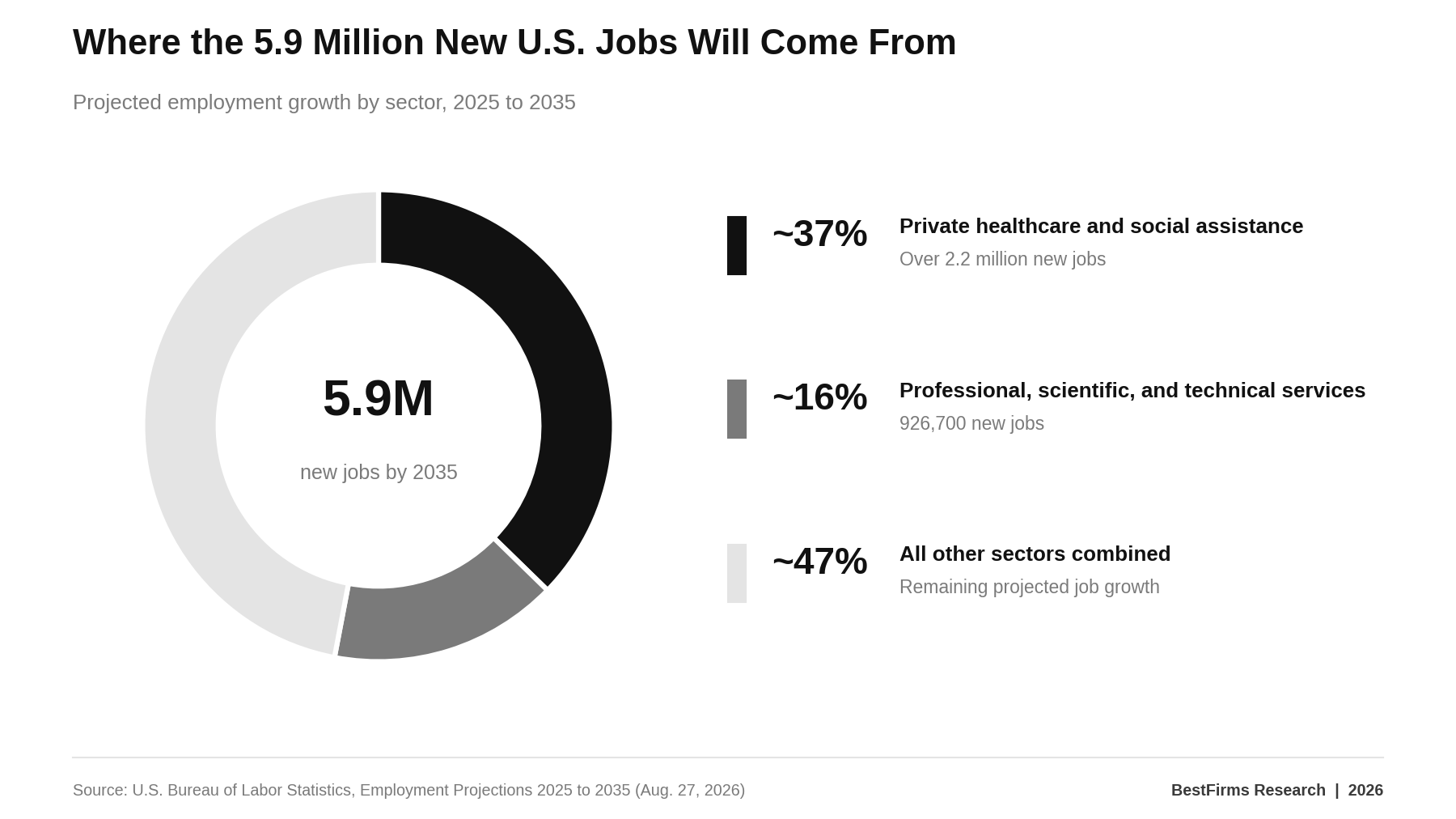
The U.S. economy is projected to add 5.9 million jobs between 2025 and 2035, and the private healthcare and social assistance sector alone is expected to account for about 37% of them (source: U.S. Bureau of Labor Statistics).
At BestFirms, we track industry data, company rankings, and market reports so founders can choose where to build based on evidence instead of hype.
Industry choice shapes a new company's demand, pricing power, and survival odds long before the first customer arrives.
Those three factors vary widely from sector to sector, which makes industry selection one of the highest-stakes decisions a founder makes.
This report analyzes 10 industries across growth projections, profit margins, survival rates, salaries, and AI adoption to identify where new businesses have the strongest odds in 2026.
Key Takeaways
- Healthcare, senior care, and therapy services show the strongest projected demand through 2035.
- Software and non-bank financial services report the highest net margins in this report.
- Local services, education, and construction outperform the national five-year survival average.
- Energy and electrical services gain directly from rising AI-driven electricity demand.
- Retail leads new business applications but combines thin margins with declining employment.
Report Methodology
This report combines seven public datasets to evaluate each industry on five factors:
- Projected demand growth
- Profit margins
- Five-year establishment survival
- Labor costs
- AI adoption.
| Dataset | Publisher | Release Date |
|---|---|---|
| Employment Projections, 2025 to 2035 | U.S. Bureau of Labor Statistics | August 27, 2026 |
| Business Formation Statistics, July 2026 | U.S. Census Bureau | August 12, 2026 |
| Business Trends and Outlook Survey (AI use) | U.S. Census Bureau | May 26, 2026 |
| Occupational Employment and Wages, May 2025 | U.S. Bureau of Labor Statistics | May 15, 2026 |
| Frequently Asked Questions About Small Business 2026 | SBA Office of Advocacy | February 2026 |
| Margins by Sector (US) | NYU Stern, Aswath Damodaran | January 2026 |
| Establishment Survival by Industry | BLS data, compiled by StartBusinessByState | August 31, 2026 |
Limitations: Margin benchmarks come from publicly traded U.S. companies and should be read as directional. Survival rates cover employer establishments only, and a closure can reflect a sale, retirement, or relocation rather than a failure. Wage figures are annual means for employees and exclude self-employed owners.
Section 1: U.S. Business Formation in 2026
Business applications reached 578,926 in July 2026, an 8.1% increase over June (source: U.S. Census Bureau).
| Industry | Business Applications, July 2026 | Change vs. June 2026 |
|---|---|---|
| Retail trade | 141,241 | +44.5% |
| Professional services | 81,366 | -2.5% |
| Construction | 48,972 | -0.5% |
| Other services | 44,741 | 0.0% |
| Administrative and support | 37,537 | +0.7% |
| Transportation and warehousing | 34,982 | +0.3% |
| Health care and social assistance | 33,953 | +0.7% |
| Accommodation and food services | 29,951 | +2.8% |
| Finance and insurance | 20,287 | +2.2% |
(source: U.S. Census Bureau)
These founders join an established base of 36,207,130 small businesses that employ 62.3 million people and generate 43.5% of U.S. GDP (source: SBA Office of Advocacy).
This collection of small business statistics adds further context on how those firms perform.
Finding: Application volume is concentrated in retail, the one major private sector where employment is projected to shrink.
For a view of which sectors already dominate the economy, see our analysis of the biggest industries in the US.
Section 2: Employment Growth Outlook, 2025 to 2035
Total U.S. employment is projected to grow 3.5% from 2025 to 2035, well below the 10.9% recorded over the prior decade (source: U.S. Bureau of Labor Statistics).
| Sector | Projected Employment Change | Primary Driver |
|---|---|---|
| Utilities | +9.8% | Electricity demand, including AI power needs |
| Private healthcare and social assistance | +9.5% | Aging population and chronic conditions |
| Professional, scientific, and technical services | +8.6% | AI systems, R&D, and consulting |
| Transportation and warehousing | +3.1% | Online delivery volume |
| Retail trade | -0.2% | E-commerce limiting store employment |
| Federal government | -3.4% | Workforce reductions |
(source: U.S. Bureau of Labor Statistics)
Computing infrastructure, data processing, and web hosting is projected to grow 25.1%. At the same time, services for the elderly and persons with disabilities will add 625,400 jobs, the most of any detailed industry (source: U.S. Bureau of Labor Statistics).
Office and administrative support occupations are projected to shed 752,100 jobs as automation spreads (source: U.S. Bureau of Labor Statistics).
Finding: Demand is shifting toward care, energy, and technical expertise, while routine administrative work contracts.
Section 3: Profit Margins by Industry
| Industry Category | Gross Margin | Net Margin |
|---|---|---|
| Software (system and application) | 71.72% | 25.49% |
| Financial services (non-bank and insurance) | 69.20% | 22.19% |
| Power | 43.57% | 12.73% |
| Homebuilding | 22.70% | 9.47% |
| Restaurant and dining | 32.24% | 9.37% |
| Education | 45.82% | 8.79% |
| Healthcare information and technology | 48.32% | 7.45% |
| Business and consumer services | 33.38% | 7.03% |
| Hospitals and healthcare facilities | 39.10% | 6.30% |
| Engineering and construction | 15.46% | 5.94% |
| Trucking | 21.19% | 3.79% |
| Retail (grocery and food) | 26.31% | 1.32% |
| Healthcare support services | 12.08% | 1.25% |
| Total market | 37.76% | 9.74% |
(source: NYU Stern, Aswath Damodaran)
Finding: Software and financial services earn more than twice the total market net margin, while grocery, trucking, and healthcare staffing operate on razor-thin returns.
Our ranking of the most profitable industries in 2026 expands on these benchmarks.
Section 4: Business Survival Rates by Industry
| Industry | 1-Year Survival | 5-Year Survival | 10-Year Survival |
|---|---|---|---|
| All industries | 77.9% | 51.4% | 34.7% |
| Agriculture, forestry, fishing, and hunting | 85.7% | 61.8% | 53.0% |
| Other services | 82.6% | 60.0% | 42.1% |
| Retail trade | 84.4% | 59.8% | 44.2% |
| Educational services | 78.4% | 58.2% | 43.1% |
| Construction | 79.7% | 56.5% | 42.6% |
| Finance and insurance | 79.2% | 53.8% | 38.4% |
| Transportation and warehousing | 77.0% | 52.7% | 36.1% |
| Health care and social assistance | 82.1% | 52.6% | 36.4% |
| Professional, scientific, and technical services | 74.5% | 50.8% | 34.3% |
| Information | 71.6% | 45.7% | 30.0% |
(source: StartBusinessByState, BLS data)
Finding: Local services, education, and construction beat the national five-year average, while information businesses churn fastest.
These startup statistics for 2026 offer additional benchmarks on early-stage outcomes.
Section 5: Salary Benchmarks for Key Roles
| Role | Annual Mean Wage | Relevant Industry |
|---|---|---|
| Personal financial advisors | $156,670 | Financial services |
| Software developers | $148,100 | Software and SaaS |
| Nurse practitioners | $137,300 | Outpatient healthcare |
| Construction managers | $124,360 | Construction |
| Management analysts | $113,790 | AI consulting |
| Physical therapists | $105,280 | Outpatient therapy |
| Accountants and auditors | $94,750 | Financial services |
| Janitors and cleaners | $38,760 | Local services |
| Home health and personal care aides | $36,120 | Senior care |
| Childcare workers | $35,030 | Childcare |
| All occupations | $69,770 | U.S. average |
(source: U.S. Bureau of Labor Statistics)
Finding: High-margin industries also carry the highest labor costs, while care and local services pair low wages with retention risk.
Founders planning early hires can compare these figures with our 2026 startup salaries report.
Section 6: AI Adoption by Industry
AI use reached 19.8% of U.S. businesses as of May 2026, compared with 39.7% in information, 33.9% in finance and insurance, and around 14% in retail (source: U.S. Census Bureau).
Firms with at least 250 employees reported 37% usage, and adoption among firms with fewer than 20 employees did not change significantly (source: U.S. Census Bureau).
Finding: Four in five businesses still do not use AI, which creates demand for implementation services and gives AI-native startups a cost advantage.
Our AI adoption by industry report breaks this down further.
Section 7: The 10 Best Industries to Start a Business in 2026
1. Home Health and Senior Care
This industry leads all detailed industries in projected job creation, with 625,400 new jobs through 2035 (source: U.S. Bureau of Labor Statistics).
Home health and personal care aides are already the largest U.S. occupation at 4.3 million workers (source: U.S. Bureau of Labor Statistics).
Opportunities: non-medical home care, adult day centers, senior transportation.
Primary risk: licensing, reimbursement rates, and caregiver turnover.
2. Outpatient Therapy and Specialized Healthcare
Nurse practitioners are the fastest-growing occupation at 41.0%, and physical and occupational therapy assistants rank among the 10 fastest-growing jobs (source: U.S. Bureau of Labor Statistics).
Opportunities: physical therapy clinics, mental health group practices, telehealth.
Primary risk: high clinical salaries and payer negotiations.
3. Software, SaaS, and AI Products
Software posts the highest net margin in this report at 25.49% (source: NYU Stern, Aswath Damodaran), but information businesses have the lowest five-year survival rate at 45.7% (source: StartBusinessByState, BLS data).
The data favors focused products, which is why founders study how vertical SaaS companies integrate AI layers to win niche markets.
Primary risk: churn and expensive engineering talent.
4. AI Consulting and Automation Services
Professional, scientific, and technical services will add 926,700 jobs through 2035, driven largely by AI systems and consulting (source: U.S. Bureau of Labor Statistics).
With most businesses not yet using AI, service firms have a wide market.
This guide to starting and scaling AI automation agencies covers pricing and delivery.
Primary risk: low barriers to entry.
5. Electrical, Solar, and Energy Services
Solar photovoltaic installers (+36.5%) and wind turbine service technicians (+29.5%) rank among the five fastest-growing occupations (source: U.S. Bureau of Labor Statistics).
The U.S. already employs 757,220 electricians (source: U.S. Bureau of Labor Statistics).
Opportunities: solar installation, EV charger installation, battery storage.
Primary risk: licensing and shifting energy incentives.
6. Construction and Skilled Trades
Construction pairs strong application volume with a 56.5% five-year survival rate, above the national average (source: StartBusinessByState, BLS data).
Net margins range from 5.94% in engineering and construction to 9.47% in homebuilding (source: NYU Stern, Aswath Damodaran).
Our guide to modern construction tech shows how new contractors protect those margins.
Primary risk: labor shortages and project cost overruns.
7. Financial Services, Insurance, and Accounting
Non-bank financial services report a 22.19% net margin (source: NYU Stern, Aswath Damodaran), and finance and insurance has one of the highest AI adoption rates at 33.9% (source: U.S. Census Bureau).
Opportunities: fractional CFO services, bookkeeping, independent insurance agencies, tax preparation.
New firms should compare the best accounting software for small businesses before onboarding clients.
Primary risk: regulation and credentialing.
8. Transportation, Logistics, and Delivery
Transportation and warehousing is projected to grow 3.1% through 2035 (source: U.S. Bureau of Labor Statistics), but trucking net margins average just 3.79% (source: NYU Stern, Aswath Damodaran).
Opportunities: last-mile delivery, freight brokerage, medical courier services.
Primary risk: fuel, insurance, and vehicle costs.
9. Education, Training, and Childcare
Education combines an 8.79% net margin (source: NYU Stern, Aswath Damodaran) with a 58.2% five-year survival rate (source: StartBusinessByState, BLS data).
Opportunities: tutoring, AI and workforce skills training, trade certification, licensed childcare.
Primary risk: staffing, since childcare wages remain among the lowest in the economy.
10. Local and Personal Services
Other services, including repair, personal care, and pet care, holds a 60.0% five-year survival rate, among the highest in this report (source: StartBusinessByState, BLS data).
Because startup costs are low, customer acquisition decides winners, so benchmark the average cost per lead by industry before buying ads.
Primary risk: local competition and price pressure.
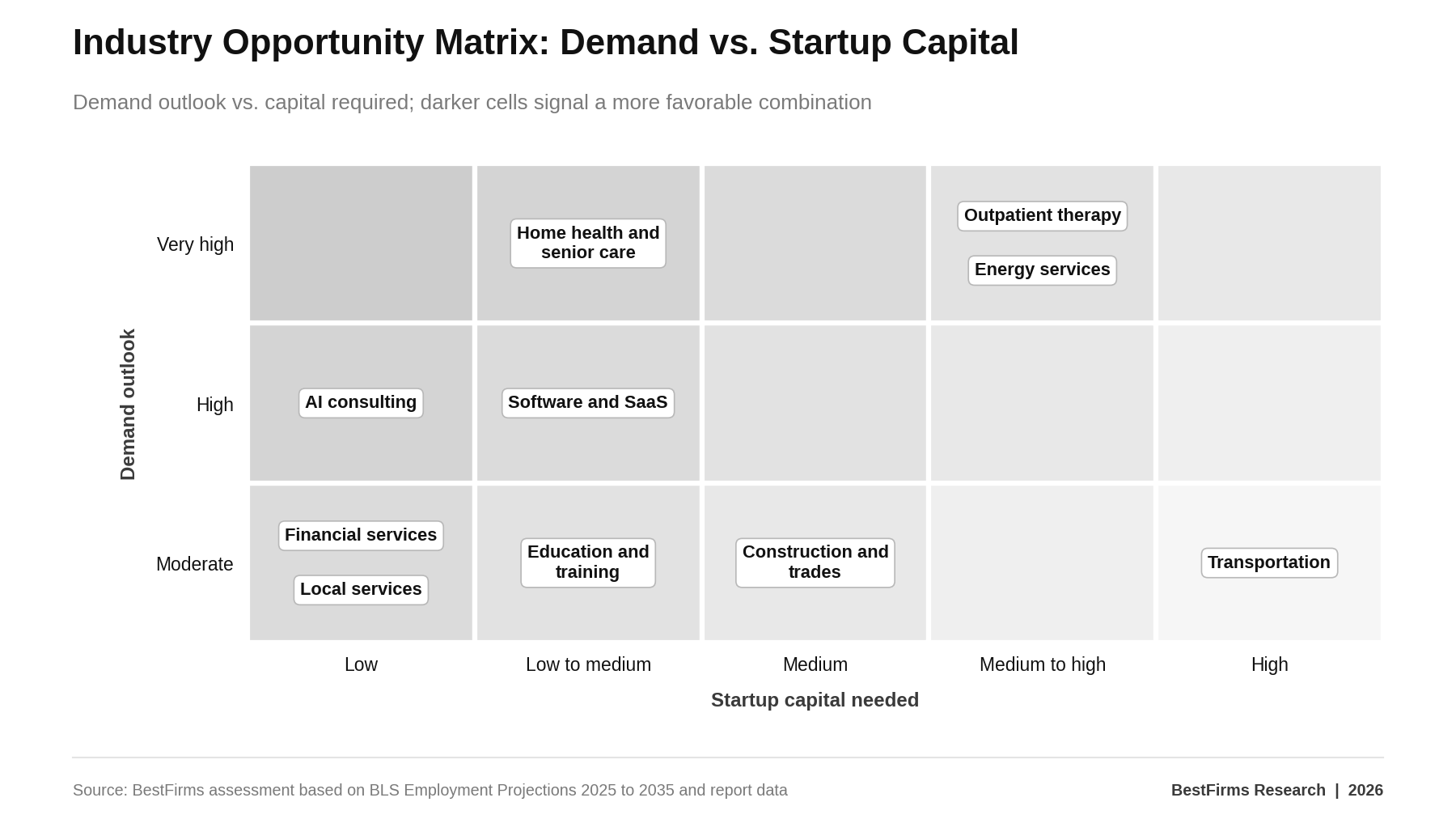
Industry Scorecard
| Industry | Net Margin Benchmark | 5-Year Survival | Demand Outlook | Capital Needed |
|---|---|---|---|---|
| Home health and senior care | 1.25% (healthcare support) | 52.6% | Very high | Low to medium |
| Outpatient therapy | 6.30% (healthcare facilities) | 52.6% | Very high | Medium to high |
| Software and SaaS | 25.49% | 45.7% | High | Low to medium |
| AI consulting | 7.03% (business services) | 50.8% | High | Low |
| Energy services | 12.73% (power) | 56.5% (construction) | Very high | Medium to high |
| Construction and trades | 5.94% to 9.47% | 56.5% | Moderate | Medium |
| Financial services | 22.19% | 53.8% | Moderate | Low |
| Transportation | 3.79% (trucking) | 52.7% | Moderate | High |
| Education and training | 8.79% | 58.2% | Moderate | Low to medium |
| Local services | 7.03% (business services) | 60.0% | Moderate | Low |
(source: NYU Stern, Aswath Damodaran for margins; StartBusinessByState, BLS data for survival; demand outlook and capital ratings are BestFirms assessments)
Section 8: Industries to Approach With Caution
Retail drew 141,241 applications in July 2026 (source: U.S. Census Bureau), yet retail employment is projected to decline 0.2% through 2035 (source: U.S. Bureau of Labor Statistics).
Grocery and food retail averages a 1.32% net margin (source: NYU Stern, Aswath Damodaran), and retail AI adoption trails the national rate.
Retail can still work with a clear niche, strong online sales, and tight inventory control, but the data does not support it as a default choice.
Section 9: Implications for Founders
Match the industry to your credentials: Licensing slows entry in healthcare, electrical work, and financial advice, but it also limits competition.
Validate demand first: Run small tests and look for signs of product-market fit before committing capital.
Model labor costs early: Use the salary benchmarks in Section 5 to set prices that protect margins from day one.
Choose the right structure: Entity choice affects taxes and liability, so compare an LLC vs S Corp in 2026 before filing.
Conclusion
BestFirms produced this report to give founders a data-first view of where new businesses have the best odds in 2026.
The findings point to healthcare and senior care for demand, software and financial services for margins, energy services and skilled trades for infrastructure-driven growth, and local services and education for survival.
Retail remains the most popular choice but the weakest on margins and employment outlook.
The strongest opportunity sits where market growth, healthy margins, and your own skills overlap.
To turn these findings into a specific idea, explore our list of the best businesses to start in 2026.
Read Next
- The best tech recruiting agencies for startups in 2026
- Best Payroll Software
- Fortune 500 Companies List
FAQs
1. What is the best industry to start a business in 2026?
The best industry to start a business in 2026 is healthcare and social assistance, especially home health and senior care. The sector is projected to add over 2.2 million jobs through 2035, the most of any sector (source: U.S. Bureau of Labor Statistics).
2. What is the most profitable industry to start a small business in?
The most profitable industry to start a small business in is software, with system and application software companies averaging a 25.49% net margin (source: NYU Stern, Aswath Damodaran). Non-bank financial services follow at 22.19%.
3. Which industry has the highest business survival rate?
The industry with the highest business survival rate is agriculture, forestry, fishing, and hunting, where 61.8% of new establishments survive five years (source: StartBusinessByState, BLS data). Other services follows closely at 60.0%.
4. What is the fastest-growing industry in the US through 2035?
The fastest-growing industry in the US through 2035 is utilities, with employment projected to grow 9.8% as electricity demand rises (source: U.S. Bureau of Labor Statistics). Private healthcare and social assistance ranks second at 9.5%.
5. What are the best low-cost industries to start a business in?
The best low-cost industries to start a business in are local services, AI consulting, bookkeeping, and tutoring, since most require skills more than equipment. Other services also shows strong five-year survival at 60.0% (source: StartBusinessByState, BLS data).
Disclaimer: This content is provided for informational purposes only and does not constitute legal, financial, or compliance advice. Protocol versions, governance arrangements, and partner counts cited here reflect publicly announced milestones as of September 2026 and are moving quickly. Adoption figures come from vendor and foundation announcements with differing methodologies and should be treated as directional signals rather than guaranteed outcomes.