
Best Businesses to Start in 2026: A Data-Backed Breakdown of Costs, Margins and Demand
Discover the best businesses to start in 2026, with real startup costs, profit margins, survival rates and demand data by sector.
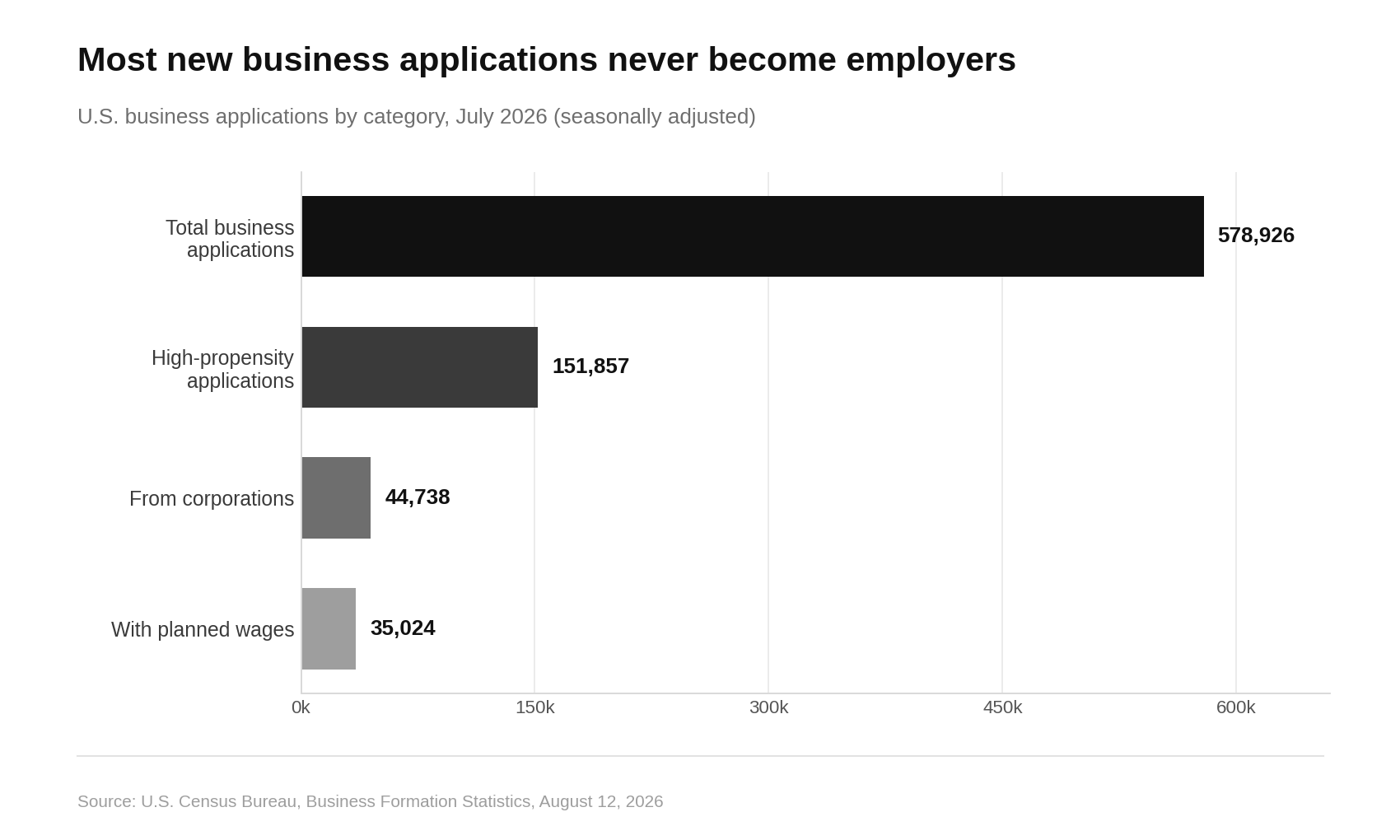
U.S. business applications reached 578,926 in July 2026, an 8.1 percent increase over June, according to Business Formation Statistics released on August 12, 2026 (Source: U.S. Census Bureau).
This report ranks the best businesses to start using federal survival data, published margin benchmarks and current demand signals rather than opinion or anecdote.
Starting a business has rarely been easier or more crowded, and the gap between models that survive and models that quietly close is explained almost entirely by structure: overhead, margin, recurring revenue and whether demand is backed by a demographic or economic trend.
This breakdown covers which businesses to start in 2026, what each one costs to launch, what it realistically pays, and which categories carry the highest failure risk.
Key Takeaways
- U.S. business applications hit 578,926 in July 2026, up 8.1 percent month over month.
- Low-overhead service businesses deliver the highest margins, frequently 40 to 80 percent.
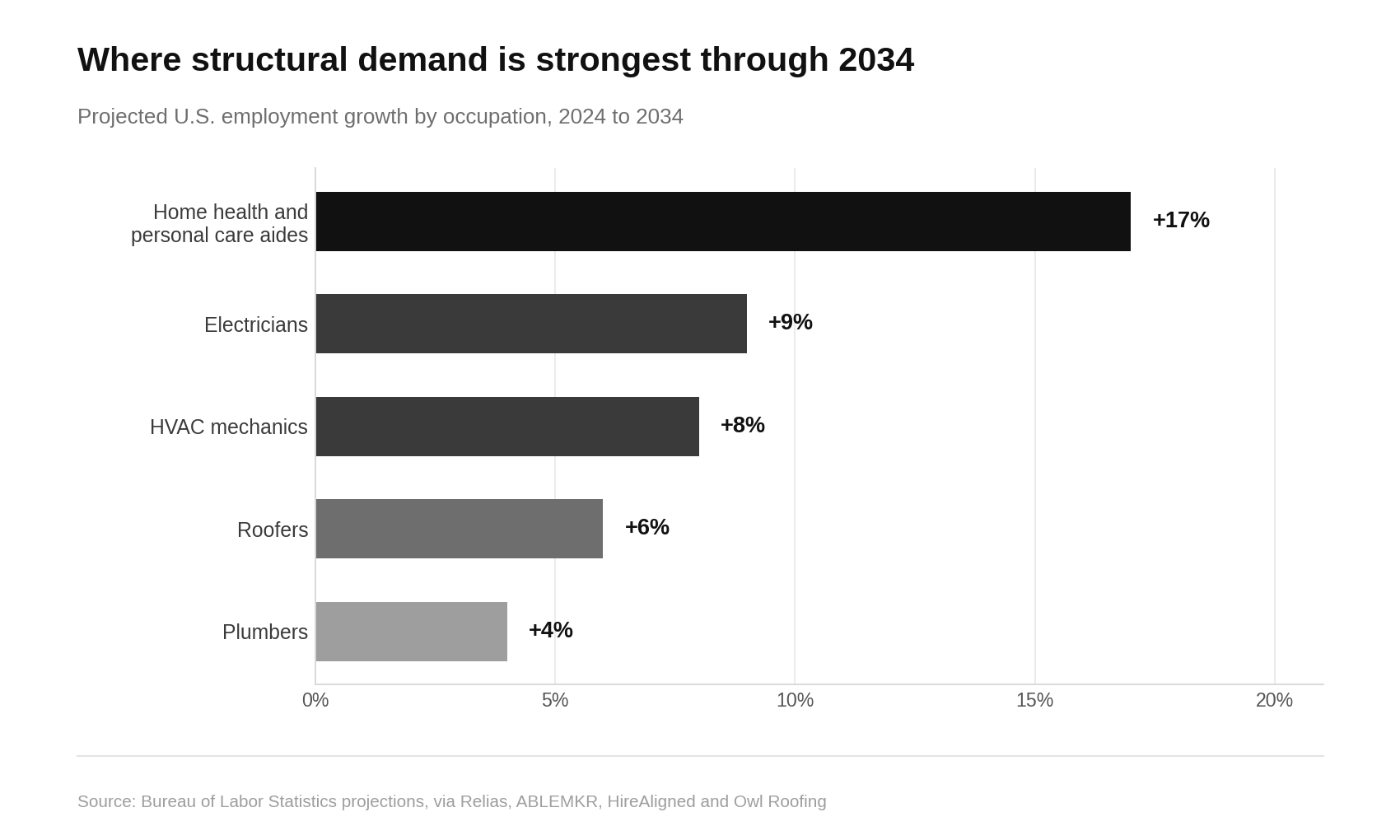
- Skilled trades and home care carry the strongest structural demand through 2034.
- Roughly half of new businesses close by year five, according to BLS data.
- Buying a retiring owner's business removes most first-year failure risk.
The 2026 Business Formation Market at a Glance
New business creation is at a record level, not a recovering one. Total U.S. business applications reached 5,671,836 in 2025, the highest annual figure on record, above the 5,390,816 filed in 2021.
First-half 2026 applications ran 12.1 percent ahead of first-half 2025, pointing toward another record year (Source: CT Acquisitions Business Churn Report).
Volume alone is misleading. The Census Bureau separates out high-propensity applications, meaning those statistically likely to become payroll employers. In July 2026, only 151,857 of the 578,926 total applications carried high-propensity markers, and just 35,024 indicated planned wages. In other words, the large majority of new "businesses" never hire anyone.
Where those applications are concentrated in July 2026 (Source: U.S. Census Bureau):
- Retail trade: 141,241 applications, up 44.5 percent month over month
- Professional services: 81,366
- Construction: 48,972
- Other services: 44,741
- Administrative and support: 37,537
- Transportation and warehousing: 34,982
- Health care and social assistance: 33,953
Construction stands out on quality rather than volume. In 2025, 30.1 percent of all applications nationally carried high-propensity markers, but in construction the share was 51.4 percent, the strongest conversion signal of any major sector (Source: CT Acquisitions).
What Survival Data Says Before You Pick a Model
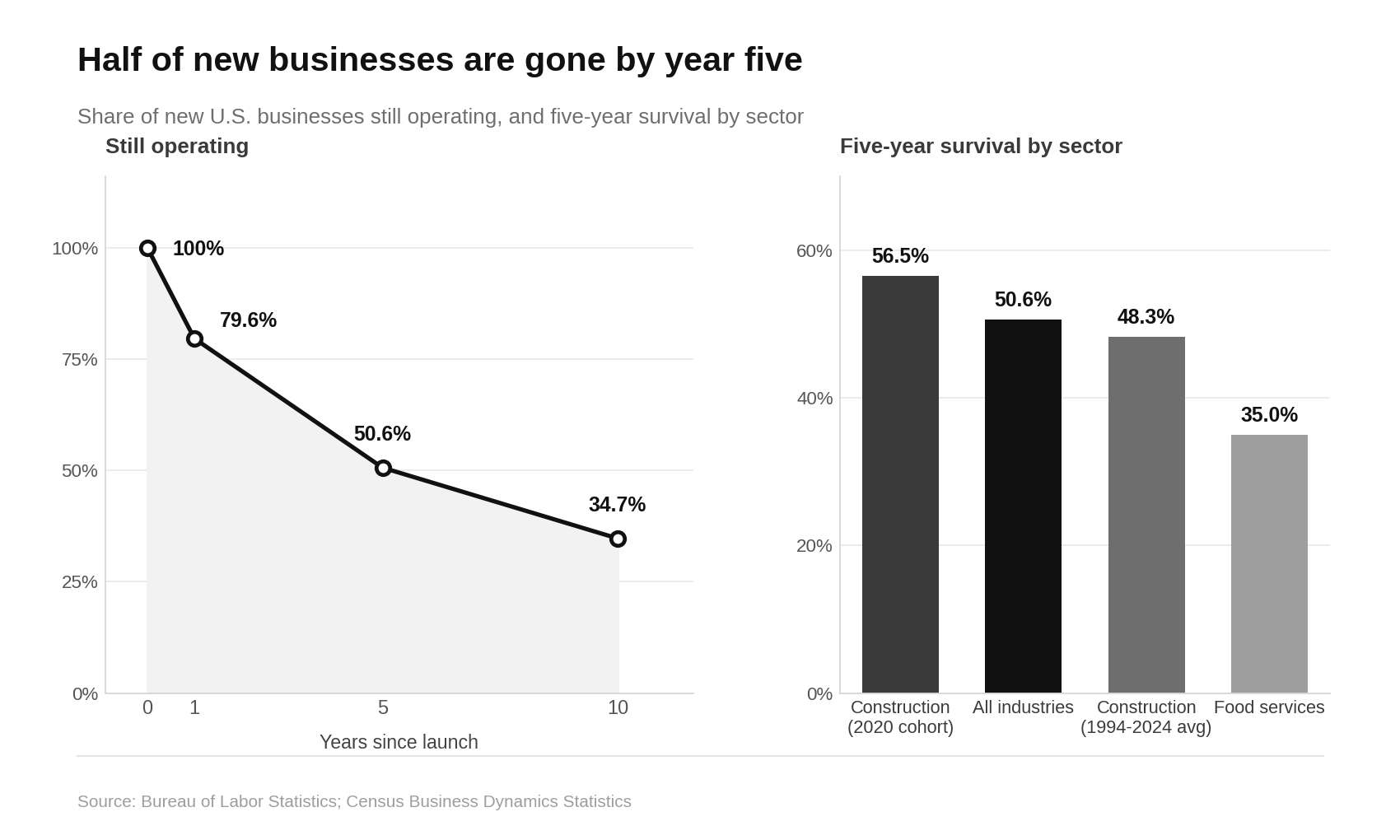
Choosing the right category matters more than execution in the first five years. Bureau of Labor Statistics figures put first-year failure for new U.S. businesses at 20.4 percent, rising to 49.4 percent at five years and 65.3 percent at ten years (Source: MakerStations).
Among businesses that reach year five, 69.5 percent go on to reach year ten, so the risk curve flattens sharply once the model is proven (Source: Stacker).
The spread between sectors is wide:
- Food services and drinking places: roughly 35 percent survive to year five (Source: VantaInsights)
- Transportation and warehousing: close to 25 percent fail in year one, with mining and information close behind at 24 percent (Source: Lendio)
- Construction: 48.3 percent five-year survival averaged across 1994 to 2024 cohorts, with the 2020 cohort reaching 56.5 percent (Source: CT Acquisitions)
- Agriculture, forestry, fishing and hunting: the lowest first-year failure rate at 12.5 percent (Source: MakerStations)
Venture-style startups are a separate category with separate odds. Roughly 90 percent of innovative startups fail over their lifetime, 63 percent of tech startups close within five years, and no market need (42 percent) plus running out of cash (29 percent) account for 71 percent of shutdowns (Source: MakerStations, citing Startup Genome and CB Insights).
How This Report Ranks the Best Businesses
Four filters were applied to every model below:
- Capital required: The SBA puts average first-year cost for a small business at roughly $30,000 to $40,000 (Source: Sum), and 77 percent of owners fund launch from personal savings (Source: StartupOwl, citing Gallup). Lower entry cost means lower downside.
- Margin structure: Healthy small business net margin sits between 7 and 10 percent overall (Source: Vena), but professional services sole proprietors report a 41.0 percent profit margin on $247.8 billion in receipts, the highest of any U.S. category (Source: Hostinger).
- Recurring revenue: Retainers and contracts stabilize cash flow and raise exit multiples, with recurring-revenue businesses typically selling at three to five times higher multiples (Source: PlanArmory).
- Structural demand: Demand backed by demographics, regulation or labor shortage outlasts demand backed by a trend.
Best Businesses to Start: Low-Capital Service Models
These carry the highest margins and lowest capital risk in 2026.
- Bookkeeping and fractional finance. Startup cost of roughly $1,000 to $3,000 for software, certification and insurance. Net margins commonly run 60 to 80 percent (Source: StartCosts). Revenue is monthly and contracted, and client churn is low because switching a bookkeeper is painful.
- Managed IT and technical support. Startup cost of $1,000 to $5,000. Typical pricing runs $100 to $200 per hour for break-fix work, or $500 to $2,000 per month per client for managed service agreements. At 15 managed clients that is $7,500 to $30,000 per month in recurring revenue (Source: Wealthvieu).
- AI implementation and automation consulting. This is the clearest arbitrage in 2026.
Small business AI adoption reached 89 percent by some measures, up from 36 percent in 2023 (Source: Booth Associates, citing U.S. Chamber of Commerce). Yet only 14 percent of small firms have AI embedded in core operations, and about half of AI-using small firms have invested nothing in training or integration (Source: ESLR, citing Goldman Sachs and SBA Office of Advocacy).
Roughly 95 percent of generative AI pilots produce no measurable profit impact (Source: CloudSecureTech). Adoption without integration is the service gap.
- Commercial cleaning. Startup cost of $2,000 to $5,000, among the lowest of any physical service, and commercial contracts carry higher margins than residential work (Source: StartCosts). Revenue is weekly or monthly, and route density improves economics as the client list grows.
- Digital products and online courses. Net margin potential of 30 to 45 percent, with no inventory and no marginal delivery cost (Source: Voted Number One). The tradeoff is acquisition: distribution has to be built before the product monetizes.
Best Businesses to Start: Skilled Trades and Home Services
The trades combine documented labor shortage with pricing power, which is rare.
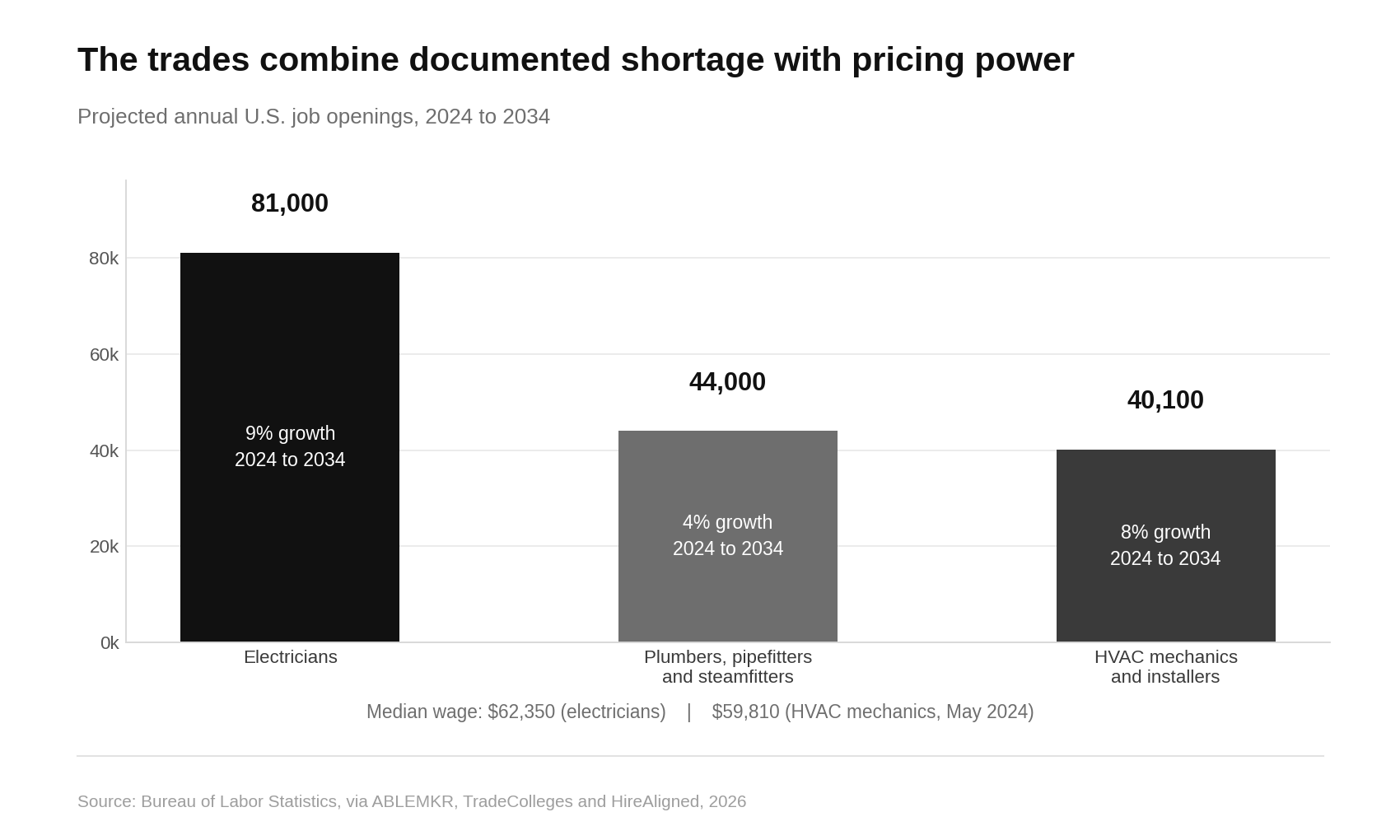
- Electrical contracting. BLS projects 9 percent employment growth from 2024 to 2034 with roughly 81,000 annual openings (Source: ABLEMKR). Median wage is $62,350, and the top 10 percent clear $106,030 (Source: Owl Roofing). Demand is being pulled by data centers, EV charging infrastructure, solar and battery integration.
- HVAC. BLS projects 8 percent growth from 2024 to 2034, described as much faster than average, with about 40,100 openings annually, most of them replacing people who retire or leave the field (Source: HireAligned). Median wage was $59,810 as of May 2024 (Source: PTT).
- Plumbing and pipefitting. Around 44,000 annual openings with 4 percent growth, still ahead of most occupational categories (Source: TradeColleges).
- Roofing and exteriors. 6 percent projected growth through 2034, driven by an aging workforce and storm-damage cycles (Source: Owl Roofing).
- Pressure washing and driveway services. High ticket per job at $200 to $500 and above, modest equipment cost, strong repeat business (Source: StartCosts).
Roughly 22 percent of tradespeople are over 55, and the shortage already adds about two months to a typical home build (Source: Owl Roofing).
Owner-operators in these trades routinely clear six figures, well above the technician median.
Best Businesses to Start: Demographic-Driven Care Services
The aging of the U.S. population is the most predictable demand curve available to a new operator.
The population aged 65 and older reached 61.2 million in 2024, up 3.1 percent year over year. Employment for home health and personal care aides is projected to grow 17 percent from 2024 to 2034, with about 765,800 openings per year, and senior housing occupancy hit 89.5 percent in Q1 2026 while new development remained constrained (Source: Relias).
The U.S. home care market has grown from $77 billion in 2020 to an estimated $113 billion in 2026 (Source: AveeCare).
Viable entry points include non-medical home care agencies, companion and transportation services, specialized memory care support for the roughly 4 million Americans aged 65 and over living with clinical Alzheimer's dementia (Source: Relias), and home modification for aging in place.
Licensing and staffing are the real barriers, not demand.
Buying a Business Instead of Starting One
The strongest risk-adjusted option in 2026 may not be starting at all.
Approximately 2.3 to 3 million baby boomer-owned businesses are expected to change hands over the next decade. That cohort employs around 32 million people and generates close to $6.5 trillion in annual revenue (Source: Forbes).
Nearly half of U.S. small business owners are 55 or older, and only about 54 percent have a succession plan (Source: Fox Business).
McKinsey projects roughly 6 million small and midsize business transitions by 2035, with more than 1 million firms viable for sale representing up to $5 trillion in enterprise value (Source: Become Business Broker, citing McKinsey).
Financing has moved in the buyer's favor. The SBA closed fiscal year 2026 with a record $44.8 billion in guaranteed loans, and more than half of 7(a) loans were under $150,000 (Source: StartupOwl).
As of March 1, 2026, the mandated FICO SBSS score of 165 for loans of $350,000 or less was removed (Source: Stacker, citing NAGGL). An acquired business arrives with customers, cash flow and staff already in place, which sidesteps the 20.4 percent first-year failure rate almost entirely.
Startup Cost and Margin Comparison
| Business model | Typical startup cost | Typical net margin | Primary demand signal |
|---|---|---|---|
| Bookkeeping | $1,000 to $3,000 | 60% to 80% | Recurring compliance need |
| Managed IT | $1,000 to $5,000 | 50% to 70% | SMB tech dependency |
| AI consulting | $1,000 to $5,000 | 50%+ | 89% adoption, 14% integration |
| Commercial cleaning | $2,000 to $5,000 | 25% to 40% | Contracted, route-based |
| Online courses | $500 to $5,000 | 30% to 45% | Scalable delivery |
| HVAC / electrical | $15,000 to $75,000 | 15% to 25% | 40,100 and 81,000 annual openings |
| Home care agency | $40,000 to $100,000 | 15% to 30% | 17% aide employment growth |
| Business acquisition | 10% equity injection | Varies by target | 2.3M+ owners exiting |
Financing the Launch
Most new owners self-fund. For those who cannot, the realistic 2026 options are:
- SBA microloans: up to $50,000, with an average loan size around $13,000 (Source: Peoples Bank), at interest of roughly 8 to 13 percent (Source: US Finance Calculators).
- SBA 7(a) small loans: $50,001 to $350,000 at approximately prime plus 2.75 percent, near 10.75 percent in 2026, with terms up to 10 years for working capital (Source: US Finance Calculators).
- Equity injection requirement: SBA 7(a) startup borrowers generally need at least 10 percent equity, plus a personal guarantee from anyone owning 20 percent or more (Source: Stacker).
Under IRC Section 195, the first $5,000 of startup costs is immediately deductible in the year the business begins operating, phasing out dollar for dollar once total startup costs exceed $50,000 (Source: Sum).
Businesses to Approach With Caution
Some categories are popular precisely because they are visible, not because they work.
Food services and retail post the lowest five-year survival rates in BLS data, driven by thin margins, high fixed costs and dense local competition (Source: VantaInsights).
Retail net margins typically run 2 to 10 percent and restaurants 3 to 9 percent, leaving almost no room for a bad quarter (Source: StartCosts).
General freight trucking swung from a net gain of 12,152 establishments in 2022 to a net loss the following year, the sharpest churn reversal of any vertical measured (Source: CT Acquisitions).
Average outcomes are also worth calibrating against. The average small business owner earns an annual salary of about $69,647, self-employed owners average $51,816, and 32 percent of owners have cut their own pay to keep the business running (Source: Vena).
Conclusion
This report ranks businesses by the structural factors that federal data shows actually determine survival:
- Capital required
- Margin
- Revenue recurrence
- Demand durability.
The best businesses to start in 2026 cluster in three places.
- Low-overhead service models such as bookkeeping, managed IT, AI implementation and commercial cleaning deliver 40 to 80 percent margins on startup costs under $5,000.
- Skilled trades including electrical, HVAC and roofing sit on documented multi-year labor shortages with tens of thousands of unfilled openings each year.
- Care services are backed by a 65-plus population of 61.2 million and 17 percent projected growth in home care employment through 2034.
Buying an existing business from a retiring owner remains the lowest-risk path of all, given that nearly half of new ventures close by year five while an acquired business arrives with revenue already in place.
Read Next
- Best Applicant Tracking Systems in 2026: Ranked by Job, Price, and Whether You Need Scorecards
- Best Time Tracking Software in 2026: Ranked by Job, Price, and Whether You Need Screenshots
- Best AI Website Builders in 2026: Ranked by Job, Price, and Whether You Still Own the Site
FAQs
1. What is the best business to start in 2026?
The best business to start in 2026 is a low-overhead service business with recurring revenue, such as bookkeeping, managed IT or AI implementation consulting, because these models combine startup costs under $5,000 with net margins of 50 to 80 percent and contracted monthly income.
2. What is the most profitable business to start with little money?
The most profitable business to start with little money is professional services delivered from home, where sole proprietors report a 41.0 percent average profit margin, the highest of any U.S. category, with no inventory, no lease and no equipment financing required.
3. How much money do you need to start a business in 2026?
The money you need to start a business in 2026 averages roughly $30,000 to $40,000 in the first year according to the SBA, though service businesses launch for $1,000 to $5,000, and 77 percent of owners fund the launch from personal savings.
4. Which businesses have the highest failure rates?
The businesses with the highest failure rates are food services, retail and transportation. Food services firms survive to year five at roughly 35 percent, transportation sees close to 25 percent fail within year one, and tech startups post a 63 percent five-year closure rate.
5. Is it better to start a business or buy an existing one in 2026?
Whether it is better to start a business or buy an existing one in 2026 depends on capital access. Buying avoids the 20.4 percent first-year failure rate and arrives with customers and cash flow, and with 2.3 to 3 million boomer-owned businesses changing hands, supply currently favors buyers.
Disclaimer: This content is provided for informational purposes only and does not constitute legal, financial, or compliance advice. Protocol versions, governance arrangements, and partner counts cited here reflect publicly announced milestones as of August 2026 and are moving quickly. Adoption figures come from vendor and foundation announcements with differing methodologies and should be treated as directional signals rather than guaranteed outcomes.