
Fortune 500 Companies List 2026
In this report: the full 2026 Fortune 500 companies list breakdown, with revenue, rankings, salaries and state data.

Last updated: 19 October 2026. Added a dated table of all 500 companies (rank, headquarters city, state and revenue) from Fortune's official ranking. List figures reflect the 2026 Fortune 500 published June 3, 2026; state and industry counts are tallied from Fortune's official ranking page; quarterly results for Amazon, Walmart and Nvidia remain the latest company filings available as of early October 2026.
The 500 largest companies in the United States generated a combined $21.0 trillion in revenue and $2.1 trillion in profit in their 2025 fiscal year, representing roughly two-thirds of total US GDP (source: Fortune).
Best Firms tracks the companies, industries, and compensation data that define the US business landscape, and few datasets define it as completely as the Fortune 500. The list, now in its 72nd year, ranks American corporations purely by annual revenue (source: Fortune).
This report breaks down the full 2026 Fortune 500 companies list: who ranks where, how much they earn, where they are headquartered by state, which industries dominate the list, how many people they employ, what they pay, and what has happened to the leaders since the list came out.
Key Takeaways
- Amazon ranks No. 1 with $716.9 billion in 2025 revenue (Fortune).
- The 2026 Fortune 500 earned $21.0 trillion combined, up 5% year over year (Fortune).
- Texas leads all states with 57 Fortune 500 headquarters; California has 56 and New York 53 (Fortune).
- Financials is the largest sector by company count, with 95 firms on the list (Fortune).
- A record 55 Fortune 500 companies are led by women, equal to 11% (Fortune).
What the Fortune 500 Actually Measures
The Fortune 500 ranks the largest US corporations by total revenue for their respective fiscal years.
It is not a ranking of market capitalization, profitability, brand strength, or employee count, which is why a company like Nvidia can be the most valuable business in America while ranking 16th by revenue.
Eligibility requires that a company be incorporated and operate in the United States, and that it files financial statements with a government agency.
That means both publicly traded companies and large private or cooperative entities can qualify, provided their numbers are public.
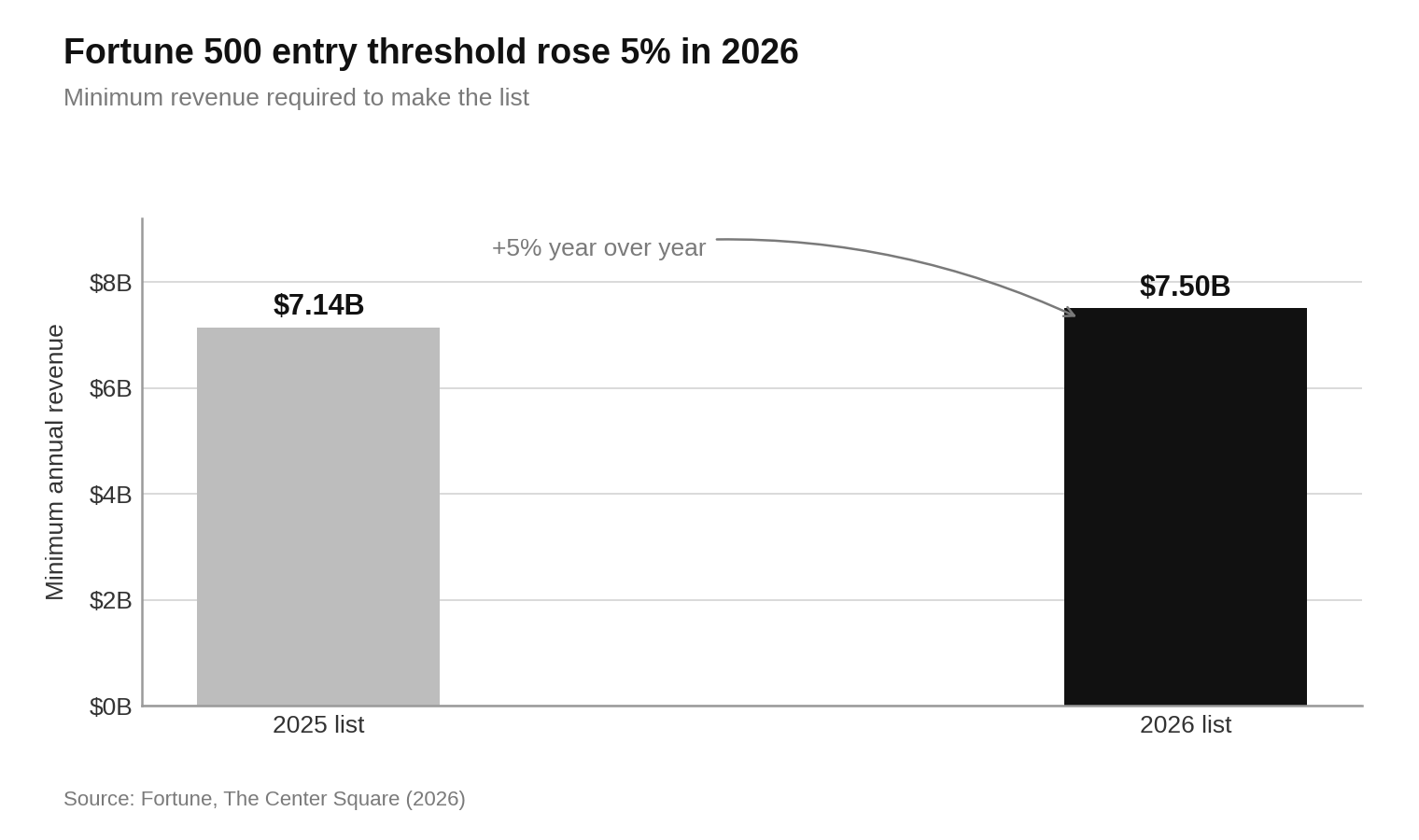
The revenue cutoff moves every year. For the 2026 edition, a company needed at least $7.5 billion in annual revenue to make the list, up 5% from the prior year (source: Fortune).
That floor is the single best indicator of how large-cap America is compounding. A business that would have comfortably made the cut a decade ago now sits well outside it.
The 2026 Fortune 500 in Numbers
The headline aggregates for the 2026 list are the largest ever recorded in nominal terms.
| Metric | 2026 Fortune 500 | Year over year |
|---|---|---|
| Combined revenue | $21.0 trillion | Up 5% |
| Combined profit | $2.1 trillion | Up 12% |
| Combined market value | $55 trillion | Up 19% |
| Total employees | 30.5 million | Down 1% |
| Revenue threshold | $7.5 billion | Up 5% |
| Cities represented | 229 | Across 39 states |
Source: Fortune
Profits grew more than twice as fast as revenue, and market value grew nearly four times as fast, in a fiscal year shaped heavily by AI capital spending.
Understanding which sectors capture that margin expansion is a separate question, and our breakdown of the most profitable industries in 2026 covers where the operating leverage actually sits.
Top 10 Fortune 500 Companies in 2026
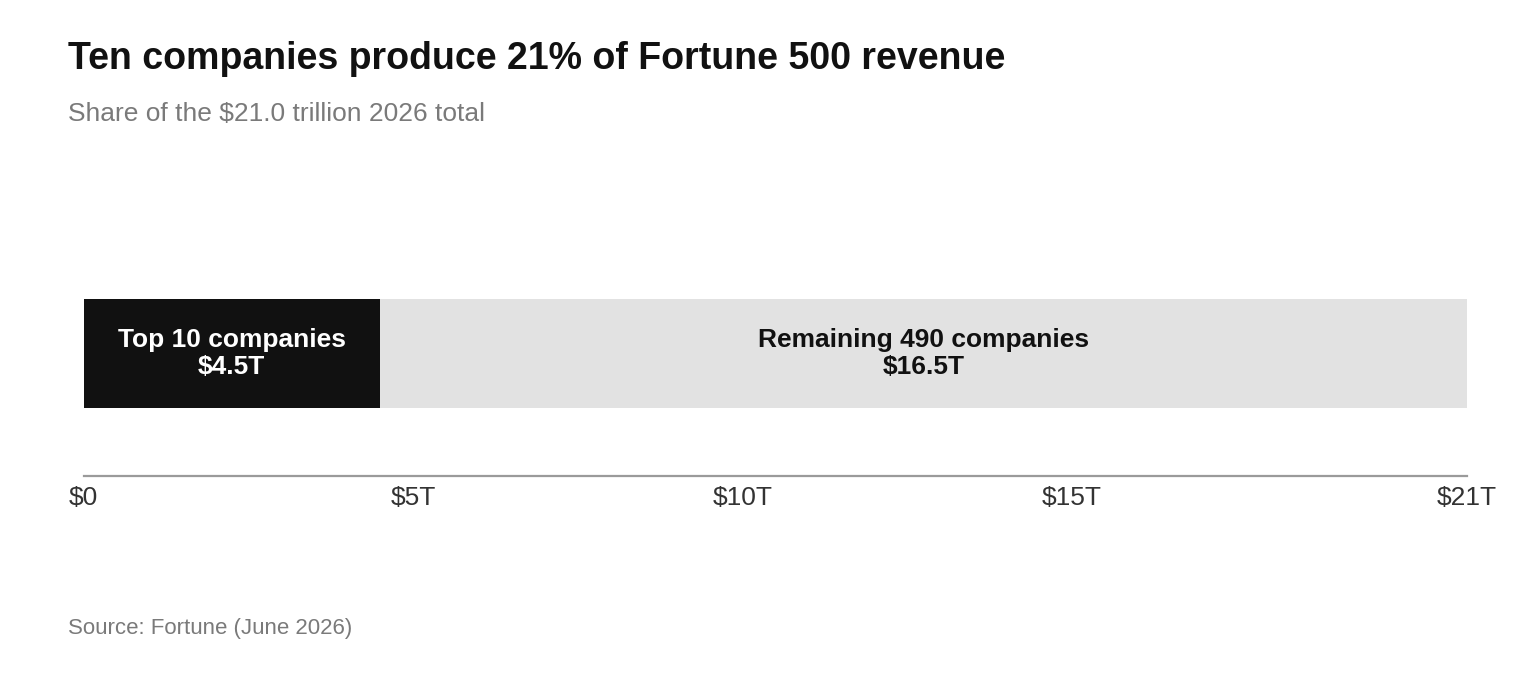
The top ten companies each cleared $320 billion in annual revenue and combined for roughly $4.5 trillion, meaning ten businesses account for more than a fifth of all Fortune 500 revenue (source: Fortune).
| Rank | Company | 2025 revenue | Sector |
|---|---|---|---|
| 1 | Amazon | $716.9 billion | Retailing |
| 2 | Walmart | $713.2 billion | Retailing |
| 3 | UnitedHealth Group | $447.6 billion | Health Care |
| 4 | Apple | $416.2 billion | Technology |
| 5 | Alphabet | $402.8 billion | Technology |
| 6 | CVS Health | $402.1 billion | Health Care |
| 7 | Berkshire Hathaway | $371.4 billion | Financials |
| 8 | McKesson | $359.1 billion | Health Care |
| 9 | Exxon Mobil Holdings | $332.2 billion | Energy |
| 10 | Cencora | $321.3 billion | Health Care |
Source: Fortune ranking.
Half of the top ten are healthcare or healthcare distribution businesses, a structural feature of the list that surprises people expecting a technology sweep.
Healthcare generated $3.6 trillion in combined revenue and placed eight companies in the top 25 (source: Fortune).
Full Fortune 500 Companies List 2026: All 500 Ranked (as of 19 October 2026)
Readers searching for a Fortune 500 companies list PDF usually want one thing: every company on one page, with rank, headquarters and revenue. The table below lists all 500, checked against Fortune's live 2026 ranking on 19 October 2026.
The cutoff company, No. 500 Resideo Technologies of Scottsdale, Arizona, made the list with $7,472 million in 2025 revenue (source: Fortune ranking).
| Rank | Company | HQ city | State | 2025 revenue ($M) |
|---|---|---|---|---|
| 1 | Amazon | Seattle | Washington | $716,924 |
| 2 | Walmart | Bentonville | Arkansas | $713,163 |
| 3 | UnitedHealth Group | Eden Prairie | Minnesota | $447,567 |
| 4 | Apple | Cupertino | California | $416,161 |
| 5 | Alphabet | Mountain View | California | $402,836 |
| 6 | CVS Health | Woonsocket | Rhode Island | $402,067 |
| 7 | Berkshire Hathaway | Omaha | Nebraska | $371,444 |
| 8 | McKesson | Irving | Texas | $359,051 |
| 9 | Exxon Mobil Holdings | Spring | Texas | $332,238 |
| 10 | Cencora | Conshohocken | Pennsylvania | $321,332.8 |
| 11 | Microsoft | Redmond | Washington | $281,724 |
| 12 | JPMorgan Chase | New York | New York | $280,345 |
| 13 | Costco Wholesale | Issaquah | Washington | $275,235 |
| 14 | Cigna Group | Bloomfield | Connecticut | $274,900 |
| 15 | Cardinal Health | Dublin | Ohio | $222,578 |
| 16 | Nvidia | Santa Clara | California | $215,938 |
| 17 | Meta Platforms | Menlo Park | California | $200,966 |
| 18 | Elevance Health | Indianapolis | Indiana | $199,125 |
| 19 | Centene | St. Louis | Missouri | $194,777 |
| 20 | Bank of America | Charlotte | North Carolina | $191,567 |
| 21 | Chevron | Houston | Texas | $189,031 |
| 22 | Ford Motor | Dearborn | Michigan | $187,267 |
| 23 | General Motors | Detroit | Michigan | $185,019 |
| 24 | Citigroup | New York | New York | $168,297 |
| 25 | Home Depot | Atlanta | Georgia | $164,683 |
| 26 | Fannie Mae | Washington | District of Columbia | $159,169 |
| 27 | Kroger | Cincinnati | Ohio | $147,642 |
| 28 | Verizon Communications | New York | New York | $138,191 |
| 29 | Phillips 66 | Houston | Texas | $136,560 |
| 30 | Marathon Petroleum | Findlay | Ohio | $135,222 |
| 31 | StoneX Group | New York | New York | $132,378.2 |
| 32 | State Farm Insurance | Bloomington | Illinois | $132,311.6 |
| 33 | Freddie Mac | McLean | Virginia | $131,688 |
| 34 | Humana | Louisville | Kentucky | $129,664 |
| 35 | AT&T | Dallas | Texas | $125,648 |
| 36 | Goldman Sachs Group | New York | New York | $125,097 |
| 37 | Comcast | Philadelphia | Pennsylvania | $123,707 |
| 38 | Wells Fargo | San Francisco | California | $123,529 |
| 39 | Morgan Stanley | New York | New York | $119,662 |
| 40 | Valero Energy | San Antonio | Texas | $115,939 |
| 41 | Dell Technologies | Round Rock | Texas | $113,538 |
| 42 | Target | Minneapolis | Minnesota | $104,780 |
| 43 | Tesla | Austin | Texas | $94,827 |
| 44 | Walt Disney | Burbank | California | $94,425 |
| 45 | Johnson & Johnson | New Brunswick | New Jersey | $94,193 |
| 46 | PepsiCo | Purchase | New York | $93,925 |
| 47 | Boeing | Arlington | Virginia | $89,463 |
| 48 | UPS | Atlanta | Georgia | $88,661 |
| 49 | RTX | Arlington | Virginia | $88,603 |
| 50 | FedEx | Memphis | Tennessee | $87,926 |
| 51 | Progressive | Mayfield Village | Ohio | $87,671 |
| 52 | Lowe's | Mooresville | North Carolina | $86,286 |
| 53 | Energy Transfer | Dallas | Texas | $85,536 |
| 54 | Procter & Gamble | Cincinnati | Ohio | $84,284 |
| 55 | Sysco | Houston | Texas | $81,370 |
| 56 | American Express | New York | New York | $80,463 |
| 57 | Albertsons | Boise | Idaho | $80,390.9 |
| 58 | Archer Daniels Midland | Chicago | Illinois | $80,269 |
| 59 | MetLife | New York | New York | $77,084 |
| 60 | HCA Healthcare | Nashville | Tennessee | $75,600 |
| 61 | Lockheed Martin | Bethesda | Maryland | $75,048 |
| 62 | New York Life Insurance | New York | New York | $73,145.5 |
| 63 | Capital One Financial | McLean | Virginia | $69,252 |
| 64 | Allstate | Northbrook | Illinois | $67,685 |
| 65 | Caterpillar | Irving | Texas | $67,589 |
| 66 | International Business Machines | Armonk | New York | $67,535 |
| 67 | Eli Lilly | Indianapolis | Indiana | $65,179 |
| 68 | Merck | Rahway | New Jersey | $65,011 |
| 69 | Nationwide | Columbus | Ohio | $64,929.8 |
| 70 | Broadcom | Palo Alto | California | $63,887 |
| 71 | Delta Air Lines | Atlanta | Georgia | $63,364 |
| 72 | Publix Super Markets | Lakeland | Florida | $63,209 |
| 73 | Pfizer | New York | New York | $62,579 |
| 74 | TD Synnex | Fremont | California | $62,508.1 |
| 75 | ConocoPhillips | Houston | Texas | $61,548 |
| 76 | Galaxy Digital | New York | New York | $61,355.7 |
| 77 | AbbVie | North Chicago | Illinois | $61,160 |
| 78 | Prudential Financial | Newark | New Jersey | $60,774 |
| 79 | TJX | Framingham | Massachusetts | $60,372 |
| 80 | Performance Food Group | Richmond | Virginia | $59,898.9 |
| 81 | United Airlines Holdings | Chicago | Illinois | $59,070 |
| 82 | Oracle | Austin | Texas | $57,399 |
| 83 | Cisco Systems | San Jose | California | $56,654 |
| 84 | HP | Palo Alto | California | $55,295 |
| 85 | Charter Communications | Stamford | Connecticut | $54,774 |
| 86 | American Airlines Group | Fort Worth | Texas | $54,633 |
| 87 | Tyson Foods | Springdale | Arkansas | $54,441 |
| 88 | Intel | Santa Clara | California | $52,853 |
| 89 | Enterprise Products Partners | Houston | Texas | $52,596 |
| 90 | Ingram Micro Holding | Irvine | California | $52,556.3 |
| 91 | General Dynamics | Reston | Virginia | $52,550 |
| 92 | Uber Technologies | San Francisco | California | $52,017 |
| 93 | United Services Automobile Assn. | San Antonio | Texas | $51,499.2 |
| 94 | TIAA | New York | New York | $50,604.7 |
| 95 | Liberty Mutual Insurance Group | Boston | Massachusetts | $50,465 |
| 96 | Travelers | New York | New York | $48,828 |
| 97 | Bristol-Myers Squibb | Princeton | New Jersey | $48,194 |
| 98 | Coca-Cola | Atlanta | Georgia | $47,941 |
| 99 | Nike | Beaverton | Oregon | $46,309 |
| 100 | Massachusetts Mutual Life Insurance | Springfield | Massachusetts | $46,053.7 |
| 101 | GE Aerospace | Evendale | Ohio | $45,855 |
| 102 | Deere | Moline | Illinois | $45,684 |
| 103 | Plains GP Holdings | Houston | Texas | $45,579 |
| 104 | Molina Healthcare | Long Beach | California | $45,426 |
| 105 | Netflix | Los Gatos | California | $45,183 |
| 106 | Thermo Fisher Scientific | Waltham | Massachusetts | $44,556 |
| 107 | Abbott Laboratories | Abbott Park | Illinois | $44,328 |
| 108 | Qualcomm | San Diego | California | $44,284 |
| 109 | Northwestern Mutual | Milwaukee | Wisconsin | $43,676.2 |
| 110 | U.S. Bancorp | Minneapolis | Minnesota | $42,861 |
| 111 | Dollar General | Goodlettsville | Tennessee | $42,724.4 |
| 112 | Northrop Grumman | Falls Church | Virginia | $41,954 |
| 113 | Best Buy | Richfield | Minnesota | $41,691 |
| 114 | Salesforce | San Francisco | California | $41,525 |
| 115 | Bank of New York (BNY) | New York | New York | $40,762 |
| 116 | Honeywell Technologies | Charlotte | North Carolina | $40,686 |
| 117 | Philip Morris International | Stamford | Connecticut | $40,648 |
| 118 | CBRE Group | Dallas | Texas | $40,550 |
| 119 | Visa | San Francisco | California | $40,000 |
| 120 | Dow | Midland | Michigan | $39,968 |
| 121 | US Foods Holding | Rosemont | Illinois | $39,424 |
| 122 | Mondelēz International | Chicago | Illinois | $38,537 |
| 123 | Lithia Motors | Medford | Oregon | $38,133.9 |
| 124 | GE Vernova | Cambridge | Massachusetts | $38,068 |
| 125 | Micron Technology | Boise | Idaho | $37,378 |
| 126 | Warner Bros. Discovery | New York | New York | $37,296 |
| 127 | Starbucks | Seattle | Washington | $37,184.4 |
| 128 | World Kinect | Miami | Florida | $36,916.6 |
| 129 | Amgen | Thousand Oaks | California | $36,751 |
| 130 | CHS | Inver Grove Heights | Minnesota | $35,462.6 |
| 131 | Advanced Micro Devices | Santa Clara | California | $34,639 |
| 132 | Coupang | Seattle | Washington | $34,534 |
| 133 | Hewlett Packard Enterprise | Spring | Texas | $34,296 |
| 134 | D.R. Horton | Arlington | Texas | $34,250.4 |
| 135 | Lennar Corporation | Miami | Florida | $34,186.9 |
| 136 | PNC Financial Services Group | Pittsburgh | Pennsylvania | $33,996 |
| 137 | Cummins | Columbus | Indiana | $33,670 |
| 138 | Oneok | Tulsa | Oklahoma | $33,629 |
| 139 | PayPal Holdings | San Jose | California | $33,172 |
| 140 | GuideWell Mutual Holding | Jacksonville | Florida | $32,863.2 |
| 141 | Mastercard | Purchase | New York | $32,791 |
| 142 | Nucor | Charlotte | North Carolina | $32,494 |
| 143 | Apollo Global Management | New York | New York | $32,102 |
| 144 | Penske Automotive Group | Bloomfield Hills | Michigan | $31,808.5 |
| 145 | Duke Energy | Charlotte | North Carolina | $31,794 |
| 146 | United Natural Foods | Providence | Rhode Island | $31,784 |
| 147 | Ferguson Enterprises | Newport News | Virginia | $31,316 |
| 148 | Arrow Electronics | Centennial | Colorado | $30,852.9 |
| 149 | NRG Energy | Houston | Texas | $30,713 |
| 150 | Truist Financial | Charlotte | North Carolina | $30,438 |
| 151 | Jabil | St. Petersburg | Florida | $29,802 |
| 152 | Southern | Atlanta | Georgia | $29,553 |
| 153 | Gilead Sciences | Foster City | California | $29,443 |
| 154 | PBF Energy | Parsippany | New Jersey | $29,332.3 |
| 155 | Paramount Skydance | New York | New York | $28,891 |
| 156 | KKR | New York | New York | $28,888.4 |
| 157 | Quanta Services | Houston | Texas | $28,479.7 |
| 158 | Paccar | Bellevue | Washington | $28,444.8 |
| 159 | Medline | Northfield | Illinois | $28,432 |
| 160 | Applied Materials | Santa Clara | California | $28,368 |
| 160 | Hartford Insurance Group | Hartford | Connecticut | $28,368 |
| 162 | CarMax | Richmond | Virginia | $28,207.3 |
| 163 | Southwest Airlines | Dallas | Texas | $28,063 |
| 164 | Baker Hughes | Houston | Texas | $27,733 |
| 165 | Charles Schwab | Westlake | Texas | $27,675 |
| 166 | AutoNation | Fort Lauderdale | Florida | $27,631.4 |
| 167 | NextEra Energy | Juno Beach | Florida | $27,412 |
| 168 | Marsh & McLennan | New York | New York | $26,981 |
| 169 | Booking Holdings | Norwalk | Connecticut | $26,917 |
| 170 | McDonald's | Chicago | Illinois | $26,885 |
| 171 | HF Sinclair | Dallas | Texas | $26,869 |
| 172 | AIG | New York | New York | $26,775 |
| 173 | Occidental Petroleum | Houston | Texas | $26,446 |
| 174 | Marriott International | Bethesda | Maryland | $26,186 |
| 175 | Jones Lang LaSalle | Chicago | Illinois | $26,115.6 |
| 176 | International Paper | Memphis | Tennessee | $26,104 |
| 177 | Freeport-McMoRan | Phoenix | Arizona | $25,915 |
| 178 | Constellation Energy | Baltimore | Maryland | $25,533 |
| 179 | Waste Management | Houston | Texas | $25,204 |
| 180 | Live Nation Entertainment | Beverly Hills | California | $25,201.4 |
| 181 | Stryker | Portage | Michigan | $25,116 |
| 182 | Dollar Tree | Chesapeake | Virginia | $25,041.8 |
| 183 | 3M | St. Paul | Minnesota | $24,948 |
| 184 | Kraft Heinz | Chicago | Illinois | $24,942 |
| 185 | PG&E | Oakland | California | $24,935 |
| 186 | Danaher | Washington | District of Columbia | $24,568 |
| 187 | Union Pacific | Omaha | Nebraska | $24,510 |
| 188 | Genuine Parts | Atlanta | Georgia | $24,300.1 |
| 189 | Exelon | Chicago | Illinois | $24,258 |
| 190 | BlackRock | New York | New York | $24,216 |
| 191 | Block | Oakland | California | $24,193.7 |
| 192 | Adobe | San Jose | California | $23,769 |
| 193 | Reinsurance Group of America | Chesterfield | Missouri | $23,698 |
| 194 | Sherwin-Williams | Cleveland | Ohio | $23,574.3 |
| 195 | WESCO International | Pittsburgh | Pennsylvania | $23,510.9 |
| 196 | Lear | Southfield | Michigan | $23,259.1 |
| 197 | Synchrony | Stamford | Connecticut | $23,121 |
| 198 | Amphenol | Wallingford | Connecticut | $23,094.7 |
| 199 | Ross Stores | Dublin | California | $22,750.6 |
| 200 | Newmont | Denver | Colorado | $22,669 |
| 201 | EOG Resources | Houston | Texas | $22,632 |
| 202 | State Street | Boston | Massachusetts | $22,628 |
| 203 | Macy's | New York | New York | $22,621 |
| 204 | Group 1 Automotive | Houston | Texas | $22,571.4 |
| 205 | CDW | Vernon Hills | Illinois | $22,424.1 |
| 206 | Avnet | Phoenix | Arizona | $22,200.8 |
| 207 | Halliburton | Houston | Texas | $22,184 |
| 208 | Super Micro Computer | San Jose | California | $21,972 |
| 209 | American Electric Power | Columbus | Ohio | $21,876 |
| 210 | L3Harris Technologies | Melbourne | Florida | $21,865 |
| 211 | Becton Dickinson | Franklin Lakes | New Jersey | $21,840 |
| 212 | Carrier Global | Palm Beach Gardens | Florida | $21,747 |
| 213 | BJ's Wholesale Club | Marlborough | Massachusetts | $21,457.3 |
| 214 | Tenet Healthcare | Dallas | Texas | $21,310 |
| 215 | Fiserv | Milwaukee | Wisconsin | $21,193 |
| 216 | Cognizant Technology Solutions | Teaneck | New Jersey | $21,108 |
| 217 | GE HealthCare | Chicago | Illinois | $20,625 |
| 218 | Automatic Data Processing | Roseland | New Jersey | $20,560.9 |
| 219 | Colgate-Palmolive | New York | New York | $20,382 |
| 220 | Carvana | Tempe | Arizona | $20,322 |
| 221 | Altria Group | Richmond | Virginia | $20,139 |
| 222 | Boston Scientific | Marlborough | Massachusetts | $20,074 |
| 223 | Cheniere Energy | Houston | Texas | $19,976 |
| 224 | Parker-Hannifin | Cleveland | Ohio | $19,850 |
| 225 | Kimberly-Clark | Irving | Texas | $19,701 |
| 226 | American Family Insurance Group | Madison | Wisconsin | $19,556.8 |
| 227 | General Mills | Minneapolis | Minnesota | $19,486.6 |
| 228 | Edison International | Rosemead | California | $19,317 |
| 229 | AutoZone | Memphis | Tennessee | $18,938.7 |
| 230 | Ameriprise Financial | Minneapolis | Minnesota | $18,911 |
| 231 | Intuit | Mountain View | California | $18,831 |
| 232 | Guardian Life Ins. Co. of America | New York | New York | $18,706 |
| 233 | Cleveland-Cliffs | Cleveland | Ohio | $18,610 |
| 234 | Global Partners | Waltham | Massachusetts | $18,561.4 |
| 235 | Aramark | Philadelphia | Pennsylvania | $18,506.3 |
| 236 | Corebridge Financial | Houston | Texas | $18,481 |
| 237 | Loews | New York | New York | $18,454 |
| 238 | Lam Research | Fremont | California | $18,435.6 |
| 239 | Goodyear Tire & Rubber | Akron | Ohio | $18,280 |
| 240 | Pacific Life | Newport Beach | California | $18,235 |
| 241 | Auto-Owners Insurance | Lansing | Michigan | $18,229.3 |
| 242 | Peter Kiewit Sons' | Omaha | Nebraska | $18,213 |
| 243 | Lincoln National | Radnor | Pennsylvania | $18,212 |
| 244 | Steel Dynamics | Fort Wayne | Indiana | $18,176.6 |
| 245 | Emerson Electric | St. Louis | Missouri | $18,016 |
| 246 | Asbury Automotive Group | Atlanta | Georgia | $17,999 |
| 247 | ManpowerGroup | Milwaukee | Wisconsin | $17,957.1 |
| 248 | W.W. Grainger | Lake Forest | Illinois | $17,942 |
| 249 | Jones Financial (Edward Jones) | Des Peres | Missouri | $17,897 |
| 250 | O'Reilly Automotive | Springfield | Missouri | $17,782 |
| 251 | Vistra | Irving | Texas | $17,738 |
| 252 | Texas Instruments | Dallas | Texas | $17,682 |
| 253 | MGM Resorts International | Las Vegas | Nevada | $17,537.7 |
| 254 | Corteva | Indianapolis | Indiana | $17,401 |
| 255 | Universal Health Services | King of Prussia | Pennsylvania | $17,364.8 |
| 256 | PulteGroup | Atlanta | Georgia | $17,312 |
| 257 | Omnicom Group | New York | New York | $17,271.9 |
| 258 | Dick's Sporting Goods | Coraopolis | Pennsylvania | $17,215.1 |
| 259 | Devon Energy | Oklahoma City | Oklahoma | $17,188 |
| 260 | Leidos Holdings | Reston | Virginia | $17,174 |
| 261 | Aflac | Columbus | Georgia | $17,164 |
| 262 | Targa Resources | Houston | Texas | $17,028.3 |
| 263 | Murphy USA | El Dorado | Arkansas | $17,017.9 |
| 264 | LPL Financial Holdings | San Diego | California | $16,989.5 |
| 265 | EMCOR Group | Norwalk | Connecticut | $16,986.4 |
| 266 | Kinder Morgan | Houston | Texas | $16,937 |
| 267 | Consolidated Edison | New York | New York | $16,918 |
| 268 | Keurig Dr Pepper | Frisco | Texas | $16,603 |
| 269 | Republic Services | Phoenix | Arizona | $16,591 |
| 270 | Markel Group | Glen Allen | Virginia | $16,589.3 |
| 271 | Farmers Insurance Exchange | Woodland Hills | California | $16,573.2 |
| 272 | Dominion Energy | Richmond | Virginia | $16,506 |
| 273 | Land O'Lakes | Arden Hills | Minnesota | $16,411.5 |
| 274 | IQVIA Holdings | Durham | North Carolina | $16,310 |
| 275 | Fox | New York | New York | $16,300 |
| 276 | AECOM | Dallas | Texas | $16,237.2 |
| 277 | C.H. Robinson Worldwide | Eden Prairie | Minnesota | $16,232.8 |
| 278 | Bitgo Holdings | Sioux Falls | South Dakota | $16,152.1 |
| 279 | United Rentals | Stamford | Connecticut | $16,099 |
| 280 | Ecolab | St. Paul | Minnesota | $16,081.2 |
| 281 | Illinois Tool Works | Glenview | Illinois | $16,044 |
| 282 | Casey's General Stores | Ankeny | Iowa | $15,940.9 |
| 283 | Raymond James Financial | St. Petersburg | Florida | $15,912 |
| 284 | PPG Industries | Pittsburgh | Pennsylvania | $15,875 |
| 285 | DTE Energy | Detroit | Michigan | $15,814 |
| 286 | Corning | Corning | New York | $15,629 |
| 287 | Principal Financial | Des Moines | Iowa | $15,625.5 |
| 288 | Mutual of Omaha | Omaha | Nebraska | $15,539.5 |
| 289 | Kohl's | Menomonee Falls | Wisconsin | $15,527 |
| 290 | Tractor Supply | Brentwood | Tennessee | $15,524.1 |
| 291 | Whirlpool | Benton Harbor | Michigan | $15,524 |
| 292 | Fluor | Irving | Texas | $15,503 |
| 293 | Gap | San Francisco | California | $15,366 |
| 294 | S&P Global | New York | New York | $15,336 |
| 295 | Ally Financial | Detroit | Michigan | $15,259 |
| 296 | Builders FirstSource | Irving | Texas | $15,190.6 |
| 297 | Sonic Automotive | Charlotte | North Carolina | $15,153.6 |
| 298 | Stanley Black & Decker | New Britain | Connecticut | $15,130.4 |
| 299 | Kenvue | Summit | New Jersey | $15,124 |
| 300 | Kyndryl Holdings | New York | New York | $15,057 |
| 301 | Diamondback Energy | Midland | Texas | $15,026 |
| 302 | EchoStar | Englewood | Colorado | $15,005 |
| 303 | Textron | Providence | Rhode Island | $14,799 |
| 304 | Expedia Group | Seattle | Washington | $14,733 |
| 305 | W.R. Berkley | Greenwich | Connecticut | $14,707.9 |
| 306 | Xcel Energy | Minneapolis | Minnesota | $14,669 |
| 307 | FirstEnergy | Akron | Ohio | $14,627 |
| 308 | Erie Insurance Group | Erie | Pennsylvania | $14,615.9 |
| 309 | First Citizens BancShares | Raleigh | North Carolina | $14,505 |
| 310 | Blackstone | New York | New York | $14,450.3 |
| 311 | Fidelity National Financial | Jacksonville | Florida | $14,445 |
| 312 | Otis Worldwide | Farmington | Connecticut | $14,431 |
| 313 | Amentum Holdings | Chantilly | Virginia | $14,393 |
| 314 | Regeneron Pharmaceuticals | Tarrytown | New York | $14,342.9 |
| 315 | Estée Lauder | New York | New York | $14,326 |
| 316 | BorgWarner | Auburn Hills | Michigan | $14,316 |
| 317 | Northern Trust | Chicago | Illinois | $14,300 |
| 318 | Viatris | Canonsburg | Pennsylvania | $14,299.9 |
| 319 | MasTec | Coral Gables | Florida | $14,299.2 |
| 320 | Reliance | Phoenix | Arizona | $14,294.3 |
| 321 | Western & Southern Financial Group | Cincinnati | Ohio | $14,270.9 |
| 322 | Alaska Air Group | Seattle | Washington | $14,239 |
| 323 | BrightSpring Health Services | Louisville | Kentucky | $14,145 |
| 324 | CSX | Jacksonville | Florida | $14,092 |
| 325 | LKQ | Antioch | Tennessee | $14,046 |
| 326 | Labcorp Holdings | Burlington | North Carolina | $13,951.7 |
| 327 | Arthur J. Gallagher | Rolling Meadows | Illinois | $13,942 |
| 328 | Venture Global | Arlington | Virginia | $13,769 |
| 329 | DoorDash | San Francisco | California | $13,717 |
| 330 | Sempra | San Diego | California | $13,702 |
| 331 | DaVita | Denver | Colorado | $13,643.1 |
| 332 | Eversource Energy | Springfield | Massachusetts | $13,547.2 |
| 333 | ServiceNow | Santa Clara | California | $13,278 |
| 334 | M&T Bank | Buffalo | New York | $13,228 |
| 335 | Henry Schein | Melville | New York | $13,184 |
| 336 | GXO Logistics | Greenwich | Connecticut | $13,178 |
| 337 | Ball | Westminster | Colorado | $13,161 |
| 338 | Unum Group | Chattanooga | Tennessee | $13,075.5 |
| 339 | Las Vegas Sands | Las Vegas | Nevada | $13,017 |
| 340 | Entergy | New Orleans | Louisiana | $12,946.7 |
| 341 | Fifth Third Bancorp | Cincinnati | Ohio | $12,938 |
| 342 | Graybar Electric | St. Louis | Missouri | $12,875.6 |
| 343 | DXC Technology | Ashburn | Virginia | $12,871 |
| 344 | Alcoa | Pittsburgh | Pennsylvania | $12,831 |
| 345 | Assurant | Atlanta | Georgia | $12,814.3 |
| 346 | Ryder System | Coral Gables | Florida | $12,665 |
| 347 | Intercontinental Exchange | Atlanta | Georgia | $12,640 |
| 348 | Cincinnati Financial | Fairfield | Ohio | $12,631.5 |
| 349 | Chewy | Plantation | Florida | $12,601.5 |
| 350 | Community Health Systems | Franklin | Tennessee | $12,485 |
| 350 | Huntington Bancshares | Columbus | Ohio | $12,485 |
| 352 | Huntington Ingalls Industries | Newport News | Virginia | $12,484 |
| 353 | Wayfair | Boston | Massachusetts | $12,457 |
| 354 | Lumen Technologies | Monroe | Louisiana | $12,402 |
| 355 | Ulta Beauty | Bolingbrook | Illinois | $12,392.8 |
| 356 | Crown Holdings | Tampa | Florida | $12,365 |
| 357 | Airbnb | San Francisco | California | $12,241 |
| 358 | AES | Arlington | Virginia | $12,233 |
| 359 | Norfolk Southern | Atlanta | Georgia | $12,180 |
| 360 | Public Service Enterprise Group | Newark | New Jersey | $12,168 |
| 361 | KLA | Milpitas | California | $12,156.2 |
| 362 | Expand Energy | Oklahoma City | Oklahoma | $12,124 |
| 363 | Hormel Foods | Austin | Minnesota | $12,106.2 |
| 364 | Darden Restaurants | Orlando | Florida | $12,076.7 |
| 365 | Citizens Financial Group | Providence | Rhode Island | $12,057 |
| 366 | Mosaic | Tampa | Florida | $12,052.4 |
| 367 | Hilton Worldwide Holdings | McLean | Virginia | $12,039 |
| 368 | Air Products & Chemicals | Allentown | Pennsylvania | $12,037.3 |
| 369 | Jacobs Solutions | Dallas | Texas | $12,029.8 |
| 370 | Vertex Pharmaceuticals | Boston | Massachusetts | $12,001.3 |
| 371 | J.B. Hunt Transport Services | Lowell | Arkansas | $11,999.1 |
| 372 | Booz Allen Hamilton Holding | McLean | Virginia | $11,980 |
| 373 | Williams | Tulsa | Oklahoma | $11,950 |
| 374 | Chipotle Mexican Grill | Newport Beach | California | $11,925.6 |
| 375 | Yum China Holdings | Plano | Texas | $11,797 |
| 376 | Oscar Health | New York | New York | $11,701.4 |
| 377 | Hershey | Hershey | Pennsylvania | $11,692.6 |
| 378 | Motorola Solutions | Chicago | Illinois | $11,682 |
| 379 | Equitable Holdings | New York | New York | $11,665 |
| 380 | Avis Budget Group | Parsippany | New Jersey | $11,652 |
| 381 | Conagra Brands | Chicago | Illinois | $11,612.8 |
| 382 | Baxter International | Deerfield | Illinois | $11,596 |
| 383 | Burlington Stores | Burlington | New Jersey | $11,566.9 |
| 384 | Caesars Entertainment | Reno | Nevada | $11,486 |
| 385 | Owens Corning | Toledo | Ohio | $11,279 |
| 386 | KeyCorp | Cleveland | Ohio | $11,228 |
| 387 | Thrivent Financial | Minneapolis | Minnesota | $11,179.1 |
| 388 | Westlake | Houston | Texas | $11,170 |
| 389 | Westinghouse Air Brake | Pittsburgh | Pennsylvania | $11,167 |
| 390 | Molson Coors Beverage | Chicago | Illinois | $11,140.8 |
| 391 | Lululemon athletica | Groveport | Ohio | $11,102.6 |
| 392 | FM | Johnston | Rhode Island | $11,101.7 |
| 393 | Ebay | San Jose | California | $11,100 |
| 394 | Expeditors Intl. of Washington | Bellevue | Washington | $11,069 |
| 395 | Quest Diagnostics | Secaucus | New Jersey | $11,035 |
| 396 | Analog Devices | Wilmington | Massachusetts | $11,019.7 |
| 397 | Andersons | Maumee | Ohio | $11,008.9 |
| 398 | Gold.com | Costa Mesa | California | $10,978.6 |
| 399 | Toll Brothers | Fort Washington | Pennsylvania | $10,966.7 |
| 400 | International Flavors & Fragrances | New York | New York | $10,890 |
| 401 | Welltower | Toledo | Ohio | $10,838 |
| 402 | Jefferies Financial Group | New York | New York | $10,823.7 |
| 403 | Autoliv | Auburn Hills | Michigan | $10,815 |
| 404 | Mohawk Industries | Calhoun | Georgia | $10,785.4 |
| 405 | Delek US Holdings | Brentwood | Tennessee | $10,722.9 |
| 406 | Fidelity National Information (FIS) | Jacksonville | Florida | $10,677 |
| 407 | Accendra Health | Glen Allen | Virginia | $10,671.7 |
| 408 | American Tower | Boston | Massachusetts | $10,644.6 |
| 409 | NVR | Reston | Virginia | $10,443.3 |
| 410 | Interactive Brokers Group | Greenwich | Connecticut | $10,424 |
| 411 | Oshkosh | Oshkosh | Wisconsin | $10,422.3 |
| 412 | Cintas | Cincinnati | Ohio | $10,340.2 |
| 413 | Campbell's | Camden | New Jersey | $10,253 |
| 414 | Vertiv Holdings | Westerville | Ohio | $10,229.9 |
| 415 | Global Payments | Atlanta | Georgia | $10,215.6 |
| 416 | Constellation Brands | Rochester | New York | $10,208.7 |
| 417 | AGCO | Duluth | Georgia | $10,082 |
| 418 | Intuitive Surgical | Sunnyvale | California | $10,064.7 |
| 419 | Ace Hardware | Oak Brook | Illinois | $10,043.6 |
| 420 | Dana | Maumee | Ohio | $9,998 |
| 421 | Biogen | Cambridge | Massachusetts | $9,890.6 |
| 422 | News Corp. | New York | New York | $9,845 |
| 423 | Concentrix | Newark | California | $9,825.8 |
| 424 | WEC Energy Group | Milwaukee | Wisconsin | $9,800.1 |
| 425 | VF | Denver | Colorado | $9,749.2 |
| 426 | Seaboard | Merriam | Kansas | $9,746 |
| 427 | Icahn Enterprises | Sunny Isles Beach | Florida | $9,658 |
| 428 | Regions Financial | Birmingham | Alabama | $9,608 |
| 429 | Thor Industries | Elkhart | Indiana | $9,579.5 |
| 430 | Workday | Pleasanton | California | $9,552 |
| 431 | Celanese | Irving | Texas | $9,544 |
| 432 | Western Digital | San Jose | California | $9,520 |
| 433 | QVC Group | West Chester | Pennsylvania | $9,497 |
| 434 | Zoetis | Parsippany | New Jersey | $9,467 |
| 435 | CenterPoint Energy | Houston | Texas | $9,357 |
| 436 | Equinix | Redwood City | California | $9,260 |
| 437 | Palo Alto Networks | Santa Clara | California | $9,221.5 |
| 438 | APA | Houston | Texas | $9,220 |
| 439 | Old Republic International | Chicago | Illinois | $9,136.3 |
| 440 | Comfort Systems USA | Houston | Texas | $9,101.6 |
| 441 | JetBlue Airways | Long Island City | New York | $9,062 |
| 442 | PPL | Allentown | Pennsylvania | $9,042 |
| 443 | Xylem | Washington | District of Columbia | $9,035 |
| 444 | Arista Networks | Santa Clara | California | $9,005.7 |
| 445 | Packaging Corp. of America | Lake Forest | Illinois | $8,989.3 |
| 446 | PVH | New York | New York | $8,950.2 |
| 447 | Ovintiv | Denver | Colorado | $8,908 |
| 448 | Avery Dennison | Mentor | Ohio | $8,855.5 |
| 449 | TransDigm Group | Cleveland | Ohio | $8,831 |
| 450 | Sprouts Farmers Market | Phoenix | Arizona | $8,806.2 |
| 451 | Prologis | San Francisco | California | $8,790.1 |
| 452 | Franklin Templeton | San Mateo | California | $8,770.7 |
| 453 | Eastman Chemical | Kingsport | Tennessee | $8,752 |
| 454 | ABM Industries | New York | New York | $8,745.9 |
| 455 | NOV | Houston | Texas | $8,744 |
| 456 | J.M. Smucker | Orrville | Ohio | $8,726.1 |
| 457 | Securian Financial Group | St. Paul | Minnesota | $8,663.4 |
| 458 | EQT | Pittsburgh | Pennsylvania | $8,644.2 |
| 459 | CACI International | Reston | Virginia | $8,627.8 |
| 460 | Graphic Packaging Holding | Atlanta | Georgia | $8,617 |
| 461 | Advance Auto Parts | Raleigh | North Carolina | $8,601 |
| 462 | Optimum Communications | Long Island City | New York | $8,590.5 |
| 463 | Sirius XM Holdings | New York | New York | $8,558 |
| 464 | CMS Energy | Jackson | Michigan | $8,539 |
| 465 | Hertz Global Holdings | Estero | Florida | $8,504 |
| 466 | Ameren | St. Louis | Missouri | $8,470 |
| 467 | Rockwell Automation | Milwaukee | Wisconsin | $8,342 |
| 468 | Solventum | Eagan | Minnesota | $8,325 |
| 469 | Monster Beverage | Corona | California | $8,294.3 |
| 470 | Nasdaq | New York | New York | $8,262 |
| 471 | Howmet Aerospace | Pittsburgh | Pennsylvania | $8,252 |
| 472 | Insight Enterprises | Chandler | Arizona | $8,247.2 |
| 473 | Zimmer Biomet Holdings | Warsaw | Indiana | $8,231.5 |
| 474 | Yum Brands | Louisville | Kentucky | $8,214 |
| 475 | Fastenal | Winona | Minnesota | $8,200.5 |
| 476 | Marvell Technology | Wilmington | Delaware | $8,194.6 |
| 477 | Voya Financial | New York | New York | $8,189 |
| 478 | American Financial Group | Cincinnati | Ohio | $8,174 |
| 479 | Post Holdings | St. Louis | Missouri | $8,158.1 |
| 480 | XPO | Greenwich | Connecticut | $8,157 |
| 481 | DuPont | Wilmington | Delaware | $8,146 |
| 482 | Sanmina | San Jose | California | $8,128.4 |
| 483 | Taylor Morrison Home | Scottsdale | Arizona | $8,121.5 |
| 484 | Dover | Downers Grove | Illinois | $8,092.6 |
| 485 | Vulcan Materials | Birmingham | Alabama | $7,941.1 |
| 486 | APi Group | New Brighton | Minnesota | $7,911 |
| 487 | Roper Technologies | Sarasota | Florida | $7,902.5 |
| 488 | KBR | Houston | Texas | $7,853 |
| 489 | Sonoco Products | Hartsville | South Carolina | $7,839.4 |
| 490 | Williams-Sonoma | San Francisco | California | $7,806.8 |
| 491 | Commercial Metals | Irving | Texas | $7,798.5 |
| 492 | Moody's | New York | New York | $7,718 |
| 493 | Continental Resources | Oklahoma City | Oklahoma | $7,693.6 |
| 494 | Ingersoll Rand | Davidson | North Carolina | $7,650.9 |
| 495 | Core & Main | St. Louis | Missouri | $7,647 |
| 496 | Coterra Energy | Houston | Texas | $7,645 |
| 497 | Primoris Services | Dallas | Texas | $7,574.9 |
| 498 | Masco | Livonia | Michigan | $7,562 |
| 499 | Somnigroup International | Dallas | Texas | $7,476.5 |
| 500 | Resideo Technologies | Scottsdale | Arizona | $7,472 |
Source: 2026 Fortune 500 ranking as published by Fortune on June 3, 2026, checked 19 October 2026. Revenue is each company's fiscal 2025 revenue in millions of US dollars. Fortune lists two ties (No. 160 and No. 350), so ranks 161 and 351 are not used.
For where these headquarters cluster, see Fortune 500 Companies by City 2026. For how the same companies rank by stock value rather than revenue, see the largest companies by market cap in 2026.
Amazon Ends Walmart's 13-Year Run at No. 1
The defining change on the 2026 list is at the very top.
Amazon posted $716.9 billion in 2025 revenue, a 12.4% jump, edging out Walmart at $713.2 billion despite Walmart recording its highest annual revenue ever (source: Fortune ranking).
Three details make this more than a scoreboard change:
- Amazon debuted on the Fortune 500 at No. 492 just over two decades ago.
- Only four companies have ever held No. 1 in 72 years: General Motors, ExxonMobil, Walmart, and now Amazon.
- Walmart fell to No. 2 for the first time since 2012 (source: Fortune).
Alphabet moved up two spots to No. 5 and repeated as the most profitable company on the list, with $132 billion in earnings, a Fortune 500 record (source: Fortune).
Microsoft climbed one position to No. 11, its highest ranking ever. Nvidia, at No. 16, became the first Fortune 500 company to reach a $4 trillion market value and overtook Apple as the most valuable company in America, having debuted at No. 387 in 2017 (source: Fortune).
Since the List: Latest Quarterly Results (as of October 2026)
The Fortune 500 ranks fiscal 2025 revenue, so it's a snapshot. Filings released since June show whether the leaders are holding their positions. As of early October 2026, Q2 results remain the latest full-quarter releases for the three companies below.
| Company (2026 rank) | Latest quarter | Revenue | Year over year |
|---|---|---|---|
| Amazon (No. 1) | Q2 2026, reported Jul 30, 2026 | $200.6 billion | Up 20% |
| Walmart (No. 2) | Q2 FY27, reported Aug 20, 2026 | $187.9 billion | Up 5.9% |
| Nvidia (No. 16) | Q2 FY27, reported Aug 26, 2026 | $96.2 billion | Up 106% |
Sources: Amazon, Walmart, Nvidia
Amazon is pulling away. Its Q2 2026 net sales rose 20% to $200.6 billion, and AWS segment sales grew 37% to $42.2 billion (source: Amazon).
Walmart is still growing, just more slowly. Total revenue for the quarter ended July 31, 2026 was $187.9 billion, up 5.9% (source: Walmart).
Nvidia is the fastest climber to watch for the 2027 list. Revenue for the quarter ended July 26, 2026 was $96.2 billion, up 106% year over year, with GAAP net income of $59.7 billion (source: Nvidia).
If those run rates hold, Nvidia's fiscal 2027 revenue would place it far above its current No. 16 slot, though Fortune ranks each company on its own fiscal year, so the timing of any jump depends on when its fiscal year closes.
Fortune 500 Companies by State and by Industry
After who ranks where, the next questions readers ask are where those companies are headquartered and which industries they belong to. The counts below are tallied from Fortune's official 2026 ranking.
Fortune 500 companies by state
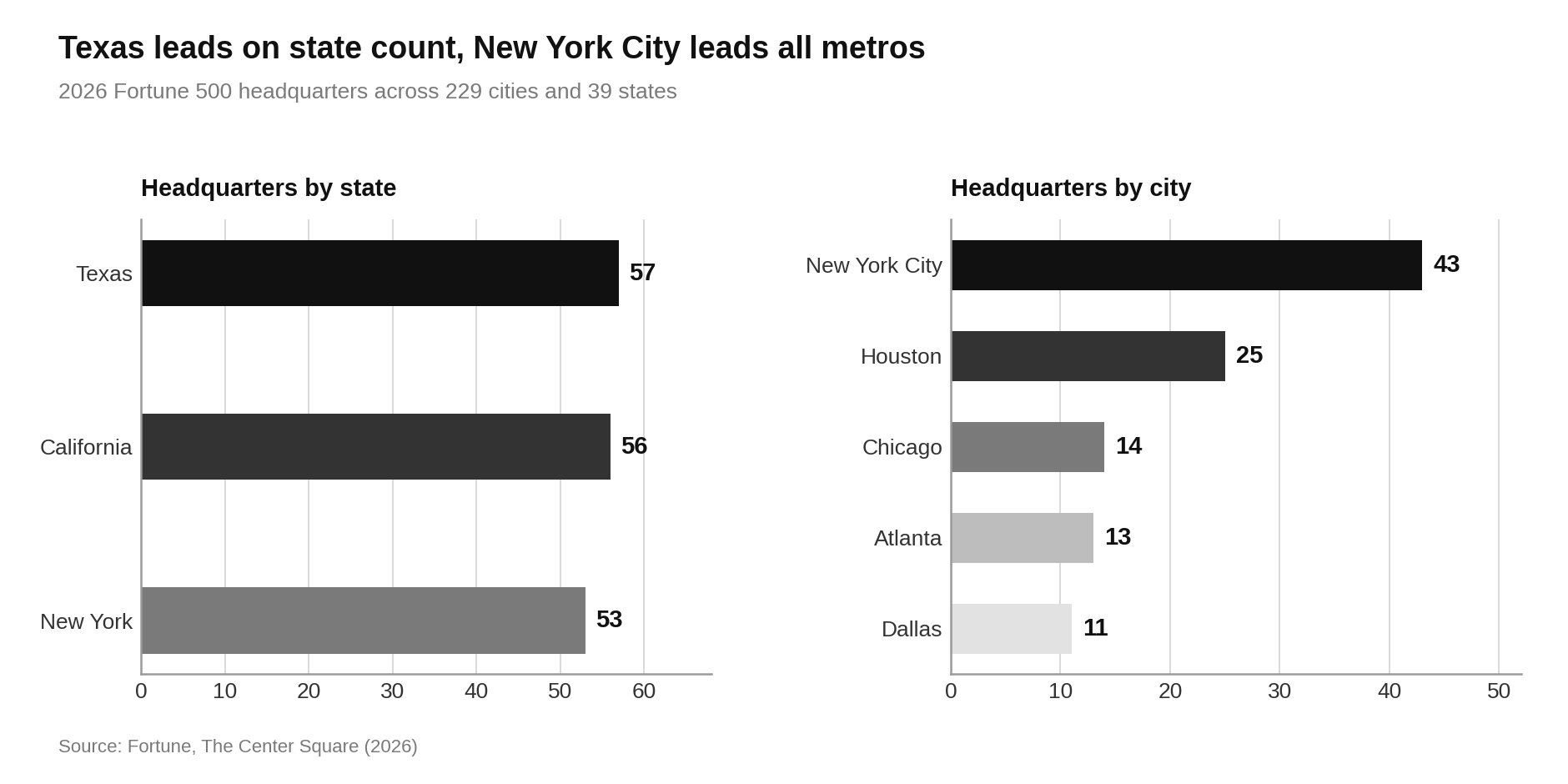
Texas leads with 57 headquarters and about $2.8 trillion in combined revenue, ahead of California's 56 companies (~$2.7 trillion) and New York's 53 (~$2.2 trillion) (source: Fortune).
| Rank | State | Headquarters |
|---|---|---|
| 1 | Texas | 57 |
| 2 | California | 56 |
| 3 | New York | 53 |
| 4 | Ohio | 29 |
| 5 | Illinois | 29 |
| 6 | Virginia | 24 |
| 7 | Florida | 22 |
| 8 | Pennsylvania | 20 |
| 9 | Minnesota | 18 |
| 10 | Georgia | 16 |
| 11 | Connecticut | 15 |
| 12 | New Jersey | 15 |
| 13 | Massachusetts | 15 |
| 14 | Michigan | 14 |
| 15 | North Carolina | 12 |
Source: counts tallied from the 2026 Fortune 500 ranking; Texas, California and New York totals also match Fortune's state breakdown and June 3 release.
The list's headquarters sit in 38 US states plus the District of Columbia (3 companies). Twelve states have none: Alaska, Hawaii, Maine, Mississippi, Montana, New Hampshire, New Mexico, North Dakota, Utah, Vermont, West Virginia and Wyoming (source: Fortune ranking).
California still leads on nearly every other measure: its Fortune 500 companies are the most profitable at $647 billion, the most valuable at $20 trillion, and employ more people than any other state at 2.8 million workers (source: Fortune).
At the city level, New York City hosts the most headquarters with 43, followed by Houston with 25, Chicago with 14, Atlanta with 13, and Dallas with 11 (source: Fortune).
Texas is the only state placing two cities in the top five.
No California city ranks in the top five, which reflects how distributed the state's corporate base is across the Bay Area, Los Angeles, and San Diego rather than concentrated in one metro.
See the full state-by-state ranking in Fortune 500 Companies by State 2026.
Fortune 500 companies by industry
Financials is the single largest sector by company count, with 95 companies, up two from the prior year. Those firms produced $4.1 trillion in revenue, up 7%, and more than $474 billion in profit, up 3% (source: Fortune).
| Sector | Companies |
|---|---|
| Financials | 95 |
| Energy | 61 |
| Technology | 53 |
| Health Care | 47 |
| Retailing | 41 |
| Food, Beverages & Tobacco | 24 |
| Industrials | 20 |
| Wholesalers | 18 |
| Business Services | 18 |
| Transportation | 17 |
| Materials | 17 |
| Engineering & Construction | 15 |
| Chemicals | 12 |
| Aerospace & Defense | 11 |
| Hotels, Restaurants & Leisure | 11 |
| Motor Vehicles & Parts | 10 |
| Media | 8 |
| Household Products | 8 |
| Telecommunications | 7 |
| Food & Drug Stores | 4 |
| Apparel | 3 |
Source: sector labels and company counts tallied from the 2026 Fortune 500 ranking. Financials' 95-company lead matches Fortune's June 3 release.
Company count is not the same as economic weight. Healthcare generated $3.6 trillion in combined revenue and placed eight companies in the top 25 (source: Fortune). Retailing remains the largest sector by headcount at just over 7 million employees; technology is second at 3.8 million; financials employ about 3.5 million (source: Fortune).
Newcomers, Debuts, and the Biggest Movers
Twelve companies debuted on the 2026 Fortune 500. The most notable entries show how quickly the composition of the list is shifting (source: Fortune).
| Company | 2026 rank | Category |
|---|---|---|
| Galaxy Digital | 76 | Digital assets |
| Medline | 159 | Healthcare supply |
| Amentum Holdings | 313 | Engineering services |
| Venture Global | 328 | LNG energy |
| Arista Networks | 444 | Networking hardware |
Source: Fortune
Carvana made the largest single jump on the list, climbing 94 places to No. 220 on 49% revenue growth (source: Fortune).
Amphenol rose 89 spots and Super Micro Computer rose 84, both riding AI hardware demand.
The churn also cuts the other way. Walgreens Boots Alliance dropped off the list after being acquired by Sycamore Partners in August 2025, and Nordstrom exited in a take-private deal (source: Fortune).
The 22 companies that departed collectively employed 659,640 people. Their 22 replacements employed 317,414 (source: Fortune).
Two of the newcomers employ fewer than 1,000 people each (Fortune).
BitGo Holdings entered at No. 278 with 603 employees, and Galaxy Digital cracked the Fortune 100 at No. 76 with 700 (source: Fortune).
Employment: Record Revenue, Fewer Workers
The single most important trend on the 2026 list is that headcount fell while every financial metric rose.
Fortune 500 employment declined 1% to 30.5 million, a loss of 301,049 workers and the second consecutive annual decline (source: Fortune).
Since 1995, when Fortune first included service firms, headcount declines had only occurred during or after recessions.
| Employment metric | 2026 figure |
|---|---|
| Total headcount | 30.5 million, down 1% |
| Net workers lost | 301,049 |
| Revenue per employee | $687,094 |
| Profit per employee | $68,743 |
Source: Fortune
Both revenue per employee and profit per employee are all-time records.
Among companies that stayed on the list from 2025 to 2026, employment grew only 0.1%, a low-hire, low-fire pattern. Amazon added 20,000 employees, up 1.3% (source: Fortune).
Walmart was flat. UnitedHealth Group shed 10,000, down 2.5%. By sector, retail headcount fell 0.9%, technology fell 1%, and financials grew 0.9% (source: Fortune).
There were outliers on the upside. Dick's Sporting Goods increased headcount 83.1% after acquiring Foot Locker, and Carvana added 5,700 employees, up 32.8% (source: Fortune).
For broader context on how this compares to hiring across the wider market, see these hiring statistics for 2026.
Salaries and CEO Pay Inside the Fortune 500
Compensation at this tier of company splits sharply between the executive suite and the median worker.
| Pay metric | 2025 figure |
|---|---|
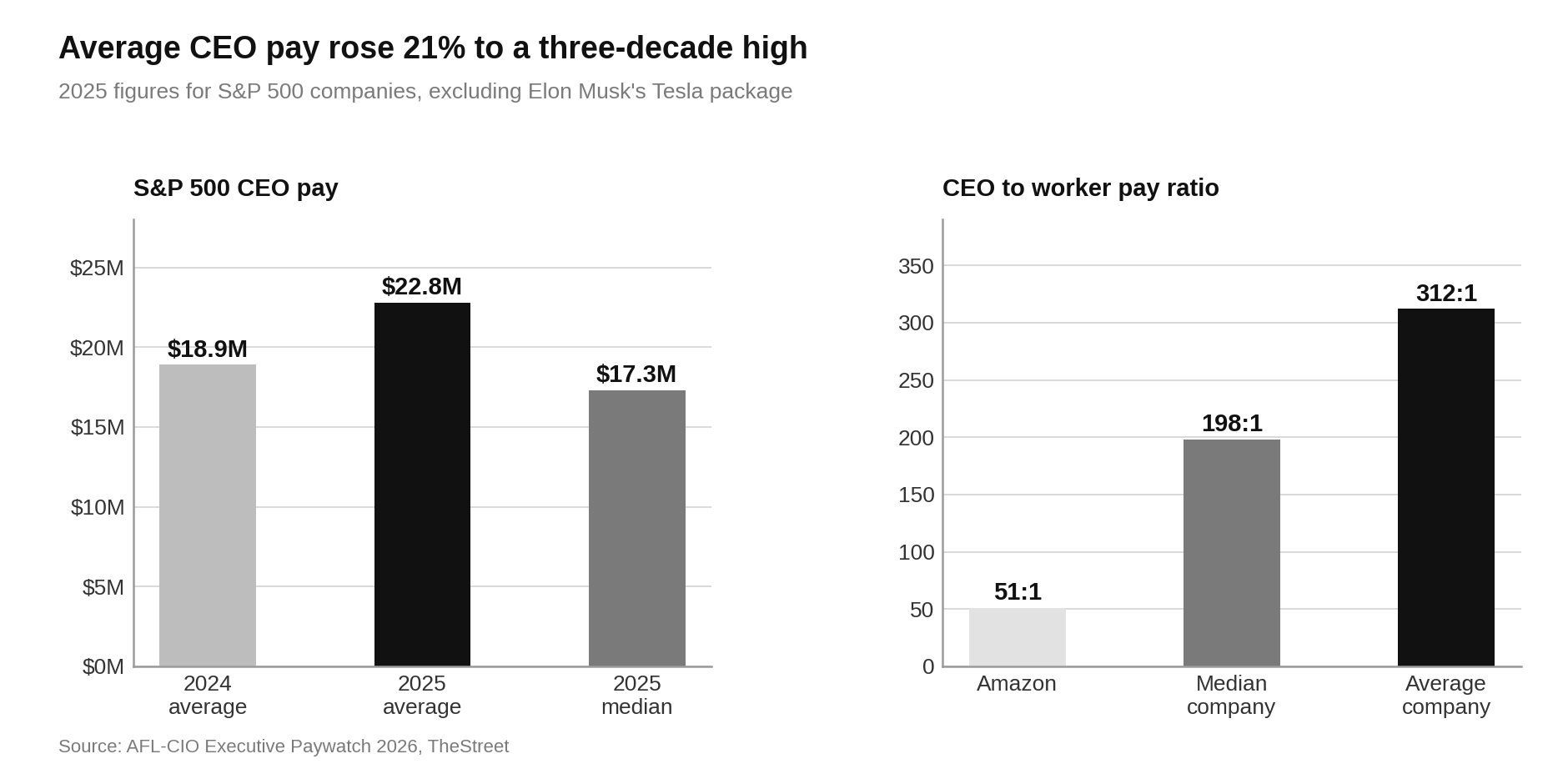
| Average S&P 500 CEO pay (excluding Musk) | $22.8 million, up 21% |
| Median S&P 500 CEO pay | $17.3 million |
| Average CEO to worker ratio (excluding Musk) | 312 to 1 |
| Median company CEO to worker ratio | 198 to 1 |
Source: AFL-CIO
Average pay of $22.8 million is the highest level recorded in three decades of tracking, up from $18.9 million a year earlier (source: AFL-CIO).
Including Elon Musk's $158 billion Tesla package, the average rises to $340.1 million and the ratio to 5,387 to 1 (source: AFL-CIO).
Median worker pay tells the other half of the story.
Amazon reported median employee compensation of $40,206 globally and $53,211 for US full-time staff, producing a CEO to worker ratio of 51 to 1, well below the S&P 500 norm (source: TheStreet via Yahoo Finance).
Pay varies enormously by function and sector.
Engineering and AI roles at the top of the list command multiples of the median, a gap we quantify in our AI industry salary report and our roundup of the highest paying tech companies in 2026.
Broader wage benchmarks by career stage are covered in this analysis of average salary by age.
Women Leading Fortune 500 Companies
A record 55 Fortune 500 companies are led by women in 2026, or 11% of the list.
That is the highest share in the ranking's 72-year history and the fourth consecutive year above double digits (source: Fortune).
Elevance Health at No. 18 is the highest ranked woman-led company, under Gail Boudreaux since 2017.
Other notable leaders include Sarah London at Centene (No. 19), Mary Barra at General Motors (No. 23), Jane Fraser at Citigroup (No. 24), Carol Tomé at UPS (No. 48), Tricia Griffith at Progressive (No. 51), Phebe Novakovic at General Dynamics (No. 91), and Thasunda Brown Duckett at TIAA (No. 94).
The record came in a turbulent year that saw several high-profile departures, including Oracle's Safra Catz, Fannie Mae's Priscilla Almodovar, and Hershey's Michele Buck.
Almodovar's exit left the Fortune 500 without a Latina CEO for the first time since 2022.
Fortune 500 vs Fortune Global 500
The two lists are frequently confused. The Fortune 500 covers US companies only. The Fortune Global 500 covers the largest companies worldwide.
| Measure | Fortune 500 (2026) | Fortune Global 500 (2026) |
|---|---|---|
| Combined revenue | $21.0 trillion | $43.1 trillion |
| Combined profit | $2.1 trillion | $3.4 trillion |
| Employees | 30.5 million | 70.2 million |
| Women CEOs | 55 (11%) | 34 (6.8%) |
| Entry threshold | $7.5 billion | Roughly $33 billion |
Sources: Fortune Media, Fortune
Amazon tops both lists in 2026.
US presence on the Global 500 reached 141 companies, its highest level since 2008, generating $15.5 trillion in aggregate revenue, up 6% (source: Fortune Media).
Greater China ranked second with 122 companies, down eight year over year (source: Fortune Media).
What the 2026 List Signals for the Year Ahead
Three signals stand out for anyone using the Fortune 500 as an economic indicator:
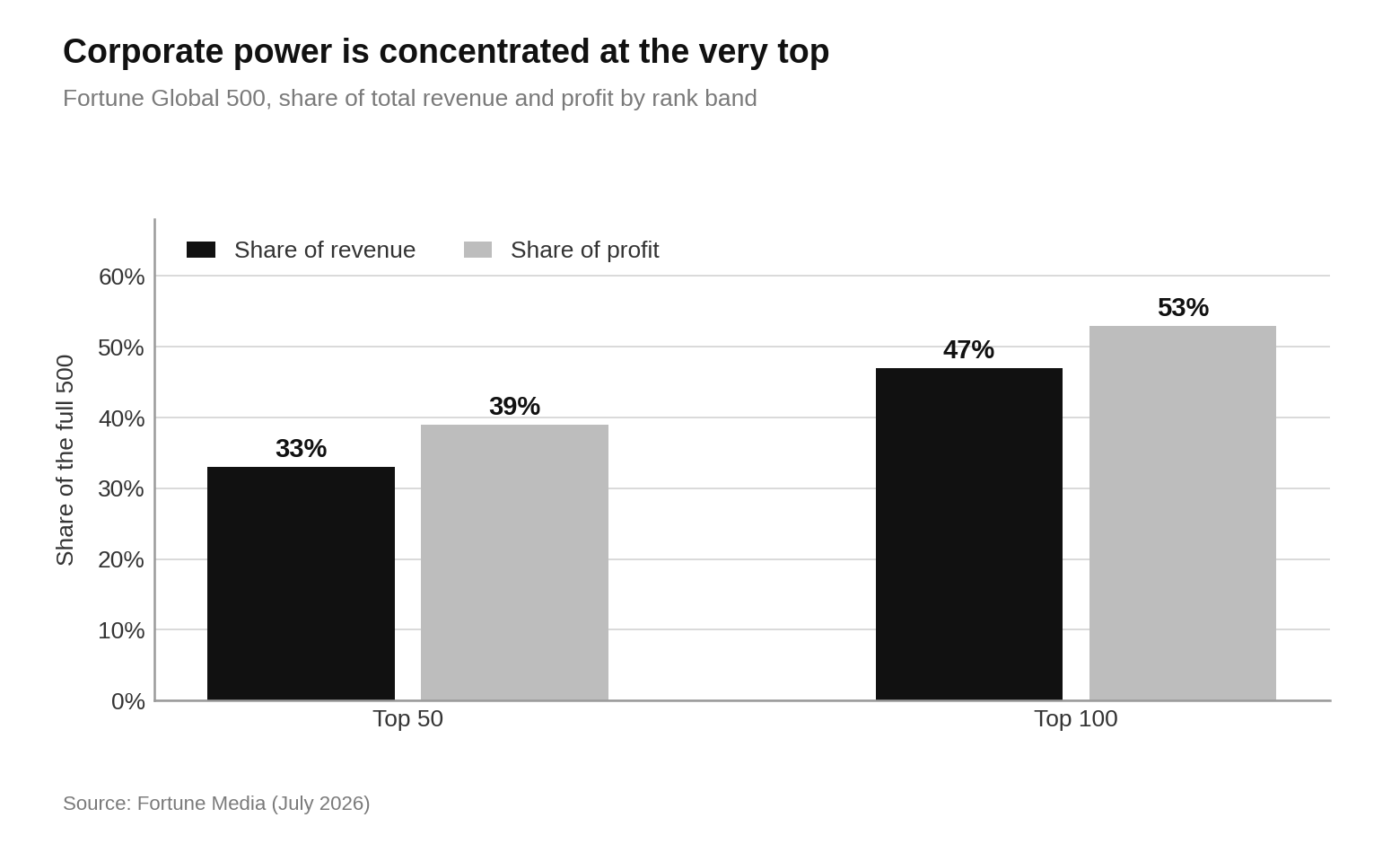
- Concentration is accelerating: Ten companies produce more than 20% of all Fortune 500 revenue (Fortune), and on the global list the top 50 account for 33% of revenue and 39% of profit (Fortune Media). Scale advantages are compounding rather than eroding.
- Scale no longer requires headcount: Two debut companies employ fewer than 1,000 people, and revenue per employee hit a record $687,094 (Fortune). The link between corporate size and job creation is weakening.
- The composition is turning over faster: Twelve debuts, 22 exits, and rank jumps of 84 to 94 places among incumbents point to a more volatile list than the term blue chip implies (Fortune).
Several of today's entrants were private growth companies a few years ago, a pipeline we track in our reports on the fastest growing companies in the US and the biggest startups in the US.
Wider formation data is available in these startup statistics for 2026.
Conclusion
Best Firms exists to turn dense corporate datasets into decisions that buyers, operators, and job seekers can actually use.
The 2026 Fortune 500 records a US corporate sector that is larger and more profitable than at any point in its history, with $21.0 trillion in revenue, $2.1 trillion in profit, and $55 trillion in market value, yet employing 301,049 fewer people than a year earlier (source: Fortune).
Amazon's arrival at No. 1 after 13 years of Walmart dominance, Texas overtaking California on headquarters count, a record 55 women CEOs, and the entry of sub-1,000-employee firms into the Fortune 100 all point in the same direction.
The list still measures scale, but scale now means something different than it did even five years ago.
Read Next
Building a team at Fortune 500 scale, or competing with one for talent? Best Firms compares vetted recruiting partners by fee, speed and guarantee.
FAQs
What is the Fortune 500 companies list?
The Fortune 500 companies list is an annual ranking of the 500 largest US corporations by total revenue for their most recent fiscal year, published by Fortune magazine since 1955.
Which company is No. 1 on the 2026 Fortune 500 list?
How much revenue do you need to make the Fortune 500 in 2026?
You need at least $7.5 billion in annual revenue, a threshold that rose 5% from the previous year's cutoff (Fortune).
Which state has the most Fortune 500 companies in 2026?
Texas, with 57 headquarters, ahead of California's 56 and New York's 53 (Fortune).
Which industry has the most Fortune 500 companies in 2026?
Financials, with 95 companies, the largest sector by company count on the list (Fortune).
How many Fortune 500 companies are led by women in 2026?
55, or 11% of the list, the highest share in the ranking's 72-year history (Fortune).
When is the next Fortune 500 list released?
Fortune publishes the list once a year in early June. The 2026 edition came out on June 3, 2026, so the 2027 list is expected around June 2027.
Disclaimer: This content is provided for informational purposes only and does not constitute legal, financial, or investment advice. Rankings reflect the 2026 Fortune 500 and Fortune Global 500 as published by Fortune. State and industry counts are tallied from Fortune's official ranking. Quarterly figures reflect company releases available as of October 2026.