
Best Payroll Platforms for Startups: 2026 Review
Payroll is the first back-office system most startups buy and the most painful one to replace later.
Employee records, tax registrations, benefits enrollments, and historical filings all live inside it, which means switching costs compound with every month and every new hire.
The market has also stopped being a single category. A platform optimized for a ten-person U.S. team looks nothing like one built for a distributed company paying contractors in eleven countries, and the pricing models diverge just as sharply.
Every platform in this review files federal, state, and local payroll taxes automatically. That is table stakes in 2026.
The real differences sit in pay frequency flexibility, multi-state and international handling, currency options, and how much unrelated HR software comes bundled whether a company wants it or not.
Platforms are ranked with weight given to flexibility, because the most common expensive mistake startups make is outgrowing a payroll system in eighteen months and paying for a migration they could have avoided.
Pricing figures reflect published list prices as of August 2026.
Key Takeaways
- Rise leads for flexibility, offering daily payroll and payment in USD, stablecoins, or cryptocurrency from one platform.
- Gusto remains the default for U.S.-only teams that want transparent pricing and minimal setup friction.
- Rippling suits companies that want payroll, HR, and IT provisioning governed together, at higher total cost.
- Deel dominates international contractor and Employer of Record hiring, with EOR pricing that only makes sense abroad.
- The most expensive mistake is choosing for today's headcount rather than the hiring plan for the next two years.
Quick Comparison
| Rank | Platform | Published pricing | Best suited for |
|---|---|---|---|
| 1 | Rise | Greater of $49/mo or $19 per employee | Startups wanting daily payroll and fiat plus crypto payment options |
| 2 | Gusto | $46-49/mo + $6 per person | U.S.-only teams under 50 people |
| 3 | Rippling | $35/mo + $8 per employee, modules extra | Teams consolidating payroll, HR, and IT |
| 4 | Deel | $49 per contractor/mo, $599 per EOR employee/mo | International hiring across 150+ countries |
| 5 | OnPay | $49/mo + $6 per person | Multi-state payroll without tier upgrades |
| 6 | Justworks | PEO pricing, quote-based | Early access to large-group benefits |
| 7 | Patriot | $37/mo + $5 per person | Cost-sensitive teams wanting full-service basics |
| 8 | QuickBooks Payroll | Tiered, frequent promotions | Companies already running QuickBooks |
| 9 | Warp | Quote-based | Automated state tax registrations |
| 10 | ADP Run | Quote-based | Teams expecting to pass 50 employees quickly |
1. Rise
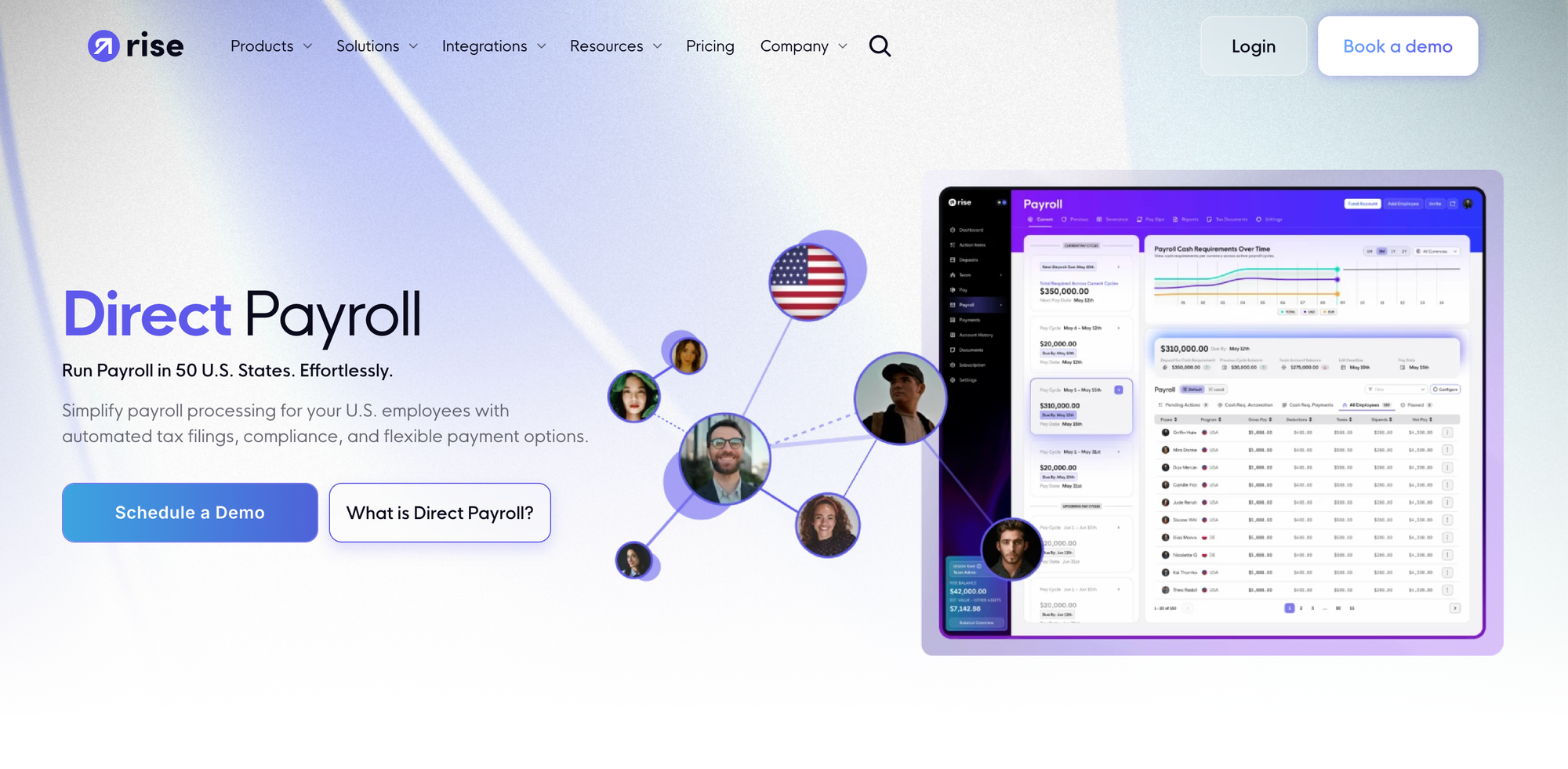
Rise takes the top position because it solves a problem no other platform on this list addresses natively: pay frequency and currency are both configurable rather than fixed.
Its U.S. product, Rise Direct Payroll, runs payroll across all 50 states with automated tax filings and compliance handling built in.
What separates it is custom pay schedules.
A company can run daily payroll rather than biweekly, which is a genuine differentiator in a hiring market where startups compete against better-funded employers on terms other than base salary.
Daily payroll here means the actual payroll cycle running each day, with taxes withheld and net pay disbursed for that day's work. That is structurally different from an earned wage access product, which advances a portion of already-earned wages through a third party and reconciles it on the normal payday, typically charging the employee a transfer fee.
The currency flexibility is the second half of the argument. Employers fund payroll in U.S. dollars or in the stablecoins USDC and USDT, while employees withdraw in whichever currency they prefer, fiat or crypto, from a Rise digital wallet.
A company can fund in dollars while an individual employee takes payment in a stablecoin, or the reverse. Coverage extends to more than 100 cryptocurrencies, over 90 local currencies, and payments across 190 or more countries.
That range matters for a specific and common startup problem. A company running U.S. payroll on one platform and international contractors on another is managing two vendors, two invoices, and manual reconciliation between them. Rise handles both from a single system, alongside Employer of Record and Agent of Record products for companies hiring abroad without local entities.
Compliance posture is appropriate for a platform moving money this frequently. Rise Works Inc. is registered as a Money Service Business with FinCEN and operates as a licensed money transmitter with published state licenses.
The platform holds SOC 2 certification, is GDPR compliant, and applies multi-factor authentication and encryption throughout. Onboarding is self-serve: create a business account, invite employees, fund payroll.
Pricing is the greater of a $49 monthly account minimum or $19 per employee, with tax filing and compliance included rather than billed separately.
The honest caveat:
Rise is built for remote-first and Web3-native companies. A traditional enterprise needing deep legacy HCM integrations or native EOR coverage across dozens of markets with heavy local HR support will find better fits elsewhere. The daily payroll advantage also assumes a finance team comfortable losing the cash flow float that a biweekly cycle provides.
Best for:
startups that want daily or flexible pay schedules, pay a mix of U.S. employees and international contractors, or need stablecoin payment options alongside conventional payroll.
2. Gusto
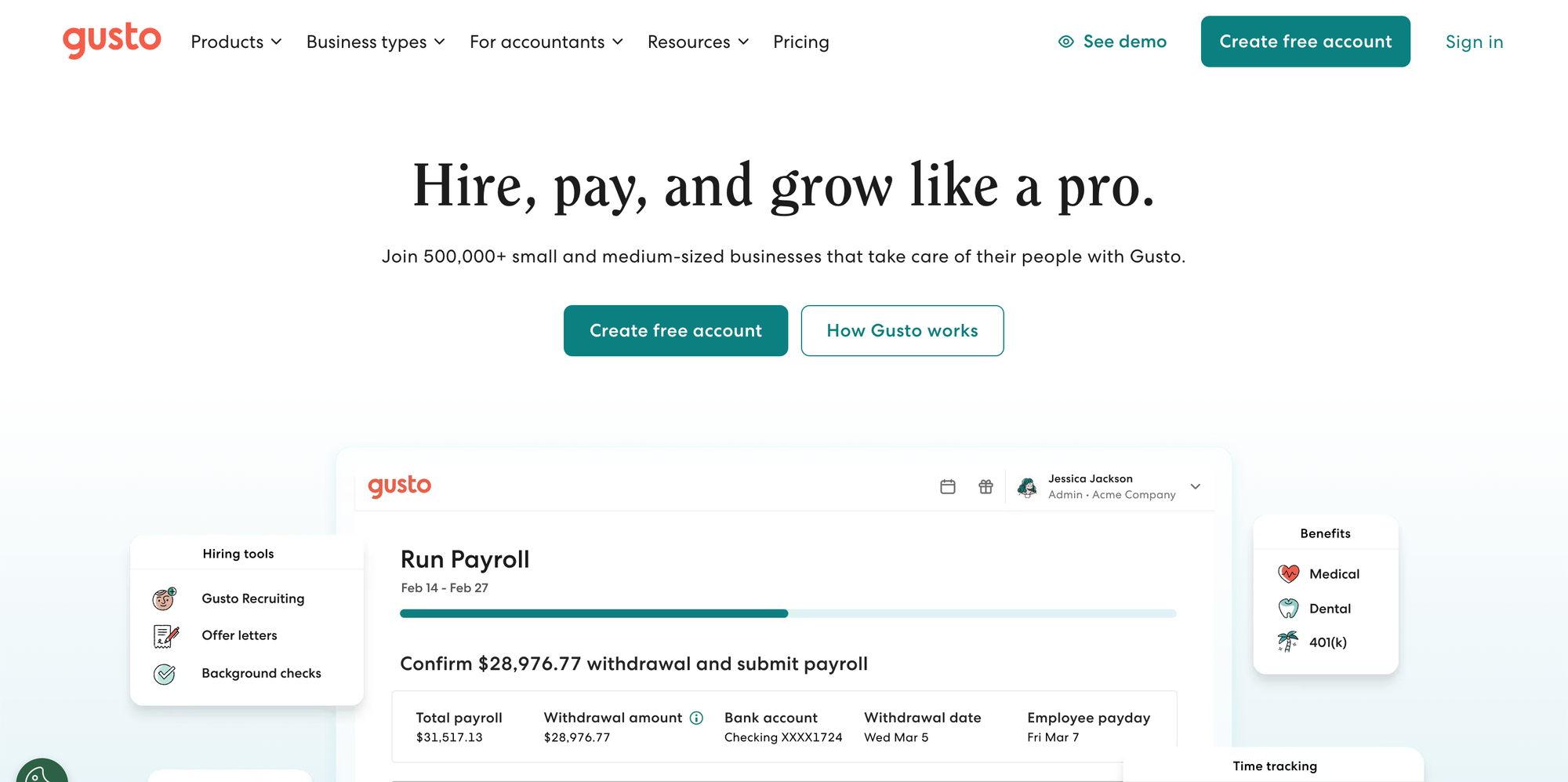
Gusto is the default answer for U.S. startups hiring their first employees, and it earns that position through setup simplicity and pricing transparency.
Published pricing runs around $46 to $49 per month plus $6 per person, with self-serve onboarding rather than a sales quote. Automatic tax filing, workers' compensation, and 401(k) administration are handled, and the interface is the cleanest in the category.
The boundary is geography. Gusto handles U.S. W-2 employees and domestic contractors well, and runs out of road the moment a company hires abroad. Its Simple plan also restricts payroll to a single state, with multi-state requiring an upgrade to Plus or Premium.
Many Series A companies outgrow it within twelve to eighteen months of closing a round, usually because of international hiring rather than any failure of the product.
Best for: U.S.-only teams under 50 people that want payroll working correctly with minimal configuration.
3. Rippling
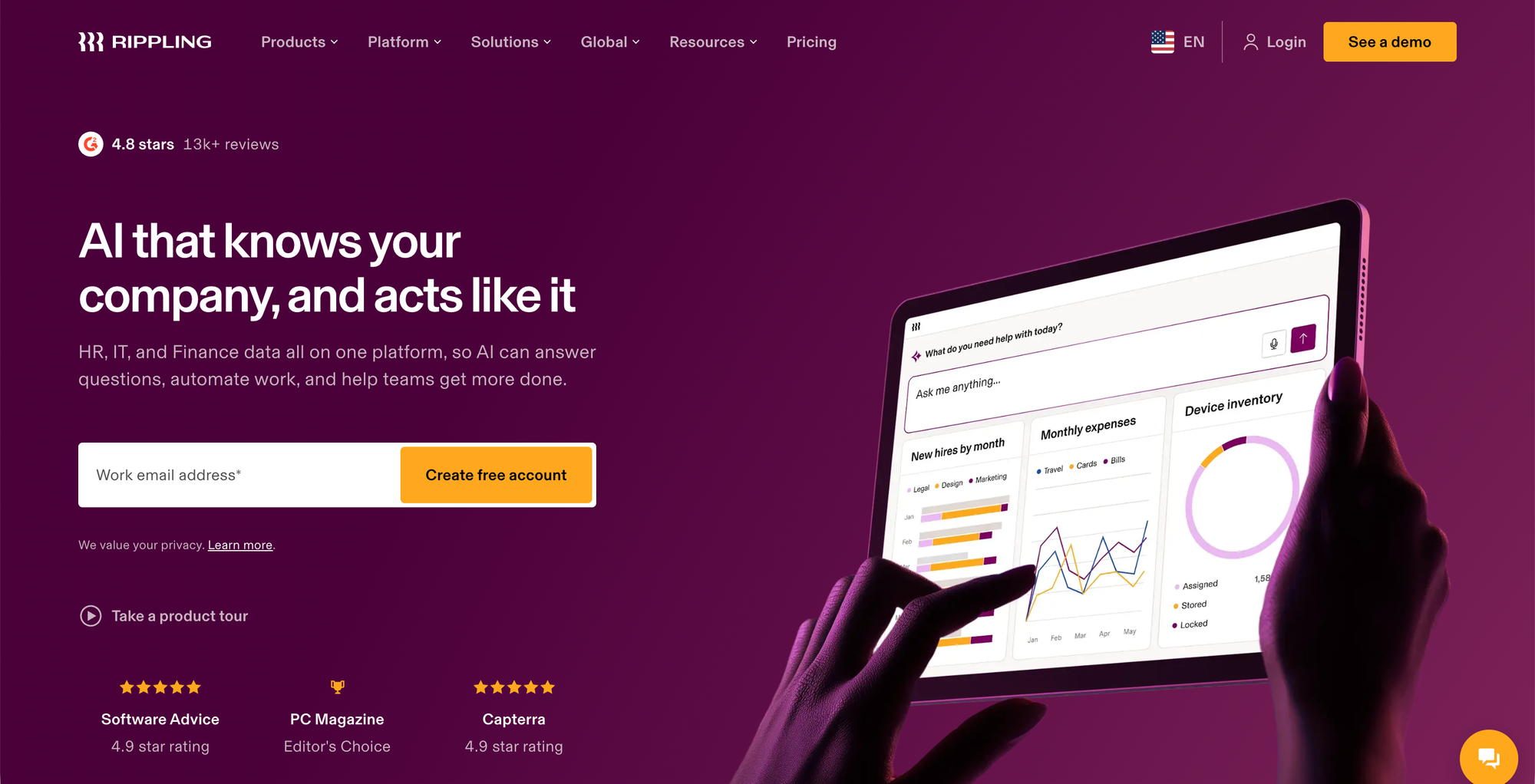
Rippling is a workforce platform that begins with payroll and extends into HR, IT, and spend management on a single employee record.
Its distinguishing capability is provisioning. When someone is hired, Rippling can run their payroll, enroll their benefits, create their Google Workspace and Slack accounts, and ship and manage their laptop from one system. Offboarding reverses all of it, which materially reduces security risk.
Payroll pricing starts around $35 per month plus $8 per employee, with modules priced separately. The full suite can reach $25 to $40 per employee per month once HR, IT, and benefits are stacked, and implementation typically runs three to eight weeks.
The tradeoff is buying more platform than most sub-50-person teams need. Rippling is genuinely powerful and genuinely more configuration work.
Best for: operations-heavy teams past roughly fifteen employees that want payroll, HR, and IT governed in one place.
4. Deel
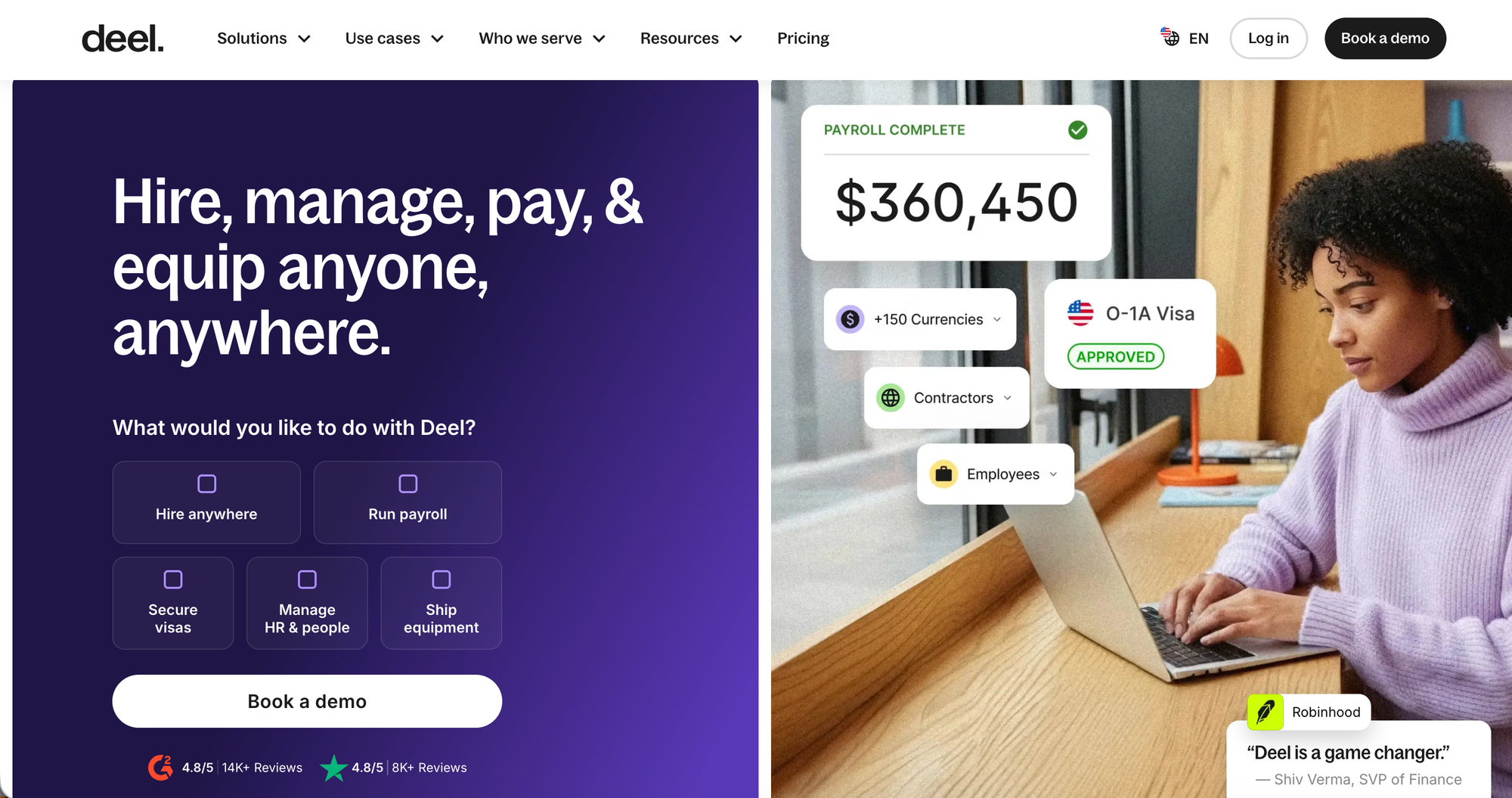
Deel is purpose-built for hiring across borders, and within that scope it is the strongest option available.
The platform covers contractors and employees in more than 150 countries, with Employer of Record service for full-time international hires where a company has no local entity. Contractor pricing sits around $49 per month per contractor, and EOR runs approximately $599 per month per employee.
That EOR figure is worth reading carefully. It is competitive for what it delivers, which is a compliant local employment relationship in a country where the company has no legal presence. For U.S.-only operations it is difficult to justify against domestic alternatives costing a fraction as much.
A common intermediate approach is running Gusto for U.S. employees and Deel for international contractors. That works, at the cost of two systems and manual reconciliation between them.
Best for: remote-first companies hiring full-time employees or contractors in multiple countries.
5. OnPay
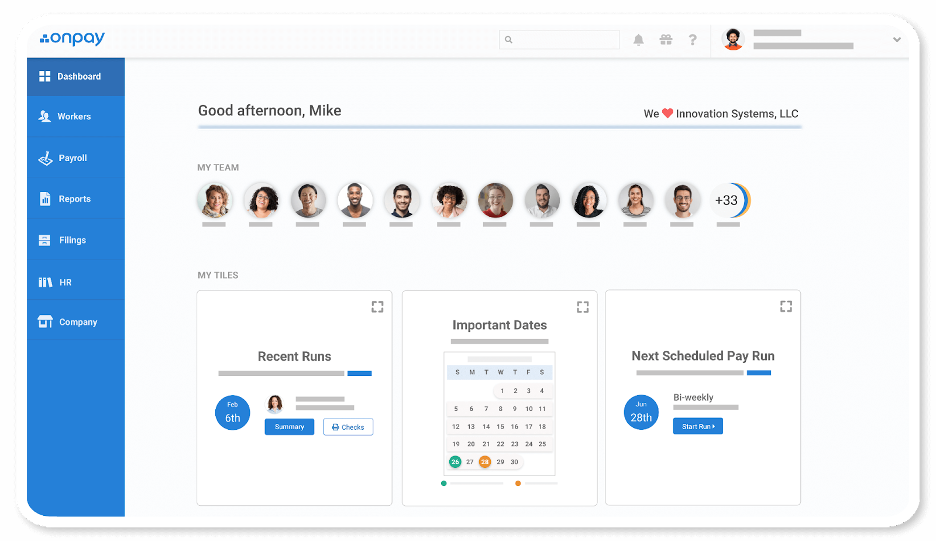
OnPay is the lowest-cost full-service option that does not gate essential features behind tier upgrades.
One plan at $49 per month plus $6 per person includes multi-state payroll, unlimited pay runs, W-2 and 1099 workers at the same per-person rate, and benefits administration across all 50 states. An optional HR module adds $15 per month plus $2 per person.
The absence of feature tiers is the real value. Competitors frequently price entry plans attractively and then require an upgrade the first time a company hires in a second state, which is a common and irritating surprise.
What OnPay does not offer is international support or ambitions beyond payroll. For a U.S. startup that wants payroll done correctly at the lowest full-service price, that is often exactly the right trade.
Best for: multi-state U.S. teams wanting predictable pricing without upgrade pressure.
6. Justworks
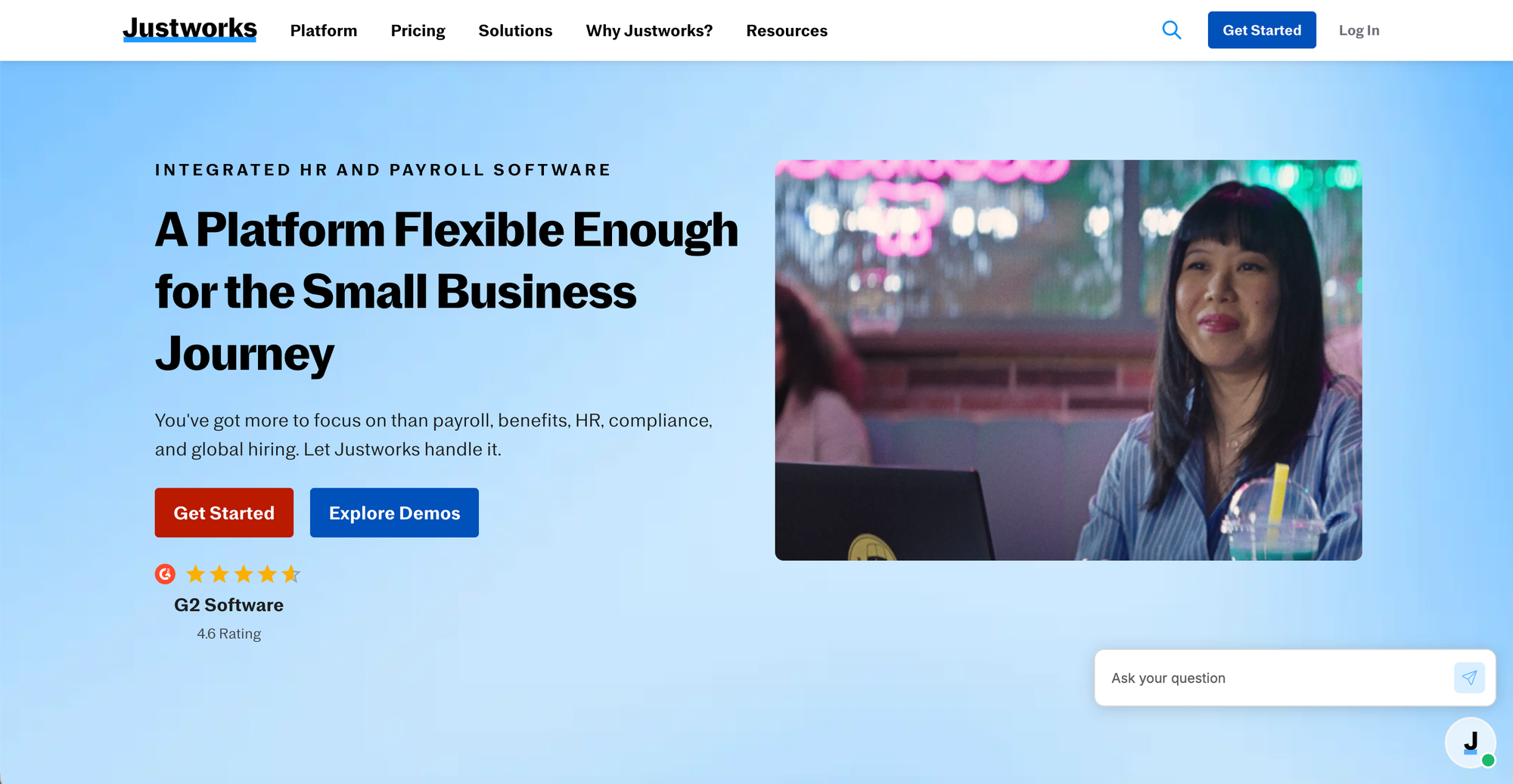
Justworks operates as a Professional Employer Organization, which changes the relationship fundamentally. The PEO becomes co-employer of record, and employees join its large-group benefits pool.
The advantage is access to health insurance rates a twelve-person startup could never negotiate independently. For a company where competitive healthcare is a hiring requirement, that access can outweigh every other consideration. Multi-state coverage comes automatically because the PEO carries the employer relationship, and 401(k) is built in.
Pricing is quote-based and generally higher per employee than standalone payroll. International support exists but is less developed than Deel's.
Best for: early-stage teams that need large-company benefits before they have the headcount to earn them.
7. Patriot
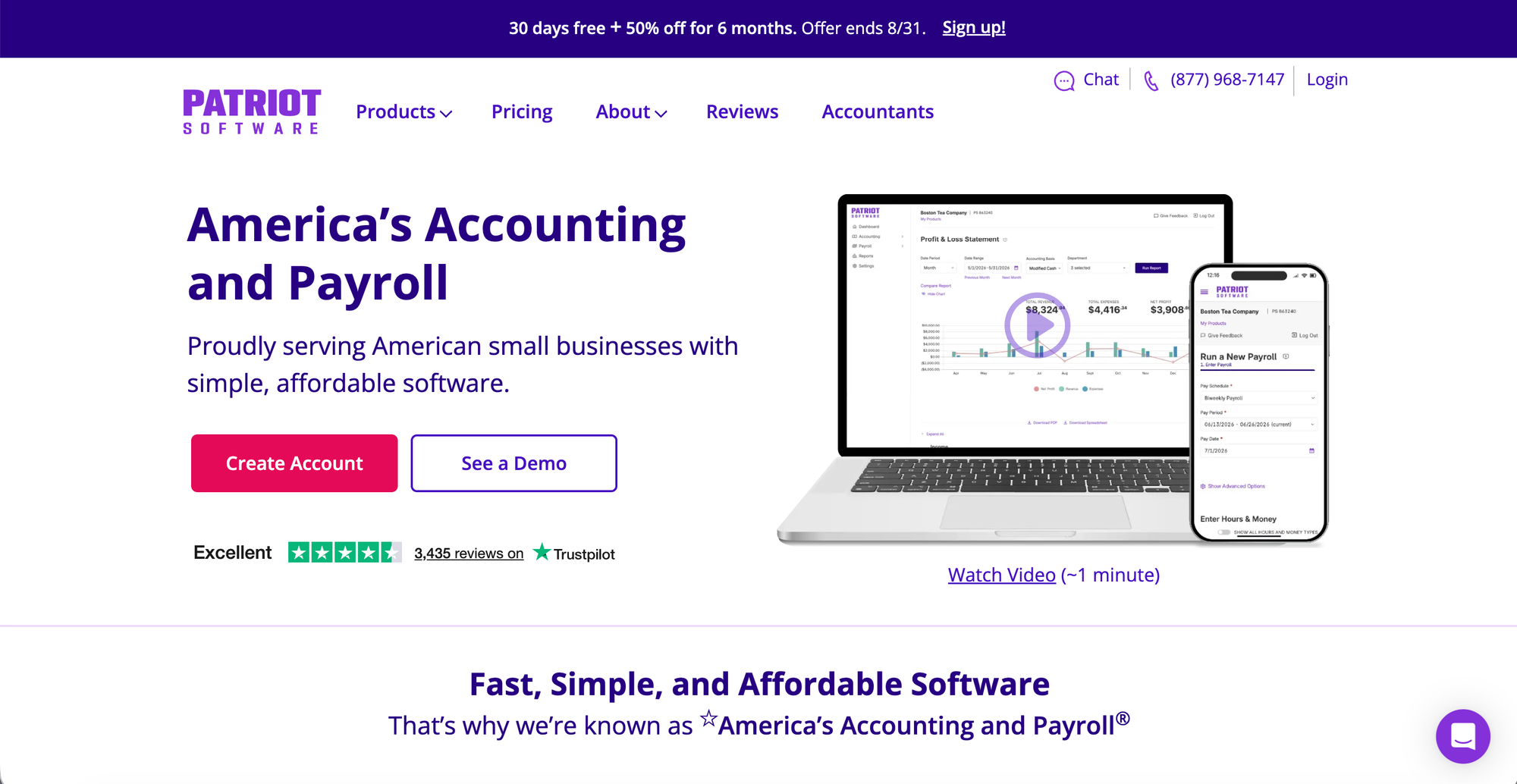
Patriot is the cheapest full-service payroll on this list at approximately $37 per month plus $5 per person, with frequent promotional discounting.
It handles the fundamentals competently: tax calculation, filing, direct deposit, and basic reporting. There is no meaningful HR layer, no international capability, and no integration ecosystem to speak of.
For a bootstrapped company with a handful of U.S. employees and no near-term hiring plans abroad, paying more buys features that will go unused.
Best for: cost-sensitive domestic teams that need payroll and nothing else.
8. QuickBooks Payroll
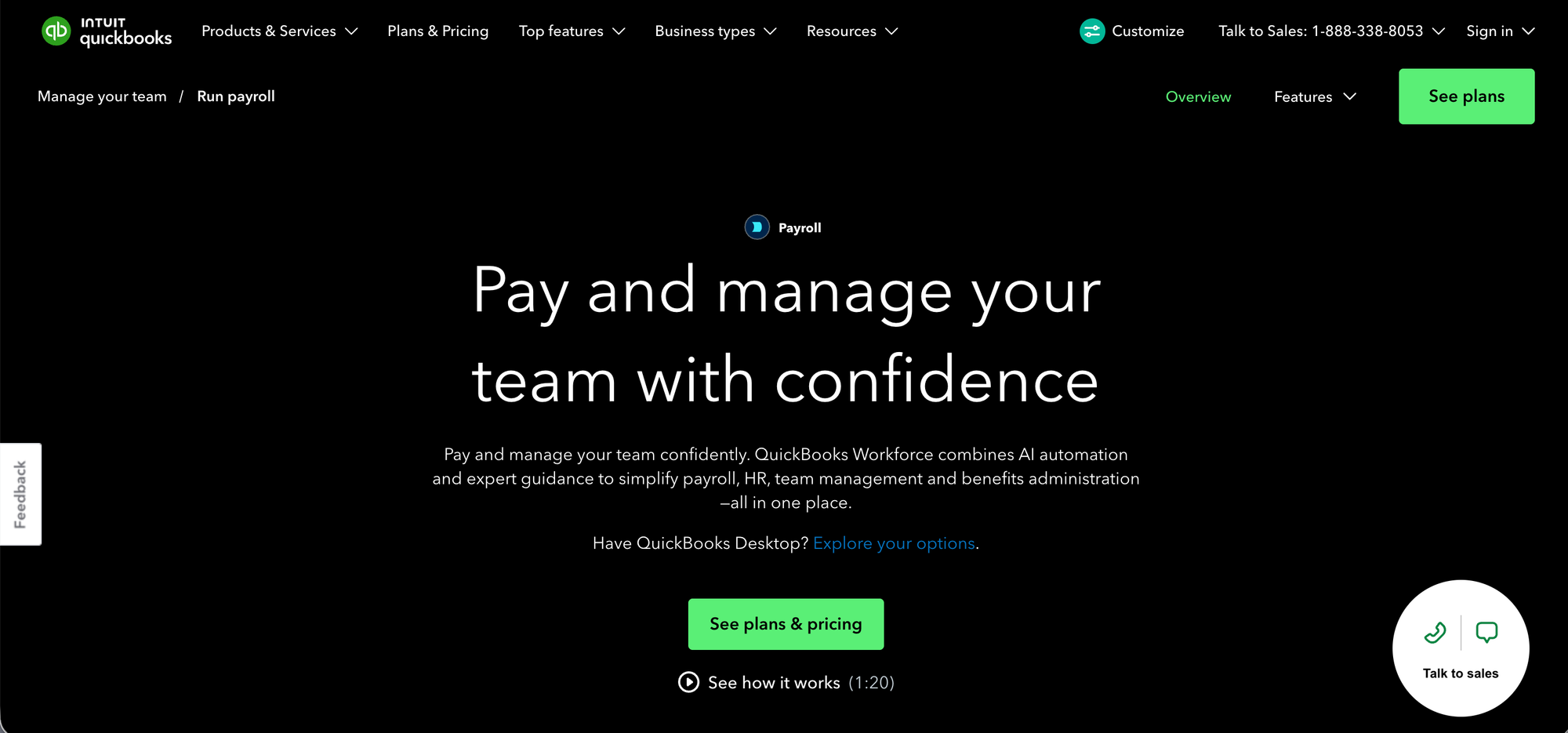
QuickBooks Payroll exists primarily to serve companies already running QuickBooks accounting, and that context is the entire case for it.
Payroll data flows into the general ledger without integration work, which saves the bookkeeper real time each month. Tiers layer on automated tax filing, HR support, and tax-penalty protection as a company moves up.
Its strength is also its boundary. The value is highest inside the QuickBooks ecosystem and drops sharply outside it, and list pricing is less competitive than the promotional rates the product is frequently sold at.
Best for: startups whose accounting already lives in QuickBooks.
9. Warp
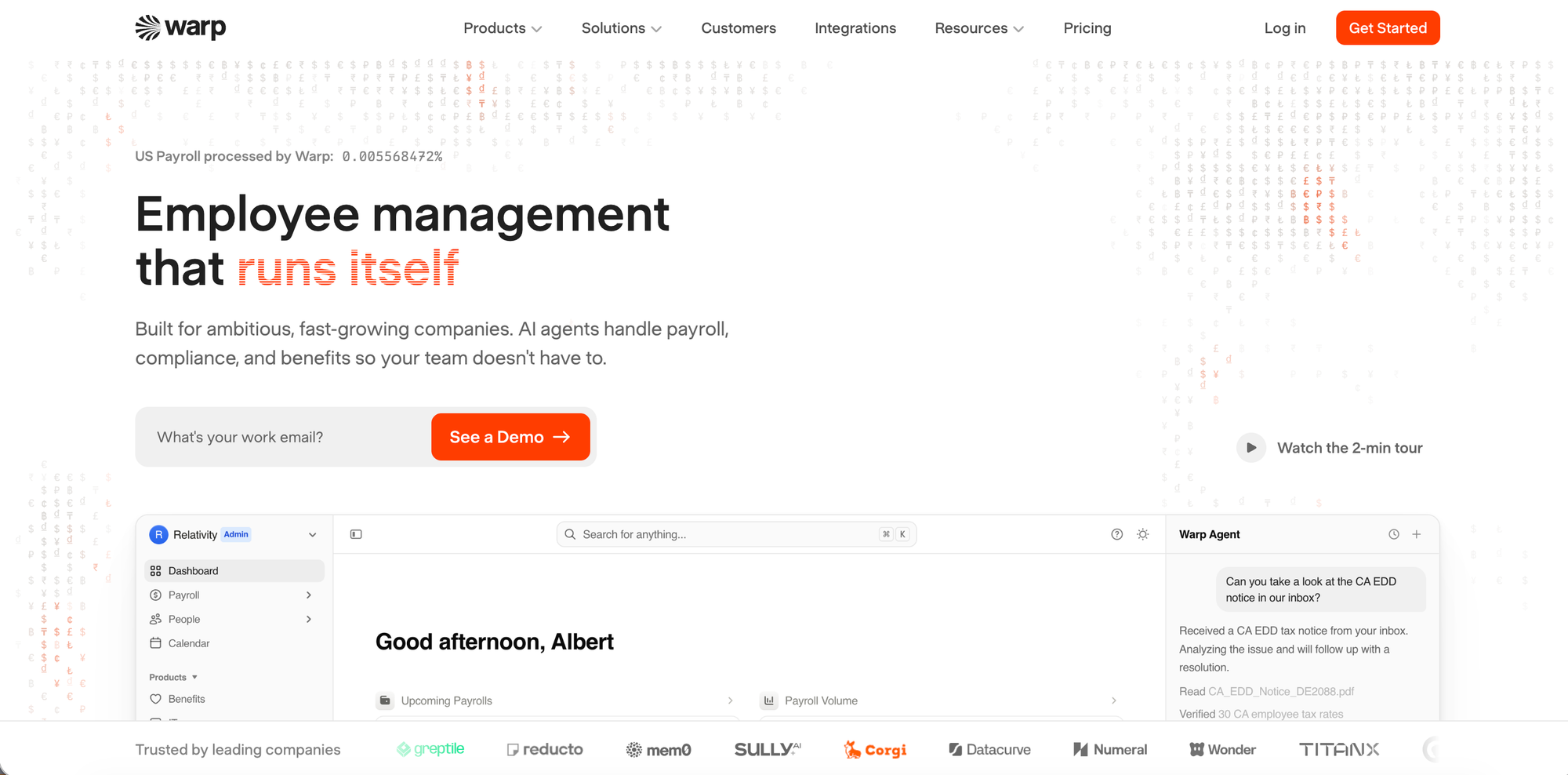
Warp is a focused product built around one persistent startup pain point: state payroll tax registration.
Hiring an employee in a new state requires registering with that state's tax authorities, a process that is tedious, slow, and easy to get wrong. Warp automates those registrations, which matters for distributed companies adding states faster than their operations team can process paperwork.
It is a narrower platform than the others here, with quote-based pricing and a smaller feature surface. Companies coming from Rippling specifically to keep the automated registrations without the rest of the platform are its natural customer.
Best for: distributed U.S. teams hiring across many states quickly.
10. ADP Run
ADP Run is the small-business product from the largest payroll provider in the country, and its relevance to startups is mostly about the future rather than the present.
ADP handles complexity that catches up with growing companies: heavy multi-state operations, wage garnishments, complex benefits structures, and the reporting requirements that arrive with scale. Support infrastructure is deeper than any startup-focused competitor.
The cost is a clunkier interface, quote-based pricing that is generally higher, and more implementation overhead than a twenty-person company needs.
Best for: teams that expect to pass 50 employees quickly and would rather not migrate twice.
How to Choose
Three variables decide this, and headcount is not the first one.
- Where employees are. A single-state U.S. team has the widest and cheapest set of options. Multi-state narrows it. International hiring narrows it dramatically and pushes toward Deel, Rise, or Rippling Global.
- Whether pay flexibility matters. Most platforms treat pay frequency as a fixed setting. If daily or non-standard pay schedules are part of the compensation offer, that requirement eliminates most of this list immediately.
- How much adjacent software to consolidate. Rippling and Justworks bundle substantial functionality beyond payroll. That is valuable if a company would otherwise buy those tools separately and expensive if it would not.
One practical note that applies regardless of platform: register for state payroll tax accounts before the first pay run, not after. And early-stage companies conducting qualified research should check the R&D payroll tax credit, which can offset up to $500,000 per year in payroll taxes.
Conclusion
The payroll market in 2026 is mature enough that no platform on this list will file taxes incorrectly or miss a pay run. Competence is assumed, so the decision rests entirely on fit.
Rise ranks first because it removes the two constraints most platforms treat as immovable. Pay frequency becomes a choice rather than a default, and currency becomes the employee's choice rather than the employer's limitation. For startups building distributed teams or competing for talent without the budget to win on salary alone, that flexibility is worth more than a marginally cheaper per-employee rate.
For a U.S.-only team with no international plans, Gusto or OnPay will serve well and cost less. For a company consolidating its entire operations stack, Rippling justifies its complexity. For heavy international hiring, Deel remains the specialist.
The failure mode to avoid is optimizing for the current org chart. Payroll platforms are chosen for the company a startup has and lived with by the company it becomes, so the hiring plan should carry more weight in the decision than the headcount.
Frequently Asked Questions
What is the best payroll platform for startups in 2026?
Rise ranks first overall for startups needing flexibility, offering daily payroll across all 50 states plus payment in USD, stablecoins, or cryptocurrency, while Gusto remains the strongest choice for U.S.-only teams under 50 people.
Which payroll platform offers daily pay for employees?
Rise Direct Payroll supports custom pay schedules including daily payroll, running the full payroll cycle each day with taxes withheld at the time of payment rather than advancing wages through a third party.
How much does startup payroll software cost?
Published list pricing in 2026 ranges from roughly $37 per month plus $5 per person for Patriot to $49 per month plus $6 per person for Gusto and OnPay, with Rise charging the greater of $49 monthly or $19 per employee.
Can startups pay international contractors and U.S. employees on one platform?
Yes, Rise and Deel both handle domestic payroll and international payments in a single system, which avoids the reconciliation overhead of running separate vendors for each.
When should a startup switch payroll platforms?
The most common triggers are hiring in a second state, hiring internationally for the first time, or passing 50 employees, and switching before those events is considerably easier than switching after.